

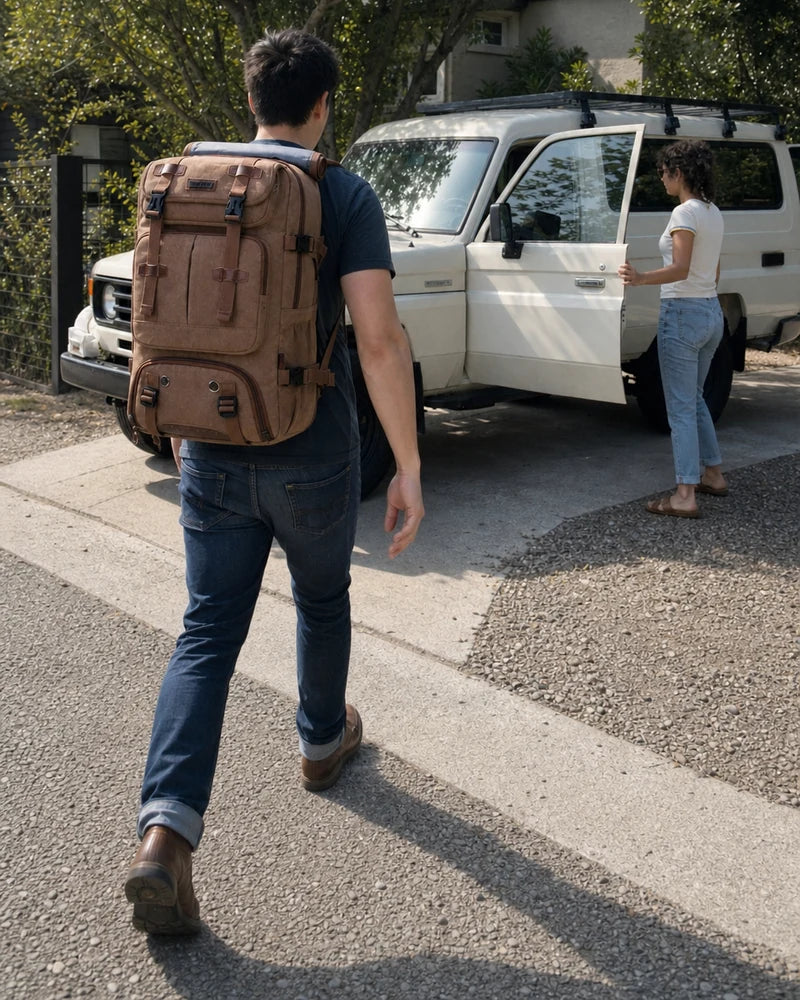
Quick Answer: The best 40L travel backpack is the better choice for five to seven days when you want room for shoes, a light layer, and a no-stress packing margin. A 30L backpack is usually the sharper choice for three days and can cover five days with repeat outfits or laundry. For seven days, 30L becomes a minimalist system; 40L is more forgiving, but neither size replaces checking the bag's packed dimensions and weight.
This is a controlled packing model for modern carry-on travel, not a claim that every 30L or 40L bag behaves identically. We put the same category of items into both size scenarios, hold footwear and toiletries constant, and change only the clothing count for a three-, five-, or seven-day trip. Pocket design, padding, fabric, and the way a manufacturer measures liters can change the result.

The Controlled Test: One Packing System, Three Trip Lengths
We built the model around ordinary warm-to-mild-weather travel rather than ultralight hiking gear. Clothing is folded or rolled without vacuum compression. The traveler wears one outfit in transit; the lists below describe what goes inside the bag.
| Packed category | 3-day kit | 5-day kit | 7-day kit |
|---|---|---|---|
| Tops | 3 T-shirts | 4 T-shirts + 1 travel shirt | 5 T-shirts + 1 travel shirt |
| Bottoms | 1 trousers + 1 shorts | 2 trousers + 1 shorts | 2 trousers + 1 shorts |
| Underwear and socks | 3 + 3 pairs | 5 + 5 pairs | 7 + 7 pairs |
| Constant in every test | Sleepwear, thin overshirt, compact rain shell, compact toiletry pouch, small cable pouch, and one packed pair of low-profile shoes | ||
Important: A sweatshirt, boots, camera cube, large hair-care kit, or 17-inch laptop can move the result up by one size category. For a warmer-weather capsule that stretches farther, use the repeat-and-laundry method in our seven-day one-backpack guide.
30L vs 40L Backpack: The Fit Matrix
The labels below describe usable margin, not laboratory-measured free liters. "Easy" means the main compartment closes without forcing the zipper and leaves access room. "Tight" means careful folding and pocket discipline are required. "Conditional" means the bag works only after removing or wearing a bulky item, planning laundry, or dropping the spare shoes.
| Trip length | 30L result | 40L result | What decides it |
|---|---|---|---|
| 3 days |
Easy Compact and stable with room for a snack or book. |
Very easy Useful extra margin, but easier to fill with "just in case" items. |
Whether you value a smaller carry profile or want space for a jacket and souvenirs. |
| 5 days |
Tight but realistic Best with one shoe pair packed and a controlled toiletry kit. |
Easy Closes without aggressive compression and keeps quick-access space. |
Shoes, laptop thickness, and whether trousers can be reworn. |
| 7 days |
Conditional Plan laundry, wear the bulkiest layer, and skip extra footwear. |
Workable The listed kit fits more naturally, though bulky cold-weather pieces can still overwhelm it. |
Laundry access and clothing bulk matter more than the day count. |
Three Days: Why 30L Usually Feels Better
For a short break, 40L capacity is not automatically an advantage. The three-day kit leaves enough slack in a 30L bag to retrieve toiletries or a cable pouch without unpacking everything. The smaller profile is also easier on trains, stairs, and crowded hotel lobbies.
A 40L bag makes sense at three days when the trip mixes work and leisure, the laptop and charger are substantial, or the destination needs a rain shell and warmer layer. It also gives you a cleaner separation between clothing and shoes. But unused space invites extra weight, so use compression straps and keep the packing list fixed.
Five Days: The Point Where 40L Starts Earning Its Space
Five days is the real dividing line in this comparison. The 30L kit still works, but the organization method becomes part of the answer: socks fill shoe interiors, toiletries stay travel-size, trousers are reworn, and exterior pockets are reserved for flat essentials rather than bulky items.
At 40L, the same kit gains a practical access margin. That does not mean ten liters of empty air; it means the rain shell can stay near the opening, the shoe area does not push into folded shirts, and the zipper does not carry the job of compressing the load. This is where many shoppers looking for the best 30L backpack for travel discover that their real question is not "Will it close?" but "Can I live out of it for five days?"
Seven Days: Laundry Is More Powerful Than Another 10 Liters
A 30L bag can serve a seven-day trip when the wardrobe is built around rewearing and one mid-trip wash. Without laundry, seven underwear sets and sock pairs consume little space individually but force the rest of the bag into rigid zones. A second pair of shoes is usually the first item to cut.
A 40L backpack handles the listed seven-day kit with less compromise, yet it is not a license to add seven completely separate outfits. Thick denim, sweaters, boots, and full-size liquids can fill 40L quickly. For family travel, shared snacks and children's items also change the calculation; our family trip bag comparison covers those quick-access demands separately.
How Big Is a 30L Backpack in Real Dimensions?
There is no universal 30L shape. A tall, shallow 30L backpack may carry differently from a short, deep one, and padded laptop walls can reduce the flexible clothing space. As a real example, the WITZMAN B716 is listed at 12.6 x 6.7 x 18.5 inches (32 x 17 x 47 cm). Its 30L rating describes capacity; those external measurements are what matter for body fit and airline checks.
The same distinction applies to 40L. The WITZMAN A8013 is listed at 13 x 20 x 9 inches (33 x 50.8 x 22.86 cm). It is only modestly taller than the B716 but is deeper, which is where much of the extra packing flexibility appears. Compare actual packed dimensions with the operating airline rather than assuming a liter rating is a carry-on approval. If under-seat space is the priority, start with our practical personal-item fit guide.
Two WITZMAN Size References
These are not interchangeable bags with only a ten-liter label change. Use them as real examples of how dimensions, material, laptop fit, and internal organization influence the choice.

B716 30L Nylon Travel Backpack
12.6 x 6.7 x 18.5 in | 3.31 lb
Recycled nylon, 15.6-inch laptop compartment, luggage strap, and compact 2-3 day orientation.
USD 83.76
Best fit here: disciplined three-day packing, business travel, or a five-day capsule with repeat outfits.

A8013 40L Canvas Travel Backpack
13 x 20 x 9 in | 4.44 lb
Recycled canvas, up to 17-inch laptop sleeve, separate shoe pocket, and convertible carry modes.
USD 95.78
Best fit here: five-day travel with easier access, or a controlled seven-day load with one packed shoe pair.
Carry-On Reality: Liters Do Not Board the Plane
Both 30L and 40L bags can be carry-on-oriented, but airlines judge the physical bag presented at the gate. Measure after packing, including filled exterior pockets, handles, and any lower shoe compartment. A soft bag may compress when lightly loaded; a tightly packed bag may exceed its listed depth.
- Check the operating airline's current size and weight rules before each trip.
- Measure the deepest point after the shoes and toiletries are packed.
- Keep a small margin rather than packing to the zipper line.
- Treat under-seat personal-item fit as a separate question from overhead carry-on fit.
- Use the delay-ready carry-on checklist to keep medication, water access, and chargers reachable during disruption.
Key Takeaways: Pick the Constraint, Then Pick the Liters
- Three days: 30L is normally the more efficient choice; 40L is useful for weather layers, larger tech, or souvenir room.
- Five days: 30L works with disciplined packing; 40L creates a meaningful access and organization margin.
- Seven days: 30L depends on laundry and minimal footwear; 40L is more realistic but still requires a capsule wardrobe.
- Shape matters: two bags with the same liter rating may have different usable space because of padding, pockets, and depth.
- Airline fit: always verify packed external dimensions; capacity alone does not establish carry-on or personal-item status.
Frequently Asked Questions
Is a 30L backpack enough for five days?
Yes, for warm or mild weather when you rewear trousers, keep toiletries compact, and pack no more than one spare pair of low-profile shoes. A bulky sweater, boots, or large camera setup can make 30L too tight.
How big is a 30L backpack?
There is no standard shape. One 30L example, the WITZMAN B716, measures 12.6 x 6.7 x 18.5 inches. Always compare the exact external measurements, because padding and pocket layout change usable space.
Is a 40L backpack enough for seven days?
Usually, for a capsule wardrobe in mild weather. Pack one shoe pair, wear the bulkiest layer, and avoid seven entirely separate outfits. Cold-weather clothing or specialist equipment may require more space.
What is the main difference in a 30L vs 40L backpack?
The practical difference is packing margin. Forty liters gives bulky items and quick-access zones more room, while 30L encourages a lighter, tighter system. The exact difference depends on each bag's dimensions and internal structure.
Is 40L too big for a carry-on?
Not necessarily. Some 40L backpacks fall within common overhead limits, while others are too deep or tall. Check the packed bag against the operating airline's current dimensional and weight limits.
Should I buy the best 30L travel backpack or a 40L model?
Choose 30L for frequent short trips, public transit, and minimalist packing. Choose 40L for five- to seven-day trips, extra footwear, changing weather, or less frequent laundry. Buy by your bulkiest normal load, not your longest imaginary trip.
In Summary: The Better Backpack Is the One With Usable Margin
A 30L backpack wins the three-day test and can stretch to five days. A 40L backpack becomes the more comfortable system at five days and the more realistic one at seven. The deciding question is not simply how many nights you are away; it is whether shoes, layers, toiletries, and laundry leave enough room to access the bag without repacking it.
Partager:
Duffle Bag Dimensions and Size Chart: 20L to 60L Explained