

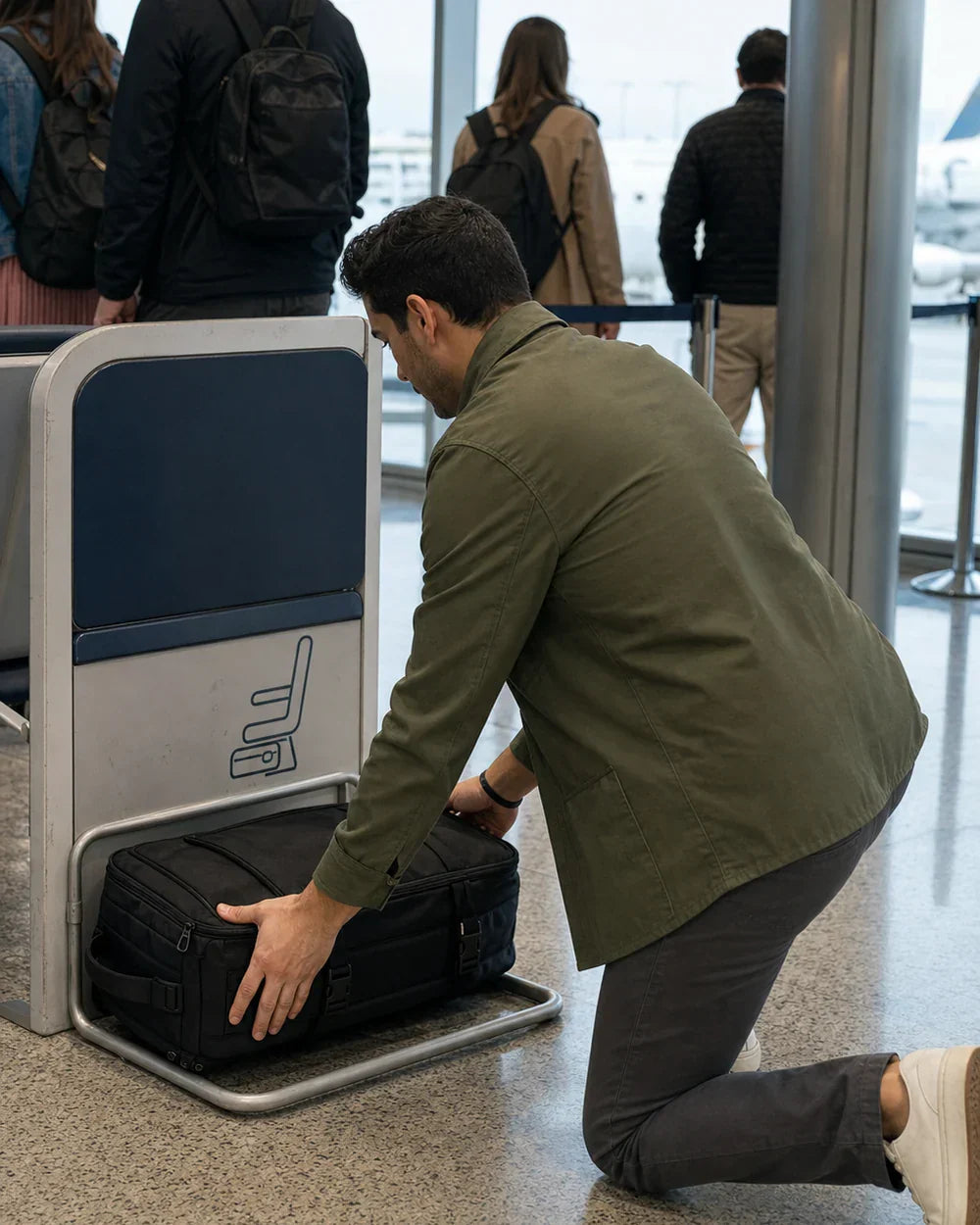
A travel backpack can count as a personal item, but only when it behaves like one. That means it fits the airline's personal-item rule, slides fully under the seat in front of you, and does not become a puffy nylon suitcase the moment you add a laptop, hoodie, chargers, snacks, and the mysterious "just in case" second pair of shoes.
This guide is for the traveler searching personal item backpack, under seat travel bag, carry on backpack size, or backpack under airplane seat because the real question is not academic. It usually sounds more like: "Will the gate agent stop me?" or "Will a flight attendant make me take my backpack out of the overhead bin after I finally found space?" Fair questions. Boarding has a way of turning calm adults into people negotiating with zippers.
Quick Answer
Yes, a backpack can count as a personal item if the packed bag fits under the seat and stays within your airline's personal-item dimensions, including handles, straps, and bulging pockets. A larger travel backpack may be a great carry-on, but that does not automatically make it a personal item. If your ticket includes only one small personal item, measure the bag after packing, not while it is sitting empty and innocent on your bed.

Key Takeaways
- A personal item is usually the bag that goes under the seat; a carry-on is usually the larger bag stored overhead.
- Backpack shape matters as much as dimensions. Soft bags can expand past the limit when every pocket is full.
- Many U.S. airlines publish personal-item limits around 18 x 14 x 8 inches, but you must check the operating airline and fare.
- If a flight is full, crew may ask backpacks and small bags to move from the overhead bin to under-seat storage.
- For strict personal-item-only fares, choose a smaller backpack or pack with compression room. For 38L-40L travel backpacks, treat them as carry-on-first unless your airline rule clearly supports under-seat use.
The Plain-English Difference: Personal Item vs Carry-On
The simplest way to separate the two categories is storage location. A personal item backpack is expected to fit under the seat in front of you. A carry-on backpack is expected to fit in the overhead bin, though it may also fit under some seats if packed lightly and shaped well.
The mistake many travelers make is assuming "backpack" equals "personal item." Airlines do not care whether the bag has shoulder straps. They care about the packed object: height, width, depth, whether it blocks foot space, and whether it can be stowed safely for takeoff and landing.
So the useful question is not "Can a backpack be a personal item?" It can. The better question is: "Can this packed backpack fit under this airline's seat on this fare without drama?" That tiny upgrade in wording saves a lot of airport nonsense.
Airline Size Rules: The Numbers Are Only Half the Story
Always check your airline close to departure, especially when flying basic economy, low-cost carriers, partner airlines, or smaller aircraft. As of this draft, American Airlines lists a personal item maximum of 18 x 14 x 8 inches, and Frontier Airlines lists the same 18 x 14 x 8 inch personal-item limit including handles, wheels, and straps. Those numbers are helpful, but they are not a universal world standard.
| Question | What to Check | Why It Matters |
|---|---|---|
| Does my fare include a carry-on? | Ticket rules, not just airline brand | Some fares include only a personal item. That changes everything. |
| What is the personal-item limit? | Length x width x depth, including straps and handles | Dangling straps and stuffed front pockets can make a bag fail a sizer. |
| What aircraft am I flying? | Mainline jet, regional jet, narrow-body layout | Under-seat space varies, especially near aisle seats and equipment boxes. |
| How full is the flight? | Boarding group, route, season | Full flights often trigger stricter overhead-bin management. |
This is where carry on backpack size becomes a separate conversation from personal-item size. A common carry-on backpack may be around 22 x 14 x 9 inches. Useful? Yes. Personal item? Often no. If your bag is closer to carry-on dimensions, treat it as a carry-on unless your airline specifically allows that size under the seat.
The Under-Seat Fit Test You Can Do at Home
You do not need a perfect airplane seat replica. You need a brutally honest packed-bag test. Load the backpack exactly as you plan to travel, including laptop, toiletries, jacket, charger pouch, snacks, and whatever you usually pretend is "small." Then measure the largest points.

- Measure the packed depth. Depth is the usual troublemaker. A bag listed at 7.5 or 8 inches deep can become much thicker when the front pocket is full.
- Check the corners. Boxy backpacks keep shape well, but square corners can be less forgiving under narrow seat frames.
- Tuck the straps. Loose shoulder straps, compression straps, and webbing can catch on seat rails or sizers.
- Keep one soft zone. Put a hoodie or soft layer near the top so the bag can settle slightly without crushing electronics.
- Do the chair test. Slide the packed bag under a dining chair or desk without forcing it. If it needs a wrestling move, it is not your calm personal-item setup.
- Leave consolidation space. You may need to tuck in a sling bag, food bag, or airport purchase before boarding.
The Overhead-Bin Problem Nobody Likes to Talk About
Here is the pain point: you board, put your backpack in the overhead bin, sit down, and breathe. Three minutes later, the bin fills up. A crew member starts rearranging bags and says smaller backpacks need to go under the seat. Suddenly your clean plan becomes aisle yoga.
This is not personal. It is physics, boarding speed, and too many roller bags. Overhead bins are usually prioritized for larger carry-ons because those bags have nowhere else to go. A backpack that can fit under the seat is the first thing likely to be moved, especially on full flights.
The fix is to pack as if the backpack may end up under your feet even if you hope it goes overhead. Keep your in-flight pouch accessible before boarding. Put your laptop, medication, passport, earbuds, and charger where you can reach them without opening the main clothing compartment. The goal is not to win an argument with the bin. The goal is to sit down without unpacking your life in row 17.

How to Pack an Under Seat Travel Bag Without Losing Your Mind
A true under seat travel bag should be packed by access timing, not by category alone. Think in zones:
| Zone | What Goes There | Rule of Thumb |
|---|---|---|
| Boarding pocket | Passport or ID, phone, wallet, boarding pass, earbuds | Reach it with one hand while standing. |
| In-flight pocket | Charger, cable, snack, glasses, medication, reading item | Reach it while seated without pulling out clothes. |
| Protected panel | Laptop, tablet, documents | Keep it flat, padded, and easy to remove if security requires it. |
| Main compartment | Clothing, toiletry pouch, soft layer | Pack flat and avoid creating a rounded front bulge. |
| Emergency gap | Empty space for a small pouch or jacket | This is your gate-agent peace offering. |
The fastest way to ruin an under-seat backpack is to use every pocket just because it exists. Pockets are organization tools, not permission slips. If each pocket becomes a hard lump, the whole bag turns into a stubborn rectangle with opinions.
When a Travel Backpack Is Better Treated as a Carry-On
If your backpack is designed for two to five days of travel, has a clamshell opening, laptop zone, shoe pocket, or 38L-40L capacity, it may be excellent for carry-on travel but too large for strict personal-item-only flying. That does not make it a bad bag. It means the job is different.
Use a larger travel backpack as a carry-on when:
- Your fare includes overhead-bin carry-on allowance.
- You are packing for several days and need clothing volume.
- You are carrying a laptop plus structured accessories.
- You want suitcase-style access, more compartments, and better load management.
- You are comfortable keeping only a small pouch or jacket under the seat.
Use a smaller personal item backpack when:
- Your ticket includes only one personal item.
- Your airline checks bag sizers aggressively.
- You need guaranteed legroom or do not want a large bag at your feet.
- You are taking a short trip with a minimalist clothing plan.
- You are connecting through smaller aircraft where storage space can be tighter.
Witzman Travel Backpack Notes for This Use Case
These Witzman backpacks are strong candidates for structured short-trip and carry-on travel. Because personal-item limits vary by airline and fare, compare the packed bag with your exact airline rule before using either as your only free personal item.

Nylon Travel Backpack for Men TSA Luggage Laptop Backpacks B737
38L, 12.5 x 20.5 x 9 in. A structured option for 2-4 day trips, business travel, and carry-on planning when your fare supports it.
From USD 158.76

Nylon Carry On Travel Backpack for Men B682
40L, 12.6 x 20.5 x 7.5 in. Useful for weekend and business travel when you want backpack, duffel, and tote carry options.
From USD 93.78
Decision Guide: Which Setup Should You Choose?
Use this quick decision ladder before buying or packing:
- If your fare includes only a personal item: choose the smaller backpack and pack around the airline's published personal-item limit.
- If your fare includes a carry-on: use the travel backpack as your main carry-on and keep a small essentials pouch inside it until boarding.
- If you hate losing legroom: do not max out the under-seat bag. Choose something that leaves space for your feet.
- If you carry a laptop: prioritize a flat protected sleeve, but make sure the tech zone does not turn the bag into a rigid block.
- If you are flying budget airlines: measure more strictly and assume the sizer may appear at the least charming moment.
Common Mistakes That Make a Backpack Fail Under the Seat
- Trusting liter capacity. A 30L bag and a 40L bag can behave very differently depending on shape. Airlines measure dimensions, not liters.
- Ignoring the front pocket. Front pockets are the usual source of surprise depth.
- Packing hard items together. Laptop, tablet, power bank, toiletry case, and shoe bag stacked in one plane can make the bag rigid.
- Leaving straps loose. A technically compliant bag can become awkward when straps snag on the seat frame.
- Assuming the overhead bin is yours. It might be, but full flights have other plans.
- Forgetting the return trip. Souvenirs, laundry, and airport purchases make bags grow. They are very talented at it.
Frequently Asked Questions
Does a backpack count as a personal item?
It can, if the packed backpack fits under the seat in front of you and meets your airline's personal-item dimensions. A larger backpack may count as a carry-on instead.
Can I bring a backpack as a personal item and a carry-on suitcase?
Often yes, if your fare includes both. Some basic or budget fares include only a personal item, so check your ticket details before packing.
What size backpack fits under an airplane seat?
There is no single global size. Many personal-item rules are around 18 x 14 x 8 inches, but airlines and aircraft vary. Measure your packed bag and check the operating carrier.
Can I put my backpack in the overhead bin?
Sometimes, but do not depend on it. On full flights, smaller backpacks are often moved under the seat to preserve bin space for larger carry-ons.
Is a 40L backpack a personal item?
Usually it is better treated as a carry-on backpack unless packed lightly and confirmed against your airline's personal-item limit. Liter capacity alone is not enough to prove compliance.
How do I avoid gate fees?
Check the airline's current personal-item rule, measure the packed bag including straps and bulging pockets, and leave space to consolidate small items before boarding.
In Summary
A travel backpack can count as a personal item when the packed bag fits the airline rule and genuinely works under the seat. For larger Witzman travel backpacks, the more realistic approach is often to use them as carry-on backpacks for short trips, then keep a small in-flight pouch accessible. The smart traveler does not ask the bag to do every job at once. That is how zippers get stressed, gate agents get involved, and boarding gets spicy.
Official References
Conclusion
The safest answer is measured, not absolute: a backpack counts as a personal item when the airline, fare, aircraft, and packed shape all support under-seat storage. For Witzman travelers comparing bags, start with the rule you must meet, then choose the packing layout and backpack size that keeps boarding calm. Browse the Witzman travel backpack collection when comparing carry-on and under-seat options for a future trip.

Partager:
Men in Business Travel: Professional Bags That Double as Weekend Gear
How to Pack for 7 Days in One Backpack Without Overpacking