

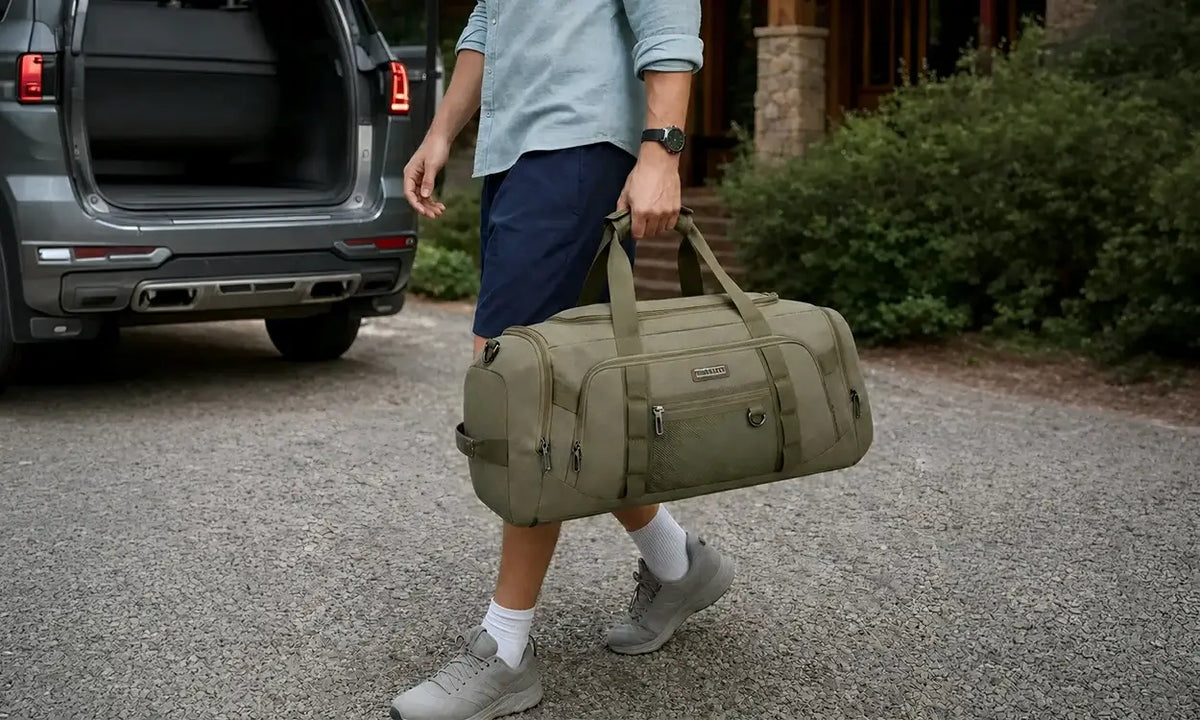
Quick answer: The most useful duffle bag dimensions depend on both capacity and the shape of the packed bag. A 20L duffle suits a day trip or light overnight stay; 30L works for one to two nights; 40-45L is a practical weekender range; and 50-60L is better for longer or gear-heavy trips. For flights, liters are not the deciding factor. Measure the bag's packed length, width, and height, then compare all three with your airline's current limit.
Duffel Bag Size Chart: What Does 20L to 60L Actually Hold?
This chart is a planning guide, not an industry standard. Brands calculate capacity differently, and rounded ends, pocket volume, lining, padding, and internal dividers can make two bags with the same liter rating feel very different. The sample external dimensions below are dimensional envelopes that produce roughly the stated volume; they are not specifications for a particular WITZMAN product.
| Capacity | Illustrative external size | Typical trip | What usually fits | Carry-on outlook |
|---|---|---|---|---|
| 20L | 17.7 x 11 x 6.3 in 45 x 28 x 16 cm |
Day trip or light overnight | One outfit, light layer, compact toiletries, small tech pouch | Often easy to place overhead; under-seat status still depends on the airline |
| 30L | 19.7 x 11.8 x 7.9 in 50 x 30 x 20 cm |
1-2 nights | Two outfits, sleepwear, toiletries, a second pair of shoes if packed tightly | Usually within common overhead dimensions if the real bag matches this envelope |
| 40L | 20.9 x 13 x 9.1 in 53 x 33 x 23 cm |
2-4 nights | Weekend wardrobe, footwear, toiletries, compact laptop or tablet setup | A common carry-on target, but depth becomes critical |
| 45L | 22.5 x 11 x 11 in 57.2 x 27.9 x 27.9 cm |
3-5 nights | Extra layers, shoes, larger toiletry kit, road-trip or gym gear | Borderline for stricter 22 x 14 x 9 in limits; underpacking may help but never guarantees acceptance |
| 50L | 22 x 12.5 x 11.3 in 56 x 32 x 28.6 cm |
4-7 nights | Bulkier clothing, two pairs of shoes, family overflow, sports equipment | Frequently too deep when full; treat as airline-specific |
| 60L | 23.6 x 13.8 x 11.4 in 60 x 35 x 29 cm |
5-7+ nights or equipment-heavy travel | Cold-weather layers, boots, shared gear, long-road-trip load | Usually a checked-bag or road-trip size when fully packed |
How the sample sizes were built: liters are approximately length x width x height in centimeters divided by 1,000. Real soft bags are not rectangular boxes, so manufacturer capacity and this geometric estimate will not always match.
What Size Duffle Bag Is Best for a Weekend Trip?
For most modern travelers taking a two- or three-night trip, the useful weekender bag size sits between 30L and 45L. Choose the lower end when you pack one pair of shoes, rewear a layer, and carry tech separately. Move toward 40-45L when the trip includes cold weather, gym clothes, a dedicated shoe section, or one-bag travel.
The decision is less about counting shirts than counting bulky zones. Shoes, a structured toiletry kit, a camera, and a thick sweatshirt can consume more space than several lightweight outfits. If footwear is the problem, use the separation method in our guide to packing shoes, clothes, and toiletries in one duffel. If your main question is whether the trip calls for a soft weekender or a cabin-focused bag, compare the tradeoffs in Weekender vs. Carry-On.
Can a 40L Duffle Bag Be a Carry-On?
It can, but 40L is not an airline rule. A 40L bag with a long, shallow profile may fit an overhead limit while another 40L bag with a deep base may fail the sizer. As of July 2026, American Airlines and Delta publish a maximum of 22 x 14 x 9 inches for standard carry-on bags, including handles and attachments. Southwest publishes a larger 24 x 16 x 10 inch limit. Policies can change, and regional aircraft may have less bin space even when the bag meets the published dimensions.
- Check the operating airline, not only the company that sold the ticket.
- Measure after packing, with every exterior pocket zipped.
- Include handles, buckles, feet, wheels, and protruding shoe compartments.
- Do not count on a soft bag compressing if it is packed tightly.
- Be ready for gate checking when overhead bins fill or a regional aircraft has smaller compartments.
For current limits, consult the airline directly: American Airlines carry-on guidance, Delta carry-on guidance, and Southwest's carry-on policy. TSA regulates what may pass through security, but tells travelers to check with their airline for size and weight restrictions; its What Can I Bring? database is the better source for item restrictions.
How Do You Measure Carry-On Duffle Bag Dimensions?
Measure the packed bag on a flat floor. A soft duffle measured empty can appear several inches smaller than the same bag filled with shoes and rolled clothing.
- Pack it as you intend to travel. Fill the shoe compartment and exterior pockets, then close all compression straps.
- Find the longest points. Length runs from the farthest end panel to the opposite end, including any rigid handle or protruding pocket.
- Measure width at the widest bulge. Do not press the tape into the fabric.
- Measure height from the floor. Include fixed feet and handles that cannot fold flat.
- Compare each number separately. Passing a total linear-inch calculation does not help when one side exceeds the airline's individual limit.
- Weigh it too. Many international airlines impose a cabin-bag weight limit even when U.S. domestic carriers do not publish one.

Why Two Duffels With the Same Capacity Can Have Different Dimensions
Liter ratings are useful for comparing broad packing volume, but they hide structure. A simple barrel-shaped bag may devote most of its stated capacity to one open chamber. A travel duffel with padded walls, an independent shoe compartment, wet/dry storage, and exterior organizers gives up some flexible interior volume in exchange for separation and access.
Materials also change the fit. Canvas has body and may hold its shape, while a lighter nylon shell may conform more readily to a partly filled load. Neither behavior creates automatic airline compliance. The safest approach is to choose the organization you need, then check the actual external measurements. Our guide to large duffel features for extended trips explains when the extra organization is worth the added size.
Two Real WITZMAN Size Examples
These two models sit in the upper half of the chart. They are useful examples of why a capacity label should always be read beside the actual measurements. Both are active and available at the time of writing, but airline allowances must be checked again before travel.
WITZMAN Duffels Matched to This Guide

A8006-3 45L Canvas Duffel
22.5 x 11 x 11 in | 3-5 day trips
Recycled canvas, three-way carry, independent shoe pocket, and wet/dry separation.
USD 89.68
Best fit here: a structured 45L weekender when organization and convertible carry matter. Check packed depth against your airline.

B717 54L Nylon Duffel
25 x 11 x 12 in | 3-5 day trips
Recycled nylon, wet/dry separation, and a multi-pocket exterior.
USD 95.86
Best fit here: road trips, gym-to-travel use, or trips where 54L organization matters more than strict 22-inch carry-on sizing.
Should You Choose 30L, 40L, or 50L?
| Your priority | Start here | Watch for |
|---|---|---|
| Light overnight travel and easy public transit | 20-30L | Limited room for shoes or cold-weather layers |
| A versatile two- to four-night weekender | 35-40L | Packed depth and laptop placement |
| Shoes, gym clothing, or family overflow | 40-50L | Carry-on dimensions can become borderline |
| Road trips, outdoor equipment, or bulky layers | 50-60L | Weight, shoulder comfort, and likely checked-bag use |
If you will carry the load through stations or on long walks, size is only half the decision. Read Backpack vs. Duffel before committing to one-shoulder carry. For driving itineraries, the role-based system in our road-trip outdoor packing guide can keep the duffel from becoming a catch-all.
Frequently Asked Questions About Duffle Bag Size
What are standard duffle bag dimensions?
There is no universal standard. Small duffels may be around 18-20 inches long, while high-capacity models can reach 24-26 inches or more. Use the product's three packed external dimensions rather than relying on labels such as small, medium, or large.
How big is a 40L duffel bag?
A rectangular 40L volume could be close to 21 x 13 x 9 inches, but real duffels have rounded ends and pockets. A manufacturer's 40L rating can therefore use different dimensions. Always check the exact specification.
Can a 50L duffel bag be a carry-on?
Sometimes, but many 50L bags are too deep or too long when full. A lightly packed soft bag may compress, yet a gate agent may still reject it. Compare the packed bag with the operating airline's current measurements.
Is a weekender bag considered a personal item?
Only if it fits the airline's under-seat personal-item limit. Most 30-45L weekenders are designed more like overhead bags than personal items. The name "weekender" does not create a separate allowance.
How do I calculate duffel bag capacity from dimensions?
For a box-shaped estimate, multiply length, width, and height in centimeters, then divide by 1,000 to get liters. Because a duffel is curved and its walls, pockets, and compartments occupy space, treat the result as an approximation.
Should I measure a duffel bag empty or full?
Measure it packed. An empty soft bag understates the real width and height, especially when shoes or exterior pockets push outward. Use the load you actually plan to carry.
In Summary: Choose Capacity, Then Verify Dimensions
Start with trip length, then reduce the choice using the items that consume real volume: shoes, outerwear, toiletries, and equipment. For air travel, stop thinking in liters once you have a shortlist. Measure each packed bag in three directions and verify the current airline rule. A smaller duffle with a deliberate packing system is often more useful than a larger bag filled without zones; our five-step weekender packing guide is a practical next step.

Partager:
Heatwave Flight Delays: What to Pack in Your Carry-On When Summer Airports Get Chaotic
30L vs 40L Travel Backpack: What Fits for 3, 5, and 7 Days?