

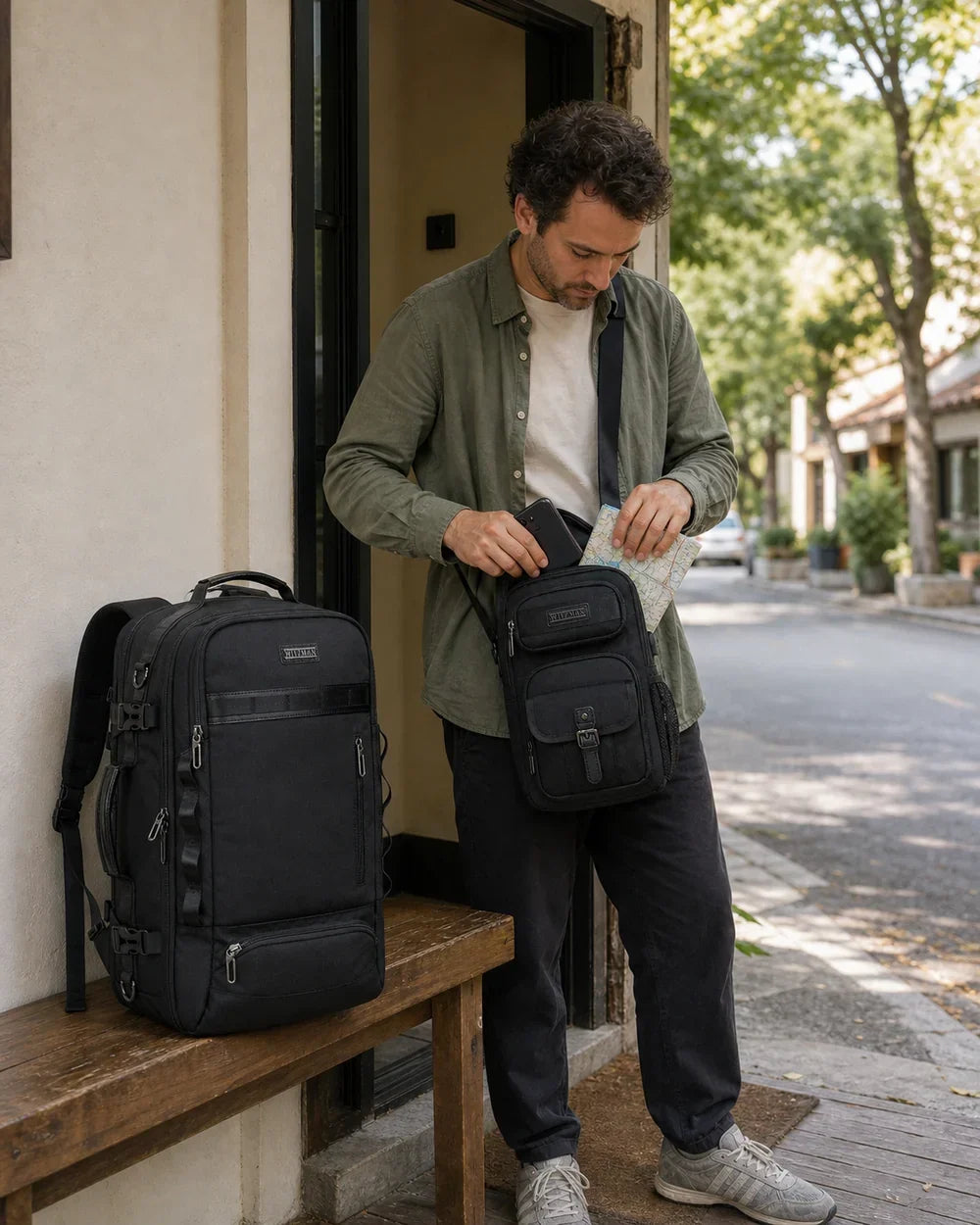
Quick Answer: One bag travel is simplest when your main backpack stays comfortable all day or your trip involves frequent moves. A 1.5-bag setup is better when you can leave the main bag at your accommodation and carry only water, a layer, a camera, or daily essentials. Choose a sling for fast access and a light load; choose a packable daypack when you need two shoulder straps, more volume, or longer walking comfort.
The useful comparison is not “minimalist versus overpacker.” It is what happens at 9:00 a.m. on the first full day, after the clothes and toiletries have somewhere to stay. Do you carry the same travel backpack to breakfast, a museum, a grocery stop, and dinner? Or did you bring a small second bag that makes modern destination travel easier?
What Does 1.5 Bag Travel Actually Mean?
A 1.5-bag system is one travel backpack plus a deliberately small destination bag. The “half” matters: it is not another weekender full of backup clothes. It is a sling, compact crossbody, or lightweight daypack sized for the items that must leave the room with you.
That distinction keeps the system honest. If your secondary bag carries shoes, packing cubes, and overflow clothing on the flight, you are traveling with two bags. That may still be the right choice, but it should be evaluated as a carry-on backpack and personal item combination, including the airline's current size and fare rules.
A true 1.5-bag setup usually takes one of two forms:
Nested daypack
A low-bulk daypack rides empty inside the main backpack. It becomes useful after check-in, then disappears again on travel days.
Working sling
A small structured sling carries phone, passport, wallet, battery, and compact daily items in transit as well as at the destination.
Start With the Hotel-Room Test
Imagine the main backpack open on a luggage rack. Clothing, spare shoes, and toiletries stay behind. Now list only what needs to go out the door for the next six to ten hours. That list—not the total trip length—chooses the secondary bag.
| Day outside | What stays with you | Best mode | What fails first |
|---|---|---|---|
| Cafe and neighborhood walk | Phone, wallet, keys, sunglasses | Sling | A backpack adds bulk without adding useful freedom. |
| Full city day | Water, battery, compact umbrella, light layer | Large sling or small daypack | One-shoulder comfort if the water and layer stay heavy all day. |
| Trail, beach, or weather-change day | Water, food, shell, sunscreen, small towel | Daypack | A sling becomes dense and swings when the route gets active. |
| Checkout plus sightseeing | Everything until the next check-in | Main backpack + accessible sling | Constantly removing the main pack for tickets, phone, or passport. |
The failure column is the fastest way to decide. If a sling's load becomes a compact brick, you need a daypack. If the daypack is mostly empty and keeps coming off for every payment, you need a sling. If neither problem appears, the main bag alone may be enough.

One Bag Travel Daypack or Sling: Use the Route, Not the Trend
A sling is strongest when the day is made of short access cycles: transit card, phone, camera, sunglasses, wallet, repeat. It can rotate to the front in a crowded train and remain compact at a restaurant. The tradeoff is load concentration. Add a full water bottle, power bank, guidebook, and rain layer, and the same convenient bag can pull on one shoulder.
A daypack spreads weight across both shoulders and gives soft items room to change shape. It is better for a long walking day, a picnic, a spare layer, or anything that may grow during the day. The tradeoff is friction: it occupies more space on transit, is slower to access, and can tempt you to carry things simply because room exists.
Your main travel backpack remains the best tool when the day includes a station change, remote check-in, or no secure place to leave luggage. A comfortable, organized main bag can also make a secondary bag unnecessary on short itineraries. For a size-based view of that decision, compare our 30L versus 40L travel backpack test.
When Does a Packable Travel Daypack Earn Its Place?
A packable travel daypack earns space when it passes the nesting test: empty it, fold or flatten it, and place it inside the main bag without changing your clothing list. If you must move shoes to an exterior pocket or strain the zipper, the “packable” bag is already influencing the trip too much.
Low packed volume is not the only criterion. Look for shoulder straps that remain wide enough under a water-and-layer load, a zipper you can operate one-handed, and fabric that does not collapse around every object. A completely unstructured sack may pack beautifully but become awkward once a bottle, charger, and sunglasses compete at the bottom.
A structured sling follows different math. It may not fold flat, but its pockets preserve access in transit and at the destination. That makes it a better 1.5-bag choice for travelers who carry the same small essentials from the airport to the evening walk. For a closer comparison of those crossbody carry styles, see sling bag versus crossbody bag guide.
The First 24 Hours: A Route Map for Both Systems
Use the sequence below before buying another bag. It reveals whether the secondary bag solves a recurring task or only looks useful in a packing video.
- Arrival: Can you reach identification, phone, charger, and transit card without opening the clothing compartment? If yes, the main backpack can handle the transfer. If no, a small sling may solve the access problem.
- Check-in: Put the main bag down. Do not automatically move every “just in case” item into the day bag.
- First walk: Carry only the items you expect to use before returning. Notice whether access or shoulder comfort becomes annoying first.
- Second morning: Adjust from evidence. Add the umbrella because rain is forecast; remove the camera because yesterday it stayed packed.
- Departure: Empty the secondary bag completely. If it nests, pack it. If it works as your personal item, confirm that your ticket and operating airline allow the two-bag arrangement.
This routine fits slow city stays particularly well because the main bag stops being part of every outing. Travelers changing accommodation daily gain less from nesting a daypack; they may prefer one highly accessible backpack and a tiny on-body pouch. Our slow travel guide explores how a less compressed itinerary changes what you actually need to carry.
Carry-On Backpack and Personal Item: Do Not Confuse Comfort With Allowance
A 1.5-bag plan describes how you use bags, not what an airline must accept. If you board with both pieces separate, the smaller bag may count as your personal item. Whether that is included depends on the fare, carrier, route, aircraft, and current policy. A packable daypack placed fully inside the main backpack is part of that one packed item; a filled sling worn separately may be treated as another bag.
Before departure, measure the main backpack after packing and check the operating carrier's latest limits. Keep medication, documents, and delay essentials accessible without assuming the small bag will receive an exception. The practical checklist in our flight-delay carry-on guide can help prioritize what must stay with you during a disrupted travel day.
A Two-Bag System Without Product Creep
These two examples occupy different jobs. B746 is the structured primary travel bag; B698 is the compact access bag. B698 is lightweight and convertible, but it is not presented here as a fold-flat packable daypack.

B746 36L Carry-On Travel Backpack
12.5 x 8.5 x 20.5 in | 4.2 lb
180-degree opening, 18+ pockets, laptop and tablet storage, wet pocket, luggage strap, and backpack/tote/shoulder carry.
USD 95.86
Best role here: the primary bag for arrival, departure, and 3–5 day travel when organized access matters.

B698 7L Convertible Travel Sling
7.6 x 11.7 x 4.5 in | 0.81 lb
Six compartments, back security pocket, water-resistant nylon, side mesh pockets, and crossbody, shoulder, or backpack carry.
USD 46.78
Best role here: phone, wallet, battery, compact umbrella, and quick-access essentials during a city day.
Key Takeaways
- Choose one bag only when you move often, have no secure luggage base, or can comfortably carry the main backpack all day.
- Choose a sling for repeated quick access and a compact load built around phone, wallet, battery, and small daily items.
- Choose a daypack for water, food, a rain shell, camera gear, or longer walking where two-shoulder weight distribution matters.
- Choose a packable model only if it nests inside the main bag without changing the rest of your packing list.
- Check the fare rules whenever the secondary bag will be filled and carried separately onto the aircraft.
Frequently Asked Questions
Is one bag travel better than carrying a backpack and sling?
It is better for frequent transfers and the simplest boarding routine. A backpack plus small sling is often more comfortable after arrival because documents and daily essentials stay accessible while the main load remains at the accommodation.
What is a one bag travel daypack?
It is a small secondary backpack carried inside the main travel bag and used at the destination. The best version packs with little bulk, has usable shoulder straps, and fits the water, layer, and essentials you genuinely carry during the day.
Should I use a daypack or sling for city travel?
Use a sling for a light load and frequent access. Use a daypack when the load includes a full bottle, outer layer, camera, food, or purchases and will remain on your body for several hours.
Can I bring a carry-on backpack and personal item?
Often, but not on every fare. Airlines apply their own current size, weight, and item-count rules. Check the operating carrier and measure both bags after packing rather than relying on capacity labels.
Does a sling count as a personal item?
It may. A filled sling carried separately can be treated as your personal item or an additional bag. Its small size does not automatically exempt it from the airline's allowance.
Is a structured sling the same as a packable travel daypack?
No. A structured sling prioritizes access and organization and may not fold flat. A packable daypack prioritizes low packed volume and two-shoulder carry. Choose based on the destination load, not the category name alone.
In Summary: Pack for the Day After Arrival
The cleanest travel system is not always the one with the fewest visible bags. It is the one that asks each bag to do a clear job. Keep the main backpack if your route is mobile. Add a sling when access is the recurring problem. Nest a daypack when water, layers, and long walks make load distribution the real constraint.
That is the practical value of 1.5-bag travel: the secondary bag remains small enough to stay subordinate, yet useful enough that you stop carrying your entire trip to buy coffee.
Partager:
30L vs 40L Travel Backpack: What Fits for 3, 5, and 7 Days?