

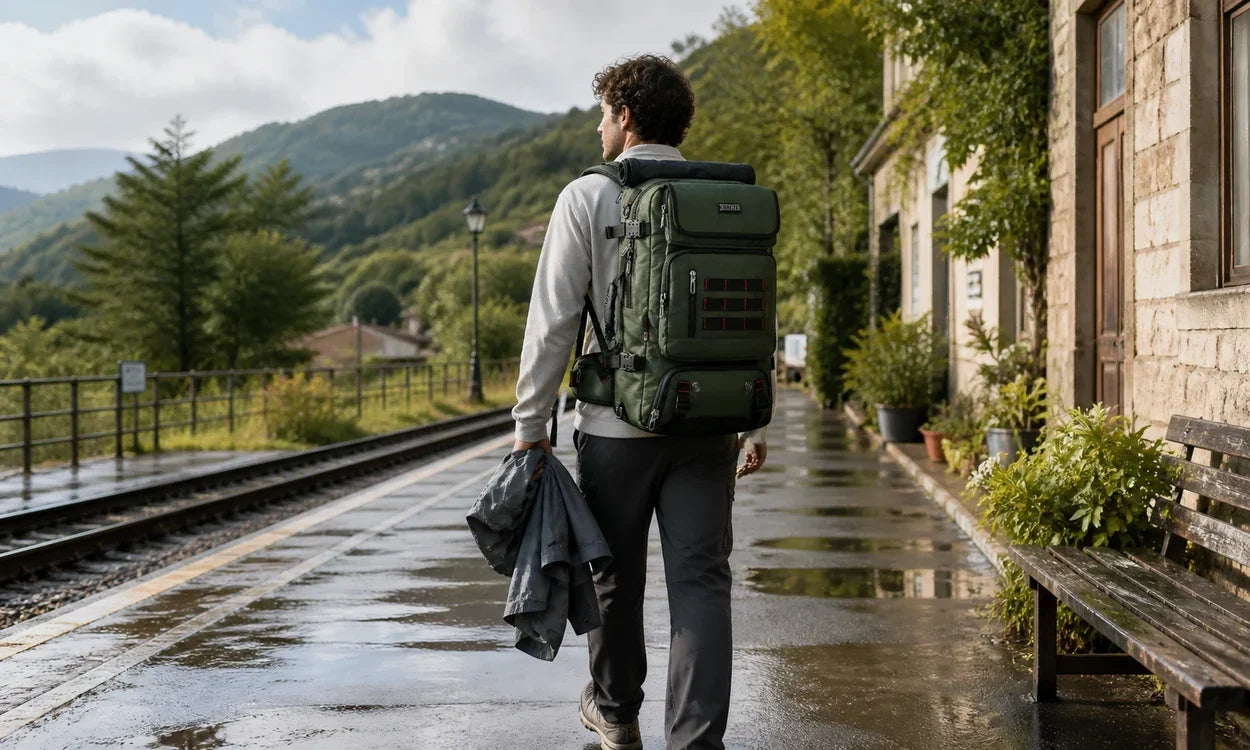
A useful shoulder season packing list for Europe is not a pile of clothes labeled "fall." It is a small system that can move between four states: warm and dry, warm and wet, cool and dry, and cool and wet. The same base, midlayer and shell should cover all four without turning a five-day trip into a suitcase of backups.
That flexibility matters from August through October. ECMWF's discussion of Euro-Atlantic weather regimes notes that transition-season behavior can resemble either warm- or cold-season patterns; there is no single autumn regime that describes every itinerary. Pack for combinations, then replace this framework with city-level forecasts shortly before departure.
The Weather Quadrant: Decide by Temperature and Wetness
Most packing lists collapse weather into one number. A high temperature does not reveal whether the afternoon brings sun, wind-driven drizzle or a cold museum after damp clothes have stopped feeling comfortable. Use two questions instead: Do I need added warmth? Do I need a surface barrier?
Warm + Dry
Base layer only. Keep the shell accessible for wind or a later shower; do not wear it by habit and trap heat.
Warm + Wet
Base plus shell. Skip the midlayer unless wind or evening cooling creates a real warmth need.
Cool + Dry
Base plus midlayer. Carry the shell as a compact wind option rather than packing a second heavy sweater.
Cool + Wet
All three layers, with ventilation adjusted while walking. This is the maximum system, not a separate outfit.
This matrix prevents regional stereotypes. A late-August Mediterranean stop and an October alpine town should not share an identical Europe fall packing list. Elevation, coast, latitude, wind and travel time matter more than the word "Europe." Check the route again 72 to 120 hours before departure, then look for current official warnings. MeteoAlarm aggregates warning information from 38 European national meteorological and hydrological services; use it for alerts, not as a replacement for a normal local forecast.
Apply Route Modifiers, Not Destination Stereotypes
The quadrant tells you which layers work together. The route tells you how quickly you must reach, remove and dry them. Before adding clothing, mark the itinerary with four modifiers.
- Elevation changes: a city-to-mountain transfer can cross quadrants within one day. Keep the midlayer and shell in reachable zones instead of sealing them under five days of clothing. Add a second warmth piece only when the actual forecast and activity level justify it.
- Coasts, islands and ferries: exposed wind can make the shell useful even without sustained rain. Treat the shell as active transit equipment, not an emergency item buried at the bottom.
- Frequent rail moves: every hotel change shortens the drying window. Favor fewer pieces that dry predictably, and carry a temporary wet-item liner so a morning departure does not force damp fabric against clean clothing.
- One-base trips: a fixed room creates more drying time and makes a small laundry rotation realistic. That can remove one or two spare base layers from the load.
These modifiers change access and redundancy, not the basic system. A traveler moving every morning may need better wet-item separation; a traveler staying five nights in one apartment may need fewer duplicate tops. Neither automatically needs a bigger backpack.
Also distinguish a forecast problem from an equipment problem. If a route shows one cool evening, the existing midlayer may solve it. If every day is cool and wet, the question becomes whether the shell fits comfortably over the midlayer and whether both can dry overnight. Buying or packing a fourth top does not repair a shell that is inaccessible, restrictive or still wet.
Build Three Layers With Three Different Jobs
A layer earns space only when it changes what the system can do. Three tops that provide similar warmth create choice, not range. Assign each layer a separate job and a clear removal trigger.
| Layer | Job | Wear it when | Remove it when |
|---|---|---|---|
| Base | Manage next-to-skin comfort and dry faster than a heavy sweatshirt. | Always; choose short or long sleeve by the day's range. | Replace it when damp or after repeated wear. |
| Midlayer | Add adjustable warmth without being the rain barrier. | Cool mornings, exposed platforms and evening walks. | You begin heating up during sustained walking. |
| Shell | Block rain and useful amounts of wind while protecting the insulation layer. | Showers, wet seating, exposed wind or cool-wet conditions. | Rain stops and trapped heat becomes the bigger problem. |
The base does not need to look like an outdoor uniform. A quick-drying T-shirt or long-sleeve top that works in a cafe is more useful than a technical piece you avoid wearing in town. The midlayer can be a light fleece, knit or compact insulated layer, but one is normally enough for five days. The shell should fit over both without compressing the midlayer or restricting shoulder movement.
Use your body, not the calendar, to operate the system. Start slightly cool before a long walk and add warmth when activity drops. That is more efficient than wearing all three layers from breakfast and carrying sweat into the next weather quadrant.
Design the Hand-Off Between Rain and Sun
Rainy weather travel packing fails when the shell is buried under clothing. Give it one repeatable home: the top of the main compartment or a quick-access pocket. The exact place matters less than using the same place every time.
When sun returns, do not stuff a damp shell among dry base layers. Use a short relay:
- Shed: remove the shell before heat builds underneath.
- Shake: remove surface droplets outdoors where appropriate.
- Isolate: place it in a separate liner or washable pouch for the transfer.
- Dry: hang it at the first practical stop; open pockets and vents.
- Reset: return the dry shell to its quick-access location.
Isolation is not drying. A sealed liner protects the rest of the load during a train ride, but it should not become the shell's permanent home. Keep "wet now" separate from "laundry later" so one pouch does not contaminate everything it touches.

A Five-Day Load That Can Cross All Four Quadrants
This is an editorial packing model, not a claim that every item has been test-packed. Adjust for laundry access, dress requirements, footwear and the actual forecast.
| System | Wear in transit | Pack | Why it is enough |
|---|---|---|---|
| Base tops | 1 short-sleeve top | 2 short-sleeve + 1 long-sleeve | Four tops create rotation without five daily outfits. |
| Warmth | 1 light midlayer | None unless the forecast requires a second level | The shell extends the midlayer into cool-wet conditions. |
| Rain/wind | Shell carried, not necessarily worn | Small wet-item liner | One barrier serves showers and exposed wind. |
| Bottoms | 1 walking trouser | 1 alternate trouser | One can rest or dry while the other is worn. |
| Underwear/socks | 1 set | 4 sets | Simple daily rotation; fewer if hand-washing is planned. |
| Footwear | Weather-tolerant walking shoes | Optional light second pair | The second pair must solve a real dress or drying problem. |
| Small systems | Phone, wallet, documents | Compact toiletries, charger, medication, sleepwear | Keep each system consolidated rather than adding spare pouches. |
For volume, compare the clothing count with the 30L versus 40L travel-backpack guide. The guide on why backpack liters do not tell the whole story explains how pocket geometry affects usable space. If toiletries expand, use the Dopp kit versus toiletry bag comparison to put a boundary around that category.
Where B682 Fits, and Where It Does Not
B682 is the only product recommended here because its listed specifications intersect the problem: five-day capacity, water-resistant nylon and a separate shoe compartment. This is specification analysis, not a rain or packing test.

WITZMAN B682: one 40L structure for the layer system
Official specifications list 40L capacity, 12.6 x 20.5 x 7.5-inch dimensions, 1.78 kg weight, high-density water-resistant nylon, a laptop area and shoe compartment. The shoe zone can keep footwear away from clothing; for a wet shell, still use a separate liner because the compartment is not documented as a waterproof wet pocket.
The tradeoff is weight and temptation. At 1.78 kg empty, B682 would leave 5.22 kg under a hypothetical 7 kg total allowance, and a 40L body makes it easy to add duplicate layers. Travelers with a strict low weight cap or a true personal-item fare should choose by loaded measurements and mass, not by the 40L label.
View the WITZMAN B682For shoe isolation versus lost clothing space, see whether a backpack shoe compartment is worth it. For frequent day excursions, the one-bag versus 1.5-bag framework helps decide whether a destination bag earns its weight.
The 48-Hour Edit Before Departure
Lay out the maximum three-layer system, then read the forecast by city and day. Remove garments that duplicate a job. If no day is cool enough for two warmth layers, take one. If rain is only a brief possibility, keep the shell but reconsider rain pants and a second pair of heavy shoes. If several days are cool and wet, protect drying capacity before adding outfits.
Load the backpack in weather order: shell first-access, dry base layers protected in the main compartment, midlayer reachable on a platform, wet-item liner empty but accessible, and the worn shoe pair outside the bag. The rainy-season packing guide adds storage logic, while the coolcation guide helps when an August route moves toward cooler elevations.
The final rule
Pack one system capable of reaching all four quadrants. Do not pack four separate outfits for weather that may never occur.
Browse the current WITZMAN travel backpack collection with loaded weight, quick shell access and wet-item separation as the criteria.

Partager:
Bagage cabine de 7kg : établir son budget de poids
Un sac à dos pour le train et les vols low cost : deux contraintes