

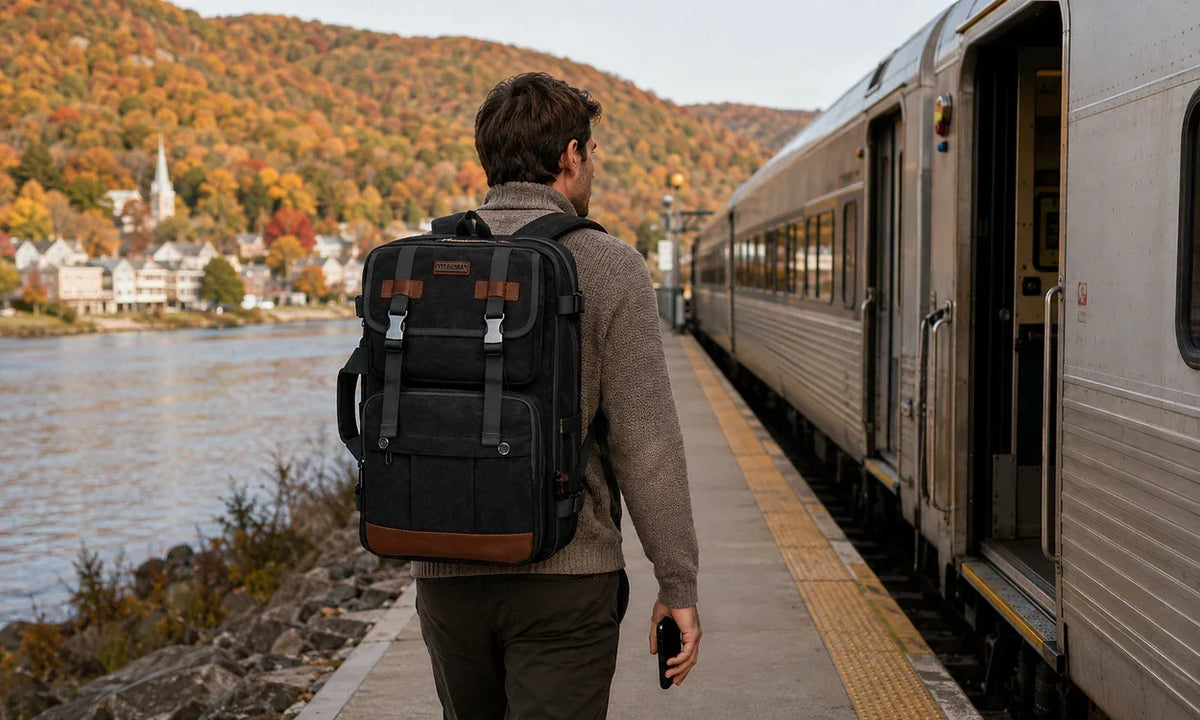
The route in one line
Northbound: aim for the left side for river views. Southbound: aim for the right. Treat this as a geography-based strategy, not a seat guarantee; train orientation, availability and service arrangements can change.
8:00 AM: Choose a Train Before Choosing a Town
A New York autumn getaway by rail begins with a distinction that travel lists often blur. Metro-North's Hudson Line leaves Grand Central and serves places such as Tarrytown, Cold Spring, Beacon and Poughkeepsie. Amtrak's Empire corridor leaves Moynihan Train Hall and continues through the Hudson River Valley toward Albany and beyond. They are different tickets, timetables and stopping patterns.
For a flexible day trip built around walking a river town, Metro-North is usually the simpler mental model: pick a stop, check the current return choices, and keep the plan light. For a farther destination or a reserved intercity itinerary, compare Amtrak's actual train and stop before buying. The official MTA Hudson Line page is the place to check live schedules and planned work; screenshots saved weeks earlier are not a timetable.
Cold Spring, Beacon and Poughkeepsie create three different scales of outing without requiring an overbuilt itinerary. The point is not to crown one “best.” It is to decide whether the day is mostly about a compact main street and river edge, a longer town walk, or more time on the train. Start with the return train you can realistically make, then work backward. That one move prevents the classic foliage-weekend failure: spending the afternoon watching the clock instead of the landscape.
9:15 AM: The River-Side Seat Rule
The scenic section runs along the east side of the Hudson. That makes the basic orientation easy to remember: when traveling north from New York, the river is generally to the left; when traveling south, it is generally to the right. On a fall foliage train trip, that side gives the longest sequences of open water, opposite-bank hills and low afternoon light.
There are three catches. First, a preferred side is not the same as a reserved seat. Second, a crowded weekend train may make “a seat” more valuable than “the perfect seat.” Third, the most photogenic window can still be compromised by glare, dirt or a structural pillar. If the carriage is open-seating, scan two or three rows rather than stopping at the first river-side pair. A slightly less ideal angle with a clean pane is often better.
A better window test
Before settling in, look through the glass at a dark object and then a bright one. This quickly reveals glare and smears. Keep the camera or phone close to the glass without touching it, switch off interior reflections where possible, and let some foreground pass through the frame. The result feels like a journey, not a postcard photographed from a stationary overlook.
10:30 AM: Let the Landscape Arrive in Chapters
South of the Highlands, the river reads wide and settled. Farther north, slopes move closer, the water narrows, and rail infrastructure becomes part of the view rather than an interruption. Towns appear briefly: roofs, church towers, brick walls, parking lots, docks. Do not spend the entire ride chasing one unobstructed photograph. The strongest sequence usually includes an imperfect town edge, a broad river frame and one close passage where leaves blur near the track.
This is where the article's packing logic starts. Anything needed during the ride should not be buried in the main clothing compartment. Put a light layer, phone cable and water in one repeatable access zone. Keep the ticket, wallet and small camera on the body. If every photograph requires opening the full backpack, the bag has too many jobs at once.
12:00 PM: Weekend Crowds Change the Rhythm
Peak-color weekends compress demand into the same late-morning departures and mid-afternoon town streets. There is no universal “uncrowded” train to promise. A practical plan is to depart earlier than the brunch crowd, keep one later return option in mind, and check service conditions again on the morning of travel. At the platform, stand where you can board without blocking a doorway; inside, place luggage before arranging jackets and cameras.
A small behavioral detail matters: do not use the adjacent seat as storage when the carriage is filling. On Amtrak, the current carry-on baggage guidance says bags belong under the seat, in overhead racks or in designated luggage storage, not on empty seats or in aisles. Metro-North is a different operator, but the same courtesy and safety logic makes a crowded train easier for everyone.
| Moment | Main backpack | Sling | What stays out |
|---|---|---|---|
| Platform | Both straps on; loose webbing controlled | Close to the front or hip | Ticket or phone only |
| Boarding | Lift directly to the rack or assigned area | Keep worn | Nothing in the aisle |
| Window seat | Leave stored | Shift low at the hip | Water and one light layer |
| Town walk | Carry only if staying overnight | Daily essentials | Hands remain free |
1:00 PM: Pack Lunch for the Carriage, Not the Picnic Photograph
Train food succeeds when it is quiet, stable and easy to close again. Choose a sandwich or wrap that does not drip, a firm fruit, a small dry snack and water. Avoid loose powders, fragile pastry flakes, strong odors and containers that need a table-sized spread. One napkin is not a spill plan; add a small wipe and a sealable bag for wrappers.
Pack food at the top of the main bag only until boarding. Once seated, move the meal into the access position you can reach without lifting the backpack down. If the train is crowded, wait for a calm stretch rather than balancing an open container while passengers are passing. The goal is to arrive hungry enough to enjoy the town, not to recreate a full café inside the carriage.
3:30 PM: Two Bags, Two Honest Jobs
For this trip, the main bag should carry the layer system, compact overnight kit if needed, food, bottle and any larger camera item. The smaller bag should handle the objects that cross the station-seat-town boundary repeatedly. That division follows the same logic as our one-bag versus 1.5-bag framework: the second bag earns its place only when it reduces repeated access friction.
A6617-3: keep the expansion closed

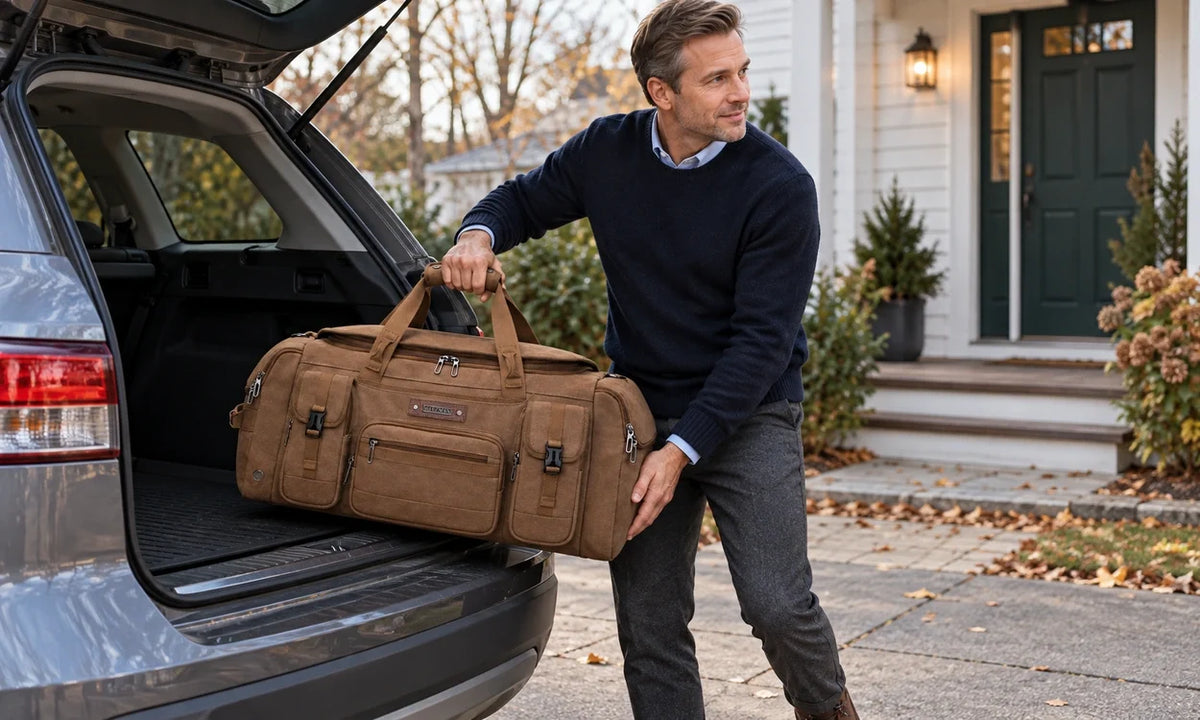
The listed collapsed dimensions are 50 x 32 x 20 cm at about 32L; opening the expansion increases listed depth to 26 cm and capacity toward 42L. For a short rail getaway, leave that extra volume unused. A narrower profile is easier to turn through doors and more predictable to lift. The 1.85 kg empty weight is also a real tradeoff: this is a structured, substantial canvas travel bag, not the lightest possible shell.
A8021: keep the access list short

At 31 x 21 x 8 cm and 740 g, the A8021 is sized for a phone, wallet, ticket, compact power bank, glasses and a small camera rather than spare clothing. Its reversible strap can support either shoulder; our left- versus right-shoulder sling guide explains how dominant hand and zipper direction affect access. The risk is mission creep: once food, a large bottle and extra layers move into the sling, it stops being the clean access layer.
Capacity labels alone cannot tell you how either bag will behave around seats and racks. The useful distinction is geometry and access, developed more fully in why backpack liters do not tell the whole story. For broader rail formats, compare our guide to bags for train travel.

On the return, the river-side seat becomes a blue-hour view; keep only the small access layer with you and leave the main bag stored.
5:45 PM: The Dusk Return Is a Different Journey
On the southbound ride, aim right for the river, but let sunset time decide how much of the return you expect to see. In early autumn, a later train may still carry warm light across the water. Later in the season, darkness can arrive before the most scenic section. Check sunset for the travel date and build a margin around it; station waits and schedule changes consume light quickly.
Dusk also changes what needs to be accessible. Move the warmer layer into the sling or the top of the backpack before boarding. Reduce screen brightness so the window does not become a mirror. Keep the camera ready for a few minutes, then put it away. Reflections of carriage lights, silhouettes of other passengers and the first lights in the river towns are not defects to eliminate. They are the visual language of returning.
A Hudson Day Should Still Feel Unfinished
The most satisfying itinerary leaves something uncollected. One town is enough. One river-side seat is enough. The backpack does not need to be expanded simply because it can be, and the Sling does not need to carry a second day's packing list. A compact system keeps the day moving from station to street and back to the window without turning every transition into luggage management.
Before leaving, recheck the operating service, departure station, return options and sunset. Wear the layer that would otherwise consume the most bag space, keep food contained, and decide where the backpack will be stored before the train moves. For a colder or wetter forecast, adapt the three-layer logic in our shoulder-season packing system; the climate is different, but the method of separating a working layer from a backup layer still travels well.
A Hudson Valley autumn train is not a sightseeing attraction sealed behind glass. It is a moving sequence of ordinary places made vivid by season and light. Pack so you can notice that sequence while it is happening.

Aktie:
Volle Gepäckfächer: Handgepäck für Feiertagsreisen vorbereiten
Neun Tage Athen: Was täglich gebraucht wurde und im Rucksack blieb