

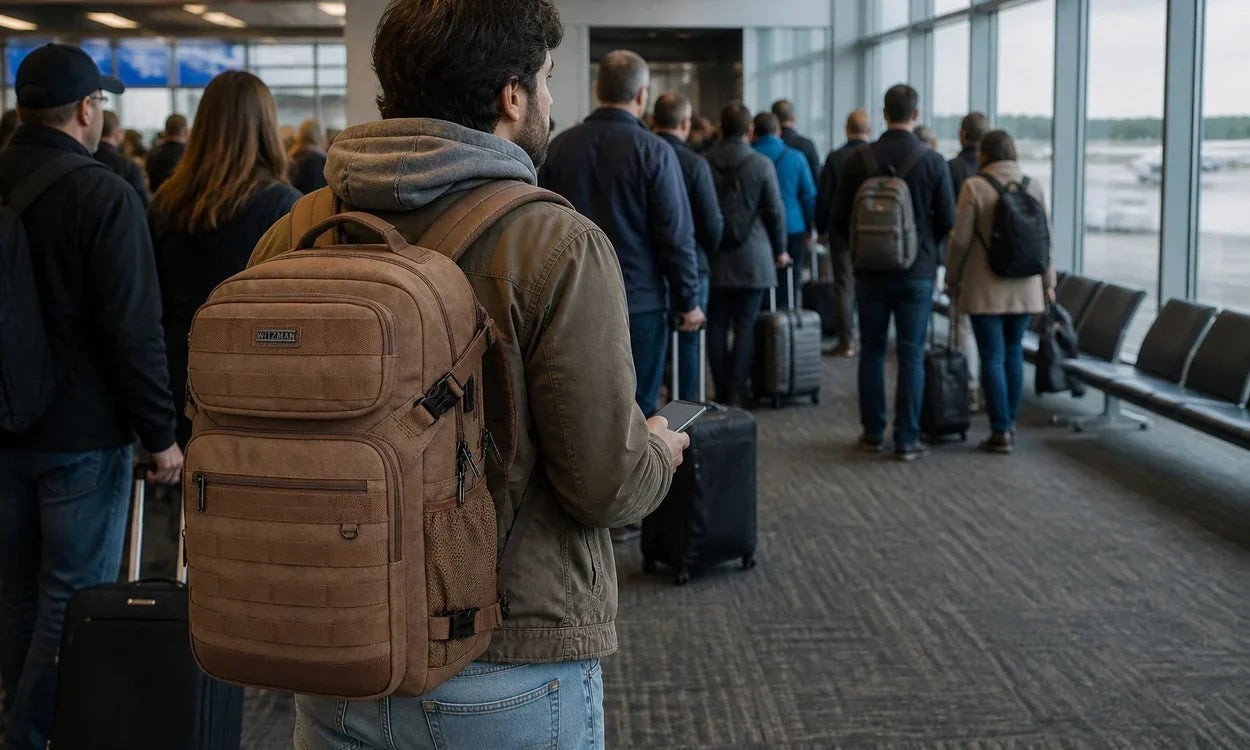
The most useful holiday travel carry on tips begin with an uncomfortable assumption: your main bag may not stay with you in the cabin. A carry-on that works only when an empty bin appears above your row is not a complete plan for a crowded October-to-December flight.
Build the bag in two states before leaving home. The first is an overhead-ready travel bag. The second is a small cabin-only module that can leave the main bag in about 60 seconds if an agent requires a gate or planeside check. Nothing else in the clothing load should need to move.
The holiday carry-on contract
The main bag may enter the hold. Medication, batteries, identification, keys and fragile valuables do not.
Three Boarding Scenarios, Three Different Moves
The FAA notes that some aircraft have limited overhead space and that an airline may require most or all bags to be checked. Its guidance also says to confirm the airline's own limits because permitted size and bag count vary. That makes an overhead-bin contingency a practical safety step, not a prediction about one particular flight.
Scene 1
There is space above or close to your row. Stow the main bag with straps secured. Keep the removable module under the seat or inside the main bag according to the baggage allowance on your fare. Do not open the main compartment after boarding unless necessary.
Scene 2
The bag goes into a bin several rows away. Remove the module before stowing. You should not need to move against deplaning traffic later to retrieve medicine, a charger, documents or keys. The bag is still in the cabin, but it is no longer accessible on demand.
Scene 3
An agent requires a gate or planeside check. Pull the cabin-only module, remove the laptop in its sleeve, close every zipper, tuck away loose straps and confirm where the checked bag will be returned. This is the moment the prebuilt system earns its space.
Do not wait for a gate announcement to decide what matters. A full queue is the worst place to search five pockets for a power bank. The preparation happens at home, where the packed dimensions can also be checked using an airline baggage sizer test.
Build a 60-Second Underseat Backup Module
The module is not a miniature version of the trip. It is the set of items that cannot tolerate separation, crushing, cold luggage holds or delayed bag return. Give it one zipper, one known handle and one repeatable location near the main bag opening.
| Category | Pack in the removable module | Reason | Boundary |
|---|---|---|---|
| Identity and access | Passport or ID, boarding documents, wallet, home and car keys | The trip cannot continue normally without them. | Use an interior zipped pocket, not an open external sleeve. |
| Health | Necessary medication and compact care items for the journey | A checked bag may not be immediately available. | Follow destination, security and prescription-document rules. |
| Battery and tech | Power bank, spare lithium batteries, phone and small electronics | FAA gate-check guidance calls for spare batteries and lithium-battery devices to remain in the cabin. | A laptop needs a separate removable sleeve; the B698 has no laptop compartment. |
| Fragile value | One small irreplaceable or breakable item | It avoids the crush and handling risk accepted by the main bag. | Large or prohibited objects need a different transport plan. |
Everything else should be able to remain in the main bag: the clothing block, nonessential toiletries, secondary shoes and soft gifts. If the backup module becomes a second full packing list, it will be too large to nest and too slow to remove.

A compact cabin module should hold only the items that cannot follow the main bag into a gate check.
The Two-Bag System Is Sometimes One Bag
A 1.5-bag strategy does not always mean arriving at the airport with two separately counted pieces. When the fare allows only one cabin item, keep the compact module nested inside the main bag and remove it only if the main bag is accepted for an operational gate check. When the fare permits a carry-on plus a personal item, it can travel separately from the start, subject to the airline's current size and count rules.
The distinction is explained more fully in our one-bag versus 1.5-bag travel guide.
For this scenario, the WITZMAN A8025 and B698 illustrate the architecture without pretending it is universal. Based on official specifications, the A8025 is a 32L canvas travel backpack measuring 31.8 x 49.5 x 20.3 cm and weighing 1.53 kg. Its padded laptop compartment, top handle and luggage pass-through suit the role of the main travel bag. Its listed depth is still not a promise that a fully packed soft bag will meet every airline limit or find bin space.
The B698 is listed at 7L, 19.3 x 29.7 x 11.4 cm and 0.37 kg. Its organizer pockets and hidden pocket make it a plausible removable valuables module. It does not have a laptop compartment, and its dimensions do not create a universal personal-item promise.
For strict weight allowances, remember that the two empty bags together use 1.90 kg before any contents; our 7 kg carry-on load plan shows how to budget from the empty bag upward.
Two WITZMAN Roles, With Clear Limits


Christmas Flight Packing: Give Gifts a Crush Plan
Holiday gifts change the load because they are often rigid, oddly shaped or emotionally difficult to replace. Pack them according to what happens if the main bag is squeezed, rotated or checked, not according to which box looks best under a tree.
Place rigid gifts in the protected center
Use folded clothing as a buffer on all sides and keep a rigid object away from the outer corners, where direct pressure is hardest to distribute. Do not place a breakable gift in a front pocket simply because the pocket fits it. If the item is small and irreplaceable, assign it to the removable module from the beginning.
Carry wrapping flat
TSA states that even a permitted item may require additional screening. For US departures, a practical response is to keep wrapping paper or a gift bag flat and wrap the item after arrival, so inspection does not destroy the presentation. This is a packing recommendation, not a claim that every wrapped gift will be opened. Review the current TSA travel guidance and the rules at every departure point.
Do not let a gift decide the bag's deepest point
A soft backpack can gain depth where a box, toiletry bottle or shoe presses against its face. Measure after the gifts are loaded, including filled exterior pockets and handles. The difference between liters and usable geometry is covered in why backpack liters do not tell the whole story.
The Gate Announcement: A 60-Second Conversion
- Release the cabin module. Pull it from the same top-access location practiced at home.
- Remove the laptop sleeve. Do this separately because the B698 cannot carry it.
- Confirm batteries and medication. Power banks, spare batteries, necessary medication and essential documents remain with you.
- Protect the main bag. Close every opening, tuck straps and remove loose accessories.
- Clarify return handling. Ask whether the bag returns at the aircraft door, baggage claim or another specified point; follow the agent's instruction.
The system fails if any step requires opening the main clothing compartment. Practice once with the actual December load. If the module catches under packing cubes, if the laptop sleeve has no clear exit path, or if gifts block the zipper, redesign the order before travel.
When the Overhead Bin Is Full, Preserve the Trip
A full bin is inconvenient; losing access to medication, keys, identification or battery-powered essentials can change the trip. Build the carry-on so the inconvenience stays small. The main bag should be ready to separate, and the cabin module should already contain the things that cannot.
This approach does not guarantee overhead space, prevent a gate check or override a fare rule. It does something more controllable: it turns a crowded boarding decision into five known actions. Travelers still deciding whether a larger backpack can serve as the smaller permitted item should begin with the personal-item and under-seat fit guide, then verify the packed bag against the operating carrier.
Continue with the packed sizer-check method, or browse the WITZMAN travel backpack collection.



Share:
One Backpack for Trains and Budget Airlines: Design for Two Different Constraints
Autumn by Train: A Window-Seat Journey Through the Hudson Valley