

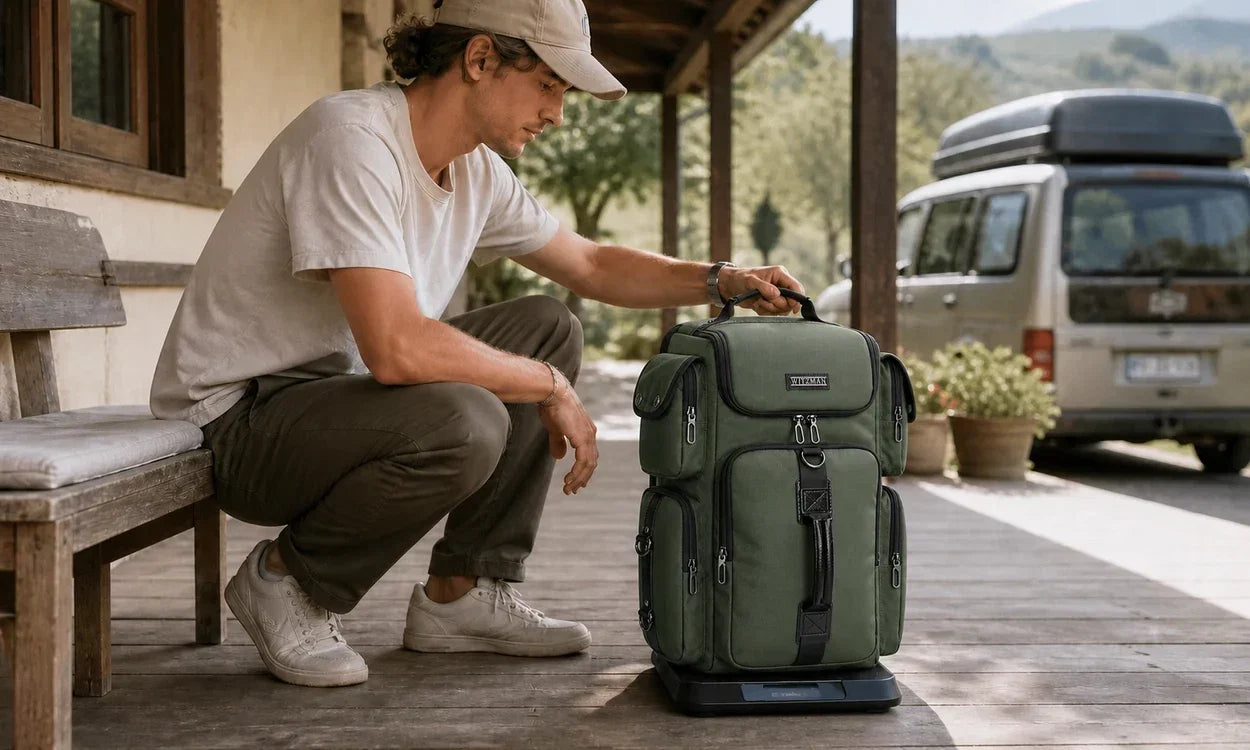
A 7kg carry on packing plan starts before the first shirt goes into the bag. If the empty backpack weighs 1,540 g, only 5,460 g remains for the laptop, shoes, chargers, toiletries and clothing. That subtraction matters more than the bag's advertised liters.
This guide treats the allowance as a ledger, not a wish list. The three loads below are illustrative budgets: WITZMAN bag weights come from official specifications, while every other gram value is a planning assumption that should be replaced with a reading from your own scale.
Check the rule before doing the math. Jetstar currently says Starter fares for travel before February 2, 2027 include two carry-on items with a combined weight of 7 kg. Qantas currently lists a 7 kg maximum for International Economy, but its allowance varies by route, cabin and aircraft. A carry on weight limit is never a universal bag standard: verify the operating airline, fare, route and date on your booking.
The 7,000-Gram Ledger
Think of the allowance as four accounts. The bag is a fixed cost. Trip-critical equipment is difficult to remove. Clothing and toiletries are adjustable. The final margin is intentionally unspent. A plan that totals 7,000 g at home has no tolerance for scale differences, a damp jacket, food bought before boarding or an item moved from a pocket into the bag.
| Account | Suggested ceiling | What belongs here |
|---|---|---|
| Empty bag | Use the listed or measured weight | Backpack plus any detachable straps or organizers that will travel with it. |
| Trip-critical | 2,000-3,000 g | Laptop, required charger, medication, documents and essential work equipment. |
| Adjustable load | 2,000-3,500 g | Clothing, spare footwear, toiletries and optional electronics. |
| Margin | 300-600 g | A deliberate buffer, not space waiting to be filled. |
The empty-bag line deserves more attention than it usually gets. Based on official WITZMAN specifications, the 34L B744 is listed at 1.54 kg. That is 22.0% of a 7 kg allowance, leaving 5,460 g. The 36L B739 is listed at 1.69 kg, or 24.1%, leaving 5,310 g. Those figures do not make either bag "too heavy"; they reveal the payload available for a particular trip.
Case One: Laptop-First Business Traveler
This traveler cannot remove the computer, so the clothing system has to absorb the constraint. The example uses the B744's listed 1,540 g empty weight and assumes a 1,300 g laptop. Replace both device rows with the exact weights of your machine and charger.
| Ledger line | Budget | Running total |
|---|---|---|
| B744 empty backpack (official specification) | 1,540 g | 1,540 g |
| Laptop | 1,300 g | 2,840 g |
| Laptop charger, phone cable and compact adapter | 300 g | 3,140 g |
| Three-day clothing capsule | 1,750 g | 4,890 g |
| Packable spare shoes | 650 g | 5,540 g |
| Toiletries | 300 g | 5,840 g |
| Documents, medication and empty bottle | 400 g | 6,240 g |
| Unspent margin | 760 g | 7,000 g |
The laptop system consumes 1,600 g, almost as much as the bag. The fastest reduction is therefore not removing socks one pair at a time. First ask whether a smaller charger can safely replace the original, whether the spare shoes are necessary, and whether a second device duplicates the laptop. For clothing volume, compare this weight ledger with the 30L versus 40L packing comparison; liters explain fit, while this ledger explains whether the load can fly.
Case Two: Warm-Weather Traveler Without a Laptop
Removing a computer and its charger releases a large block of weight, but that space is easy to refill with "just in case" clothing. This example deliberately spends part of the gain on a light outer layer while preserving a larger 910 g margin.
| Ledger line | Budget | Running total |
|---|---|---|
| B744 empty backpack (official specification) | 1,540 g | 1,540 g |
| Five-day warm-weather clothing capsule | 2,250 g | 3,790 g |
| Light outer layer | 500 g | 4,290 g |
| Sandals or light spare shoes | 550 g | 4,840 g |
| Toiletries and sunscreen | 400 g | 5,240 g |
| Phone charger, cable and compact power bank | 350 g | 5,590 g |
| Documents, medication and empty bottle | 500 g | 6,090 g |
| Unspent margin | 910 g | 7,000 g |
The important move is to keep the margin visible. If this traveler wants to add another 700 g pair of shoes, the ledger should show the margin collapsing to 210 g before the shoes enter the bag. The article on whether a shoe compartment is worth its space helps with organization, but a compartment cannot make footwear weigh less.
Case Three: Creator With a Compact Camera Kit
This case uses the B739's listed 1,690 g empty weight and budgets for a small laptop plus a compact camera kit. It is intentionally tight: only 310 g remains. That narrow margin is a warning, not a target.
| Ledger line | Budget | Running total |
|---|---|---|
| B739 empty backpack (official specification) | 1,690 g | 1,690 g |
| Compact laptop | 1,200 g | 2,890 g |
| Camera body and one lens | 750 g | 3,640 g |
| One consolidated charging kit | 350 g | 3,990 g |
| Three-day clothing capsule | 1,650 g | 5,640 g |
| Packable shoes | 600 g | 6,240 g |
| Toiletries, documents and medication | 450 g | 6,690 g |
| Unspent margin | 310 g | 7,000 g |
If the camera is genuinely trip-critical, this traveler should question the second pair of shoes before removing essential equipment. If the camera is optional, it is the cleanest single deletion. This is why a useful lightweight travel backpack packing list is not simply the shortest list; it identifies which grams protect the purpose of the trip.

When the Scale Says 7.6 kg, Cut in This Order
Do not remove the lightest objects first. Remove the grams that create the least disruption. A 70 g cable may look expendable, but not if it is the only way to charge the phone. A 700 g duplicate pair of shoes can solve the entire problem in one decision.
- Consumable excess: full-size liquids, extra snacks and filled water bottles. Keep medication and required supplies.
- Duplicate footwear: wear the heavier pair and remove a second pair unless the trip has a real dress or activity requirement.
- Redundant clothing: remove the third version of the same function, not the only warm or rain layer.
- Duplicate tech: combine chargers where device compatibility and power requirements allow; remove spare cables that do not protect a critical failure point.
- Convenience organizers: weigh packing cubes, pouches and detachable accessories together. Organization has a mass cost.
- Optional trip equipment: camera, tablet, second lens or entertainment device, judged against the reason for the trip.
- Change the baggage plan: if only essential items remain, buy additional allowance or check a bag rather than hiding weight or gambling on enforcement.
Moving an item into a personal item does not automatically solve the problem. Jetstar's cited Starter allowance is combined across the main and small item. Read the exact wording on the booking, then use the under-seat personal-item guide separately for size and legroom.
Choose the Backpack by Payload, Not Capacity Alone
For this article, the two WITZMAN options were selected because both are active 2026 travel backpacks with exact listed empty weights. This is a specification comparison, not a hands-on weighing test.

B744: More payload for a strict ledger
Listed at 1.54 kg, the 34L B744 leaves 5.46 kg of a 7 kg allowance. Its official specification includes a 16-inch laptop compartment, wide U-shaped opening and convertible backpack/hand carry. It is the better fit of these two when every 100 g matters, though it still consumes more than one-fifth of the budget.
View the WITZMAN B744
B739: More organization, 150 g less payload
Listed at 1.69 kg, the 36L B739 leaves 5.31 kg. Its 180-degree opening, dual-compartment layout and 16-inch laptop compartment suit travelers who value separation. Under a strict 7 kg cap, however, that structure costs 150 g more than B744 before packing.
View the WITZMAN B739A larger pack can be useful without being appropriate for a weight-limited fare. The guide to why backpack liters do not tell the whole story explains the capacity side of that mismatch. For trip length, the seven-day one-backpack guide can help reduce item count, but the scale remains the final judge.
A Two-Weigh Protocol for Departure Day
First, weigh the complete bag exactly as it will reach the airport: all straps attached, every pocket loaded, and the personal item included if the airline combines the allowance. Then remove the laptop, power bank and any item that security or cabin rules require you to access, and weigh again only to understand where the mass sits. Do not use the second, lighter number as the compliance number.
Run the same check after the return trip is packed. Receipts, gifts, damp clothing and hotel toiletries alter the ledger even when the outbound bag passed. If the packed shape is also close to the dimensional limit, use the airline sizer test guide; weight and size are separate gates.
The decision rule
Subtract the empty bag first, protect the trip-critical rows, and leave at least 300-600 g unspent. If the essentials alone exceed the remaining payload, change the baggage allowance rather than pretending a different packing technique will erase mass.
Airline rules checked August 18, 2026. Confirm the current allowance shown on your booking and the operating carrier's website before departure.
Continue with WITZMAN one-bag versus 1.5-bag decision guide, or compare the current travel backpack collection using empty weight as the first filter.

Share:
Left- vs Right-Shoulder Sling Carry: Access, Security, and Comfort
Shoulder-Season Packing for Europe: A Rain-to-Sun Layer System