

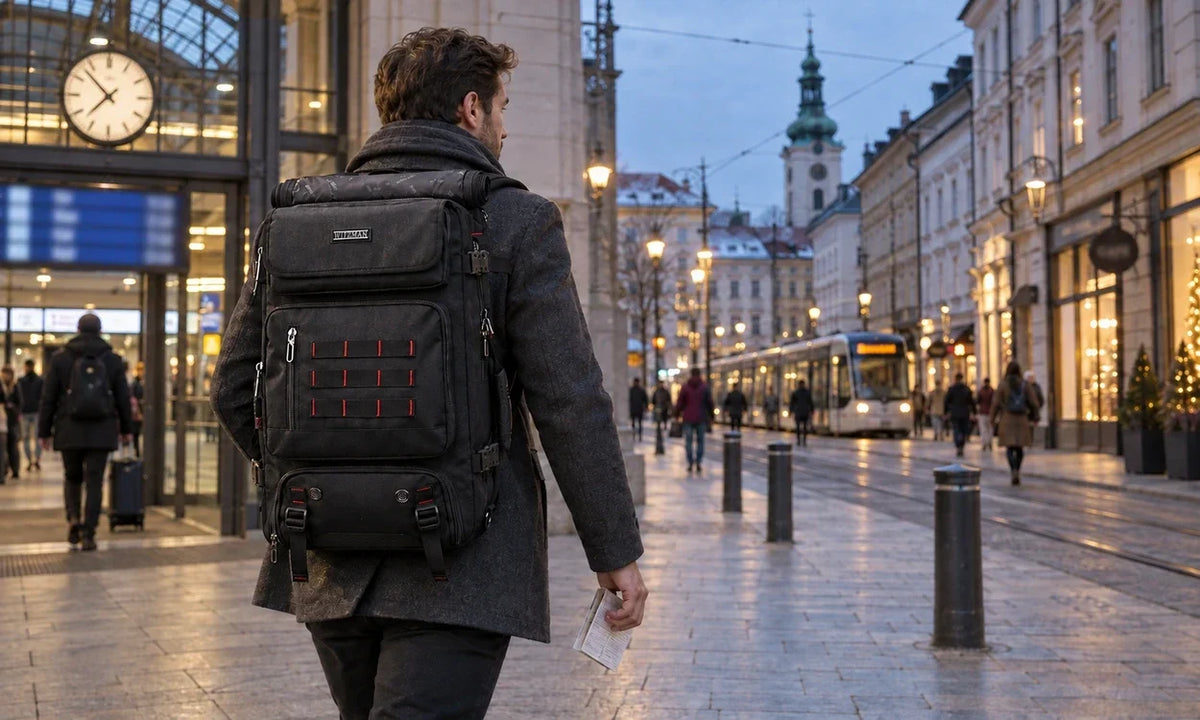
The difficult part of a Prague-Vienna-Budapest Christmas-market trip is not the train seat. It is the chain around it: winter checkout, a platform change, a luggage rack, local transport, cobblestones and the final repack after buying something rigid. Choosing the best travel backpack for Europe therefore starts with a less glamorous question: can the loaded bag move through every transfer without being unpacked, carried by hand or split into loose pieces?
One Route, Five Different Load States
A three-city rail itinerary keeps changing what the backpack needs to do. In the hotel it is storage. Between cities it becomes mobile luggage. On the train it must fit the available rack or floor space without loose straps wandering into the aisle. At the market it should stay behind, while a compact access layer handles the few objects needed for the evening. On the return leg it has to absorb laundry and purchases without losing balance.
| Journey moment | What happened | What the bag must solve |
|---|---|---|
| Prague arrival | Station exit, local transfer, bag drop | Clothing stays buried; hat, gloves, documents and power stay reachable |
| Prague to Vienna | Checkout, platform movement, carriage storage | Stable carry, controlled loose straps and a load that does not pull backward |
| Vienna market days | Repeated outdoor-to-indoor transitions after dark | Main bag stays at the hotel; a small daily layer carries essentials without becoming luggage |
| Vienna to Budapest | Second hotel move with used clothing and purchases | Fast checkout, fixed document access and no loose souvenir bag to manage |
| Return journey | Fullest and least orderly version of the load | A protected souvenir zone and a separate damp-laundry boundary |
The useful unit is not “one train ride.” It is the complete door-to-door transfer: packing, checkout, local transport, platform movement, boarding, arrival and another local transfer. A direct train may remove a connection, but it does not remove the luggage work around the train.
That is why a practical backpack for a Europe trip should be judged across the whole transfer chain. Our guide to one backpack for trains and budget airlines separates rail access from airline dimensions. For this journey, the rail question is narrower: can the loaded bag move from a hotel room to a tram, platform, luggage rack and cobbled street without needing to be rebuilt?
Day One Was Decided by What Stayed Outside the Bag
A winter load becomes manageable when the largest thermal pieces are assigned before the packing list is written. The coat, primary footwear and warmest midlayer are volume anchors. Decide which of them will be worn during transfers, which must temporarily fit inside the backpack on a heated train, and which can be eliminated because another piece already performs the same job.
- Wear the volume anchor: the coat and primary walking boots travel on the body, not inside 40L.
- Pack one working warmth system: base layer, one dependable midlayer and a weather layer selected from the actual forecast.
- Choose trousers around layering: a second bottom earns space if it accepts the same base layer and can alternate while the first dries.
- Protect the boring essentials: comfortable socks matter more after six hours on stone than a fourth photogenic sweater.
This is the place where many Europe winter packing lists go wrong. They count outfits but ignore volume state. A coat on the body occupies no bag volume during the transfer. The same coat stuffed into the main compartment may erase the entire souvenir reserve. A second pair of rigid shoes behaves differently from three soft tops even when their weights are similar.
Use the comparison in our 30L versus 40L travel backpack guide as a starting point, then apply winter penalties. Forty liters offers a better margin for cold-weather layers, but it is not a magic number. Our explanation of why backpack liters do not tell the whole story shows how padding, dividers, curves and opening geometry spend part of the nominal volume.
The Thirty-Minute Test: A Better Standard Than “Fits Everything”
Imagine the Prague-to-Vienna transfer as a test with four checkpoints. The bag passes only if it works at all four.
Hotel door
Nothing hangs loose, the coat can be added or removed without opening the main compartment, and checkout documents have one fixed home.
Platform
The load stands or leans without rolling into the aisle, and tickets, phone and gloves are available without placing the bag on wet ground.
Carriage
The traveler can lift the bag deliberately, control its depth while turning, and keep a small ride kit out before storing the main load.
Old Town
The harness remains stable after thirty minutes, the bag does not pull away from the back, and no hand is occupied by overflow.
The last checkpoint is the honest one. A backpack can feel comfortable for the ninety seconds it takes to walk around a bedroom. Winter rail travel adds a coat under the straps, slippery paving, stairs, crowds and a body already carrying the fatigue of cold-weather sightseeing. Load the actual bag, wear the actual coat, and walk for thirty minutes before departure. Include stairs and one period of standing still. That test does not guarantee comfort, but it reveals strap slip, backward pull and poor access far better than an empty fitting.
The Winter Volume Tax
Cold-weather packing does not simply add more clothes. It adds four kinds of inflexible space: insulation, thick socks, weather-tolerant footwear and a place for damp items. Treat those as separate accounts.
| Volume account | What belongs there | Control rule |
|---|---|---|
| Worn insulation | Coat, primary midlayer, scarf, beanie | The system must still work when the coat comes off on the train; leave a temporary stow plan. |
| Dry rotation | Base tops, underwear, dependable socks, alternate trousers | Pack by wash cycle, not by one complete outfit per day. |
| Rigid objects | Optional second shoes, charger, toiletries, camera | Each rigid item must solve a distinct job; softness cannot reclaim its shape. |
| Dirty and damp return | Used socks, laundry, wet gloves, shell | Isolate during transfer, then dry promptly; separation is not drying. |
For changing winter conditions, the operating logic in our Europe layer-system guide still applies, but the winter baseline moves warmer. The important discipline is unchanged: every layer has one job, and the weather forecast decides which jobs are active. Do not turn a Christmas market packing list into three separate wardrobes for Prague, Vienna and Budapest.
At the Market, the 40L Bag Should Disappear
Market days expose the other half of the problem. Carrying the main travel backpack through every stall preserves access to everything while making ordinary movements harder: turning in crowds, sitting in cafés, managing a hot drink and protecting purchases.
A small destination bag earns its weight when it carries only the objects that cross every boundary: phone, wallet, transit card, compact power bank, lip balm, glasses, medication and perhaps a tightly packed glove or beanie. This follows the role separation in our one-bag versus 1.5-bag travel guide. The small bag is an access layer, not a second wardrobe.
B682: the main rail load

WITZMAN lists the B682 at 40L, 32 x 52 x 19 cm and 1.78 kg. Its nylon body, laptop compartment, shoe compartment and convertible carry options fit the organizational needs of a multi-city rail trip on paper. The tradeoff is important: 1.78 kg is part of the travel weight before clothing enters the bag. Its listed water-resistant fabric is not a waterproof guarantee, and its dimensions do not guarantee acceptance by any airline or rail operator.
B699: the market access layer

The B699 is listed at approximately 7L, 20.3 x 27.9 x 11.9 cm and 0.485 kg. Its role here is intentionally narrow: daily documents and small essentials after the B682 stays at the hotel. The front and hidden pockets can separate access levels, but no pocket makes a bag theft-proof. Keep the strap controlled and move the bag toward the front in dense market crowds.
Making Room for the Market Without Adding a Third Bag
Christmas-market purchases are unusually hostile to neat packing. Ceramic mugs, handmade ornaments and food gifts are rigid, fragile or both. A one-backpack plan therefore needs a visible limit before the first purchase, not a compression trick discovered during the last checkout.
Reserve one rectangular zone before leaving home. It can be the volume of one medium packing cube, but it must be physically empty on day one. Do not treat compression as reserve space; compressed clothing will expand as soon as laundry, damp fabric and imperfect hotel repacking enter the system.
- Prague: buy only what can survive two more hotel moves.
- Vienna: place fragile objects in the center of soft layers, away from the back panel and outer corners.
- Budapest: perform the final volume edit before the last market night, not during checkout.
- Every city: decline bulky packaging when the seller can wrap the object safely in a smaller form.
If the reserved zone is full, the trip has reached its souvenir limit. A foldable shopping tote can carry purchases from a stall to the hotel, but it should not quietly become a permanent third piece of luggage. Travelers flying home should also weigh the complete load; our 7 kg carry-on load plan shows how quickly an empty bag, electronics and winter footwear consume a weight allowance.

The Return-Day Subtraction Test
A useful packing list should become shorter when tested against the final day, because that is when clean organization has deteriorated and the bag is at its fullest. For every optional item, ask whether it still deserves space after laundry, damp accessories and one rigid purchase have entered the system.
The next-trip subtraction list
Remove the weak second shoe. Pack it only if it solves a dress, drying or activity requirement the primary boot cannot handle.
Remove decorative warmth. A second sweater that performs the same job as the first competes directly with souvenir space.
Remove weak basics. Fewer dependable socks plus a realistic wash plan beat a full set that becomes uncomfortable during a long walking day.
Remove one hotel move where possible. A slower route does not lighten the backpack, but it reduces how often the entire load has to be rebuilt and carried.
Remove the automatic station walk. Compare distance, weather, paving and load before deciding that walking is the simplest transfer.
The Return-Ticket Edit
The best bag for this route is not simply the largest pack that still looks carry-on sized. It is the bag that can hold a disciplined winter system, leave deliberate space for one or two meaningful purchases, and remain controllable during the least glamorous thirty minutes of the trip.
Start with the route, not the product page. Confirm the trains and market dates. Decide which coat and footwear will be worn. Build the dry rotation around laundry, then protect one empty souvenir zone. Test the loaded backpack over the actual coat for thirty minutes. Finally, decide whether a compact daily bag will reduce access friction enough to justify its own weight.
Prague, Vienna and Budapest provide the lights, stone streets and hot drinks. The packing system should recede into the background. When the traveler can step off the train, store the main bag and enter the city without reorganizing everything on the platform, one backpack has done its real job.

Share:
The Backpack After Ten Days: Scratches, Rain Marks, and What to Reach for First