

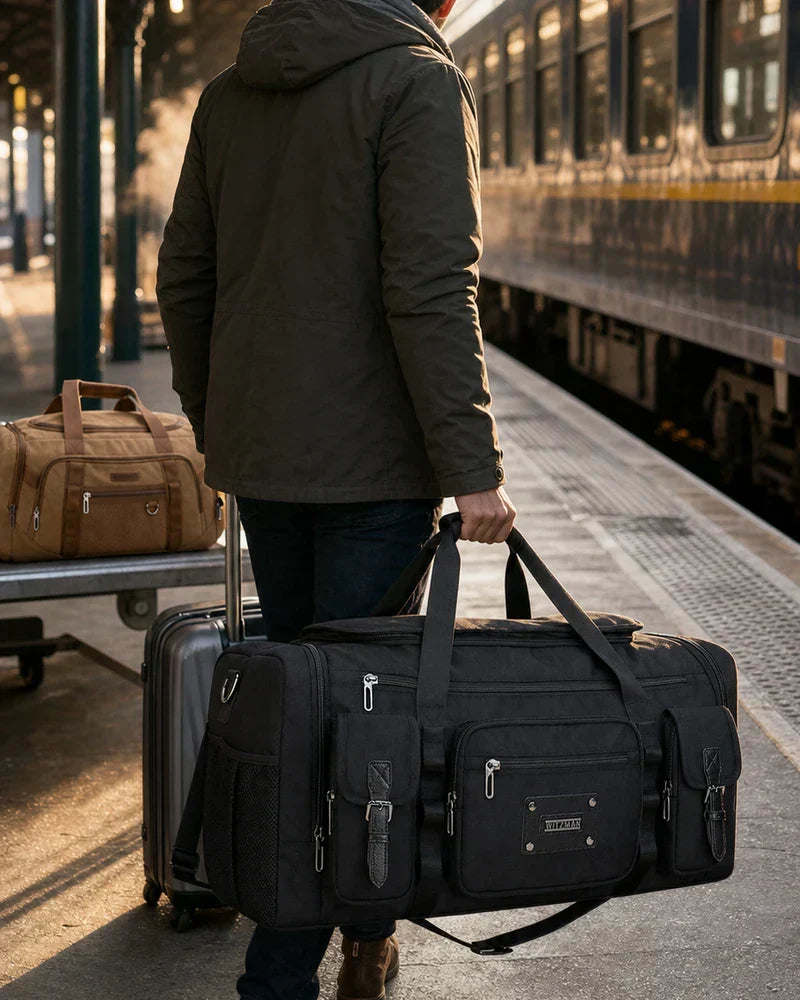
A large duffel bag can be a practical choice for an extended trip, especially when the route involves road travel, rail connections, hotels, or gear that does not fit neatly into a rigid suitcase. But capacity alone does not make a duffel useful. Once a bag is fully packed, handle strength, shoulder comfort, opening design, internal structure, dimensions, and weight distribution become just as important as the number of liters.
Quick Answer
For most extended trips, look for a large duffel with realistic capacity for your packing list, reinforced carry points, a comfortable removable shoulder strap, a wide opening, useful exterior access, and enough structure to keep the load manageable. A 40L bag can suit disciplined three-to-five-day travel, while a 50L-plus duffel gives more room for five-to-seven-day trips, bulky layers, or activity gear. Always compare the packed dimensions and weight with your transport provider's rules; a product name that includes “carry-on” does not guarantee acceptance by every airline.
Key Takeaways
- Choose capacity from a test packing list, not from trip length alone.
- A larger bag becomes uncomfortable quickly if the handles, strap, or load balance are weak.
- Wide openings improve visibility, while separate pockets protect frequently used or dirty items.
- Soft-sided duffels are flexible, but they still need sensible structure and disciplined packing.
- Check external dimensions and packed weight for every flight or transport segment.
What Counts as a Large Travel Duffel?
There is no universal definition of “large,” but travel duffels around 40L often sit at the upper end of short-trip use, while bags in the 50L-to-65L range can support longer travel or bulkier equipment. The correct capacity depends on climate, clothing size, laundry access, footwear, work equipment, and the type of transport.
A warm-weather hotel trip may require less space than four days of cold-weather road travel. A traveler carrying hiking shoes, a jacket, and camera equipment may fill a 54L bag faster than someone packing a compact capsule wardrobe for a week. Capacity should therefore be treated as a planning range, not a promise.
Modern travelers should also distinguish between volume and portability. A bag may hold everything on the floor of a bedroom, yet become difficult to lift into a trunk, carry through a station, or manage on stairs. The best large duffel is not the biggest one available. It is the largest bag you can pack, lift, and move without creating unnecessary strain.
Seven Features That Matter on Extended Trips
1. Capacity That Matches the Actual Load
Start by laying out the items required for the trip, then remove duplicates before selecting capacity. Pack clothing by outfit function, not by individual day. A coordinated wardrobe, one primary pair of travel shoes, and a realistic laundry plan can reduce the space required more effectively than moving to a larger bag.
If your load fits a 40L duffel without heavy compression, the smaller profile will usually be easier to carry. Consider a 50L-plus model when the itinerary genuinely requires extra layers, equipment, gifts, or a longer stretch without laundry. Leave a small amount of unused space so the return pack does not become a struggle.
2. Carry Comfort Under Full Weight
Carry comfort is easy to overlook when viewing an empty product photo. On an extended trip, a large duffel may hold enough clothing and equipment to become heavy. Look closely at the handle wrap, webbing attachment points, shoulder strap width, padding, adjustment range, and metal or reinforced hardware.
A removable shoulder strap offers useful flexibility, but a single-shoulder carry can become tiring over long distances. If the route includes long station walks or frequent public transport, a convertible duffel-backpack configuration may be worth considering. Whatever the carry style, test the complete load for at least ten to fifteen minutes before departure.
3. A Wide, Usable Main Opening
A long bag with a narrow zipper opening can hide items at both ends. A wide top opening makes it easier to see packing cubes, folded clothing, and equipment without emptying the entire bag. The zipper should travel smoothly around the opening and provide enough clearance for the largest item you intend to pack.
Opening shape matters particularly when the duffel will serve as your main storage during the trip. If you change hotels frequently, organize the bag so one cube can be removed at a time. If you stay in one location, a broad opening makes complete unpacking faster.
4. Organization Without Pocket Overload
Exterior pockets are valuable for transit items such as cables, a small notebook, gloves, or a compact wash pouch. End compartments can help isolate footwear or equipment. However, more pockets are not automatically better. When several compartments look alike, important items become harder to track.
Use fixed zones: one exterior pocket for transit essentials, one protected pouch for electronics, one main clothing area, and one separation area for shoes or worn garments. Consistency is more useful than distributing small items across every available zipper.

5. Material and Construction
Nylon and canvas offer different travel characteristics. Nylon is commonly chosen for practical travel equipment because it can provide a relatively light, flexible shell. Canvas offers a substantial hand feel and a classic appearance, but its weight and care requirements vary by construction. Neither material name alone proves durability or weather performance.
Inspect the areas that receive the most stress: handle stitching, shoulder-strap anchors, zipper ends, base seams, and the corners where the bag contacts the floor. Reinforcement in these locations matters more than decorative details. If water resistance is important, verify the manufacturer's stated material and construction information rather than assuming all nylon or canvas bags perform the same way.
6. Base Shape and Load Stability
A large soft bag can sag when the contents are uneven. This makes the duffel harder to carry and can place pressure on fragile items. A defined base, structured end panels, or carefully placed packing cubes help the bag retain a manageable shape.
Place dense items low and near the center. Avoid loading all shoes and toiletries at one end. Fill small gaps with soft clothing, but do not force the zipper closed. A balanced duffel should lift without twisting dramatically toward one side.
7. Dimensions, Weight, and Transport Compatibility
Liter capacity does not determine whether a bag meets airline limits. Two 50L bags can have very different external dimensions, and a flexible duffel can expand beyond its listed shape when overpacked. Before flying, compare the packed bag's length, width, height, and weight with the rules for each carrier and fare type on the itinerary.
For rail or road travel, consider storage spaces, stairs, and vehicle access. A long duffel may fit easily across a car trunk but feel awkward in a narrow train aisle. Transport compatibility is a route-specific decision, not a universal feature label.
Large Duffel Feature Comparison
| Feature | Why It Matters | What to Check |
|---|---|---|
| 40L capacity | Keeps a short extended-trip load compact | Whether your real 3-5 day list fits without overstuffing |
| 50L+ capacity | Accommodates longer trips or bulky layers | Whether the packed weight remains comfortable |
| Wide opening | Improves visibility and hotel access | Zipper clearance and ability to reach both ends |
| Exterior pockets | Separates transit essentials | Useful pocket placement rather than pocket count |
| Shoulder strap | Adds hands-free flexibility | Width, padding, anchors, adjustment, and hardware |
| Structured base | Reduces sagging and load shift | Shape when the bag is fully packed |
| Soft-sided body | Adapts to trunks and storage spaces | Risk of overpacking beyond transport limits |
Two Witzman Duffel Options to Compare
The two products below serve different packing ranges. The B717 emphasizes greater volume for a five-to-seven-day load, while the A8006-3 offers a more compact canvas option for three-to-five-day travel. Prices and product details can change, so use the live product pages as the final source for current specifications and availability.

Witzman B717 Large Travel Duffel Bag
54L | Nylon | Suggested for 5-7 days
Best considered when extra clothing, layers, or equipment justify a larger main load.
From USD 95.86

Witzman A8006-3 Classic 3-in-1 Canvas Duffel
40L | Canvas | Suggested for 3-5 days
A more compact option for road trips, hotel stays, and travelers using a disciplined wardrobe.
From USD 93.86
Explore the broader Witzman duffel bag collection if your trip calls for a different material, capacity, or compartment layout.
How to Choose Between 40L and 54L
Choose 40L when you can repeat outfits, pack one main pair of shoes, use laundry during the trip, or want a bag that remains easier to handle. It is also a sensible choice when the duffel supplements another small personal item rather than carrying every piece of equipment.
Choose 54L when the trip includes cold-weather layers, larger footwear, sports equipment, a longer gap between laundry opportunities, or room for shared items. Before committing, complete a test pack and carry it. If the additional capacity encourages you to add low-value items, the larger bag may create more work than convenience.
A Practical Packing System for a Large Duffel
- Build the clothing plan first. Select coordinated layers and remove duplicate functions.
- Use two or three packing zones. Keep everyday clothing together, occasional items separate, and transit essentials accessible.
- Place weight near the center. Toiletries, dense equipment, and shoes should not pull the bag heavily to one end.
- Protect liquids. Use a sealed pouch and avoid placing it directly against electronics or clean clothing.
- Isolate shoes and worn items. A dedicated compartment or washable bag keeps the main area cleaner.
- Leave expansion room. Aim for a closed bag that is full but not stretched tight.
Common Buying Mistakes
- Buying the largest capacity available: unused space often becomes unnecessary weight.
- Ignoring empty and packed weight: soft luggage can become surprisingly heavy once full.
- Assuming “carry-on” is universal: airline dimensions and fare rules vary.
- Counting pockets instead of planning access: organization should reduce searching, not create it.
- Testing only the shoulder strap: also lift the bag by its handles and move through a doorway or stairwell.
- Choosing material by appearance alone: consider route, care, weather exposure, and construction details.
Frequently Asked Questions
What size duffel bag is suitable for a week-long trip?
A disciplined warm-weather packing list may fit in roughly 40L, while 50L or more can help with layers, larger clothing, activity equipment, or limited laundry access. Build the actual list and test pack before selecting a capacity.
Is a 54L duffel considered carry-on luggage?
Capacity alone cannot answer this. Airlines assess external dimensions and weight, and a soft bag can expand when overfilled. Measure the packed bag and compare it with the current rules for every carrier and ticket on your route.
Is a duffel bag better than a suitcase for an extended trip?
A duffel can be easier to fit in a car trunk, lodge, or flexible storage space, while a wheeled suitcase may be easier across long smooth terminals. Choose according to the route, carrying distance, storage conditions, and items being transported.
How do I keep a large duffel organized?
Use a small number of clear zones: clothing cubes, an accessible transit pocket, a protected electronics pouch, and a separate area for footwear or laundry. Avoid filling every pocket simply because it exists.
Are canvas or nylon duffel bags better for travel?
Neither material is universally better. Compare the specific bag's construction, weight, care requirements, reinforcement, and verified performance claims. The route and packing load should decide the material, not appearance alone.
How can I make a heavy duffel easier to carry?
Remove low-priority items, center dense objects, shorten and adjust the shoulder strap, and use the handle wrap when lifting. For routes with long walking distances, consider a convertible carry system or a wheeled format instead of relying on one shoulder.
In Summary
A large men's duffel should provide useful capacity without becoming an uncontrolled load. Match liters to a real packing list, then evaluate carry comfort, access, organization, material, base stability, dimensions, and the hardest transfer in the itinerary. A 40L duffel rewards compact packing; a 54L option provides more room for longer or equipment-heavy travel. The right choice is the one you can still move confidently after it is full.
Conclusion
For an extended trip, buy for the packed journey rather than the empty bag. When capacity, carrying method, organization, and route all agree, a large duffel becomes a flexible travel tool instead of a heavy container that is difficult to manage.

Share:
Adventure vs. Relaxation: Finding Your Travel Style and Bag
Sling Bag vs. Crossbody Bag: Which Is Best for Your Daily Commute?