

Tomorrow's meeting starts before hotel check-in is likely to be useful. Tonight, the same bag has to carry a laptop, the right documents and enough personal kit for one night. An overnight business trip packing list works best when it protects that morning's work first: choose the meeting outfit, separate the overnight items, and leave the laptop accessible without opening the clothes.
An expandable briefcase can be a sensible option for this narrow job. The important question is not whether you can close the zip. It is whether you can retrieve the work load in a meeting room, remove the personal load at the hotel, and carry everything again after checkout.
This is a planning guide based on the listed designs of WITZMAN B771 and B773, not a hands-on packing test. The load below is a starting proposal to check with your own clothes, device and meeting requirements.
Before Departure: Choose Tomorrow Outfit First
Start with what the meeting requires rather than what usually lives in your work bag. A client visit in a jacket and polished shoes is a different packing problem from an internal workshop in a knit shirt. If one outfit can cover the journey, dinner and the following day's meeting, the bag does not need to carry a second complete wardrobe.
For a business-casual trip, consider wearing the trousers, shoes and outer layer you intend to use again. Pack a fresh shirt or top, underwear and socks, plus lightweight sleepwear if you need it. Rewearing travel clothing is a personal choice, not a requirement: a hot journey, physical site visit or formal dress code may make a complete change necessary.
Give a spare pair of shoes an explicit reason to come. A required safety shoe or a separate formal pair may be non-negotiable. An optional second pair is different: it competes directly with flat space for clothes and documents. Decide that tradeoff before buying a smaller wash bag or squeezing the shirt more tightly.
Finally, confirm the meeting address, check-in arrangements, return booking and whether the hotel can hold luggage after checkout. The answer determines whether your morning briefcase is genuinely work-only or still carrying last night's belongings.
What to Pack for a One Night Business Trip
Use three labels: worn, packed and conditional. This stops the familiar mistake of packing an outfit that is already on your body, then adding another one just in case. The quantities here are editorial starting points, not a claim that a particular size or fabric fits either briefcase.
| Load | Starting list | Decision before it goes in |
|---|---|---|
| Worn, not packed | Meeting-compatible trousers, shoes, belt and jacket or outer layer | Can these reasonably be worn again tomorrow? |
| Work core | Laptop; required charger and cable; essential adapter; phone | Which devices and connections does the meeting actually need? |
| Meeting materials | Slim folder, necessary printouts, notebook and pen | Bring the required copies, not the entire office file. |
| Fresh clothes | One shirt or top, one set of underwear, one pair of socks | Add trousers only if the dress code or journey calls for a change. |
| Night and morning | Light sleepwear if needed; compact wash kit; personal medication | Confirm hotel amenities, but keep your own essential items. |
| Small necessities | ID, wallet, keys, glasses if needed; empty laundry pouch | Give return-trip laundry a place before it exists. |
| Conditional additions | Tablet, power bank, umbrella, second shoes, samples or spare outfit | Name the event that makes each one necessary. |
Keep a required laptop adapter even if you cut an optional tablet. Removing the accessory that connects your presentation is a poor exchange for a slightly tidier bag. Likewise, an essential medication should not become the item you leave behind to preserve a one-bag plan.
For toiletries, choose the kit by what you actually use tonight and tomorrow morning, not by the number of empty pockets available. Toothbrush, toothpaste, deodorant and your essential grooming items may be enough; your routine decides. Our toiletry bag size and layout guide helps distinguish useful organization from a container that takes up space on its own.
Two Main Compartments Need Two Different Jobs
A dual-compartment design is useful only if opening one side does not force you to disturb the other. On a laptop bag for overnight travel, make the division about when you need things, not an equal split of volume.
The Work Opening: Flat Items and Predictable Retrieval
Use the designated laptop storage for the computer. Keep the document folder in a suitable flat area, without bending it around a charger or pushing it against a hard plug. Put the charger and adapters in an accessible organizer or small pouch, rather than loose against the screen or buried under clothing.
Then rehearse the meeting: place the bag beside a chair, open the work compartment and take out the laptop, folder and charger. If the shirt has to come out first, change the arrangement. If the folder catches on cables, relocate the cable pouch. This is a useful access check even when the total load already seems comfortably small.
The Hotel Opening: One Removable Overnight Module
Keep the fresh clothes together in a soft pouch or a simple folded bundle that can be lifted out. Put toiletries in their own closed bag, separate from papers and electronics. A compartment divider is not a leakproof barrier. Do not treat ordinary lining as a substitute for securely closed containers.
The opposite rehearsal happens at the hotel: remove the clothes and wash kit without unloading the work compartment. A small laundry pouch should stay with this personal module so used socks or a worn shirt have somewhere to go on the return journey. Damp items need suitable separate containment, not loose storage beside the laptop.
These are proposed zones, not names printed on the bag. The B771 and B773 both list two main compartments; the exact pocket you use depends on the shape of your charger, folder and clothing bundle.

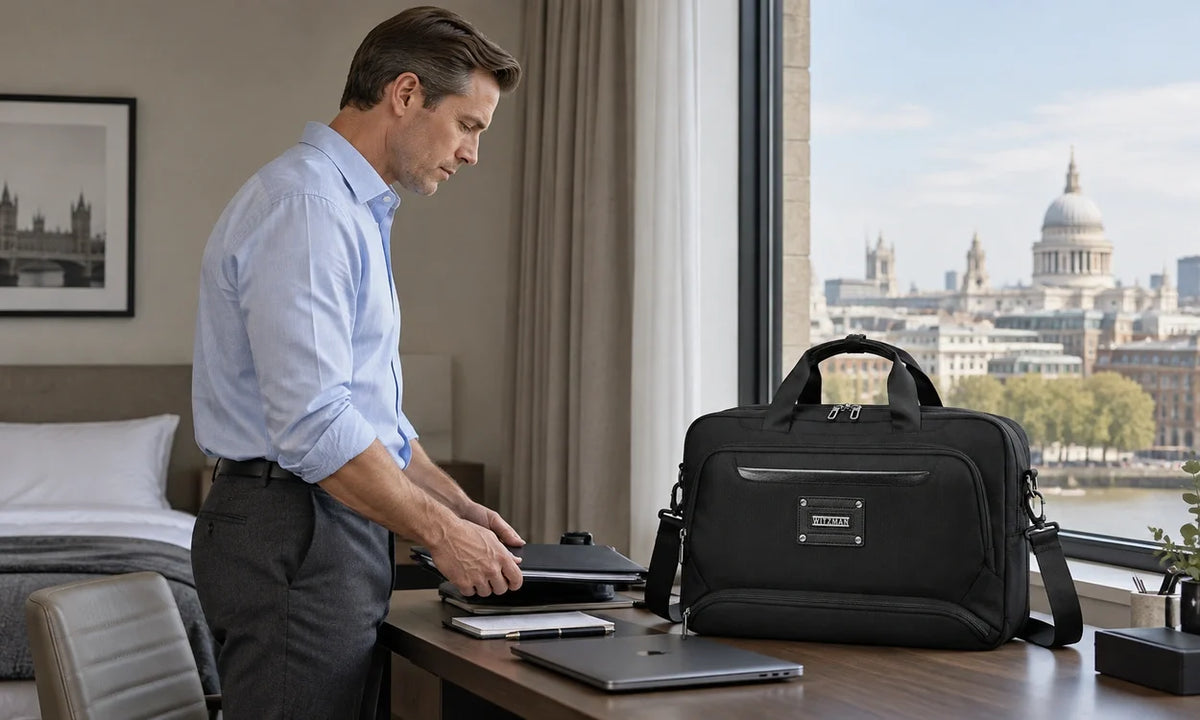
Illustrative hotel reset: remove the overnight module before arranging the meeting load. AI-generated scene; not a photograph of a packing trial.
When to Expand: Change the Depth, Not the Whole Packing List
Try the planned load with the expansion panel closed first. This does not mean forcing the zip: the point is to discover whether extra depth solves a real obstruction. Keep the same items in place when you open the expansion panel so you can judge the difference fairly.
The B771's listed depth changes from approximately 7 to 9 inches. That is a depth adjustment, not evidence of a larger laptop sleeve or a promise that another pair of shoes will fit. Use the extra space when it allows the clothing bundle and work load to sit without obvious pressure, while keeping the bag manageable to carry.

Manufacturer's expansion illustration for B771, not an independently measured before-and-after packing result. Labels show exterior depth, not usable clothing space.
Check closure, retrieval and carrying separately. The zipper should close without forcing the panels together; the laptop and folder should still come out independently; the loaded bag should feel manageable on your actual walking route. Passing one check does not establish the other two.
If it closes but the laptop sleeve is visibly pressed by the clothing load, rearrange or remove items. If everything comes out easily but the load is unpleasant to carry, expansion is not the solution. More available space does not make an additional charger, book or pair of shoes weigh less.
For flights, assess the packed exterior in the configuration you intend to carry. Neither briefcase is automatically an accepted personal item on every fare. The home-check method in our airline sizer guide applies to checking a loaded soft bag too; consult your carrier's current limits separately.
B771 or B773: Choose the Workday Profile You Need
Both models are listed with two main compartments and laptop storage up to 15.6 inches. Selection here is based on those published designs, exterior dimensions and empty weights, not an observed overnight fit. Check your device's actual width, depth and thickness; screen diagonal alone does not establish compatibility.
B771: The More Compact Starting Point

The B771 expandable laptop briefcase lists a 17.5 × 7 × 11.7-inch exterior and an empty weight of 1.35 kg. Its zip-front layout is the starting option to examine when your work kit is compact and the overnight module is limited to a change of essentials.
The limitation is the same one this packing plan addresses: an additional full outfit, bulky toiletries or spare shoes can compete with easy work access. Treat expansion as flexibility, not a reason to add all three.
B773: A Larger Exterior, With More Empty Weight

The B773 expandable briefcase lists 17.5 × 7.5 × 12.8 inches, increasing to 9.5 inches deep when expanded, with an empty weight of 1.65 kg. Its double-buckle front flap is a visible difference from B771. Consider its larger listed exterior when comparing an overnight business travel bag for a bulkier work load, but verify your actual items rather than assuming a fit.
It starts 0.30 kg heavier than B771, calculated from the listed empty weights. That difference belongs in the same decision as the extra exterior space, particularly if the day includes substantial walking.
For either expandable laptop briefcase for men, check the practical handling before departure: load your own equipment, lift it, adjust the shoulder strap and walk with it. A wider bag is not automatically a more useful bag. If flying under a strict allowance, include the empty bag in the complete carry-on weight budget, not just the contents.
At the Hotel: Prepare the Bag for Its Next Opening
On arrival, take out the personal module before spreading work equipment across the desk. Hang or lay out the meeting clothes according to their care needs, place the wash kit where you will use it, and give worn items their own pouch. You can then inspect the work load without repeatedly moving tomorrow's shirt.
Do the meeting setup tonight: charge the devices you need, check the required adapter, save an accessible copy of essential documents and locate the ID or booking details for the next journey. Pack the charger after use rather than leaving it as an unrecorded loose item on the desk.
If You Can Return to the Room
Leave the personal module in the room only when your booking and access arrangements allow it. Return the work essentials to their chosen pockets, remove unused overnight items from the briefcase and close the expansion panel only if the remaining load closes freely. The bag now has a different job: getting through the meeting without unnecessary belongings.
If You Check Out Before the Meeting
Do not plan around leaving anything upstairs. Either arrange permitted luggage storage in advance or pack the full return load before leaving. Used clothes go back into the personal compartment in their separate pouch; the meeting opening stays available. Remember that returning laundry still occupies space even though it no longer counts as a fresh outfit.
Make the last check against locations rather than categories: wall socket, bathroom shelf, wardrobe, safe if used, then desk and bedside table. This catches the adapter or wash item that is no longer sitting beside the bag.
When One Briefcase Is the Wrong Constraint
A one-night trip does not automatically mean a one-briefcase trip. Use additional luggage when the contents need more protection, separation or carrying support than this layout can reasonably provide.
- A suit must arrive separately from your travel outfit. Do not assume a packed jacket will remain meeting-ready under the rest of the load.
- You need another substantial pair of shoes. Formal footwear, safety shoes or sports shoes may justify a different bag arrangement.
- The work load is physically bulky. Multiple devices, sample equipment or bound presentation materials can consume the space reserved for personal items.
- The journey includes long walks or several transfers. Evaluate loaded carrying comfort, not just whether a shoulder strap is available.
- Everything must accompany you after checkout. A full day of meetings with no storage may change the value of a compact, work-only profile.
The useful boundary is straightforward: if retrieving a work item means unpacking clothes, or keeping clothes presentable means forcing the bag closed, change the luggage plan. One extra piece can be more practical than asking a briefcase to perform a job it does not suit.
For this kind of trip, aim to leave home with the next morning already arranged: the outfit chosen, the work opening clear, the overnight load removable and the return laundry accounted for. Expansion is then an option you can use deliberately, rather than the last step in rescuing an overfilled bag.
Compare the B771 and B773 above against the broader WITZMAN messenger bag collection if your everyday work load needs a different profile. Choose around that daily load first; the occasional overnight should be an extension of it, not a permanent reason to carry more.

Share:
Chasing the Northern Lights: What Actually Mattered on a Winter Trip to Tromsø