

Put a 40L travel backpack beside a 45L duffel and the five-liter difference looks decisive on paper. Pack both with the same cube, shoes, and electronics, however, and geometry takes over: the horizontal duffel accepts wide pieces differently, while the upright backpack distributes depth across structured zones. This is the central problem with travel backpack size: liters describe volume, but they do not describe the shape of that volume, how much structure occupies it, or whether your particular objects can use it.
The liter label is not useless. It is simply one line in a larger capacity audit. To judge a backpack professionally, read four things together: the stated capacity, exterior dimensions, internal geometry, and the way the bag opens.
Start With the Contradiction, Not the Number
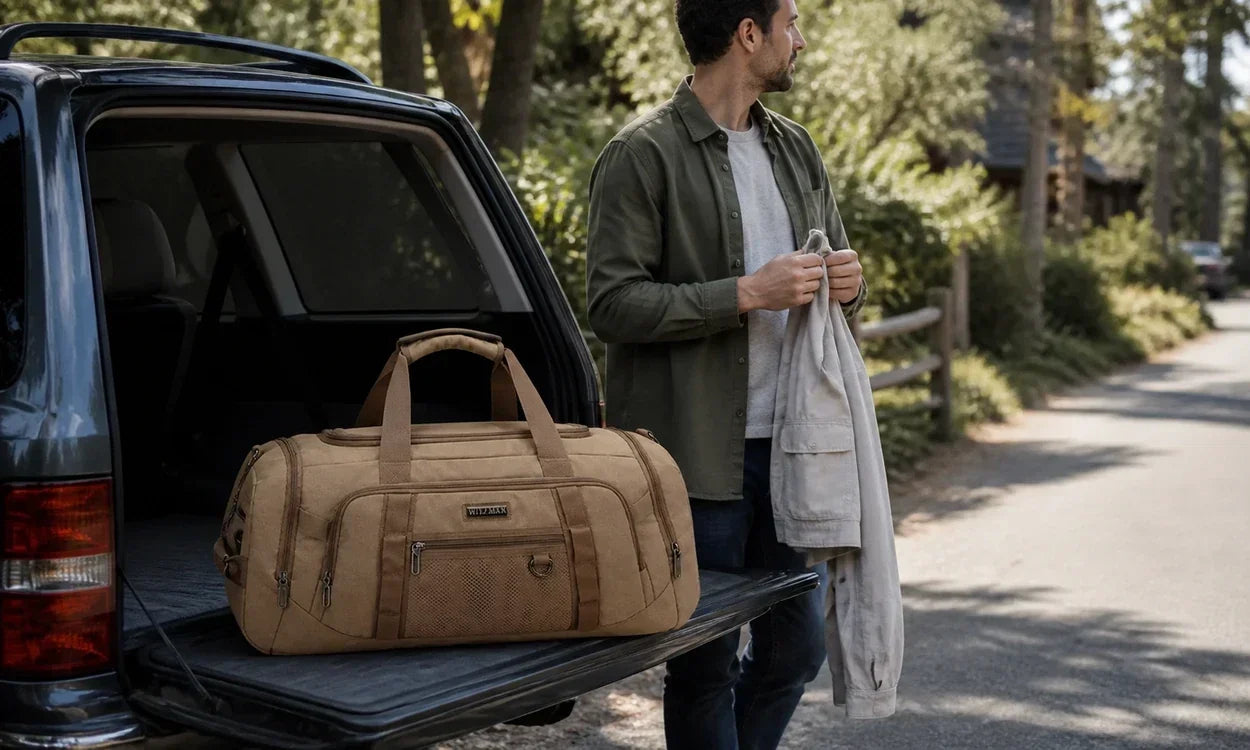
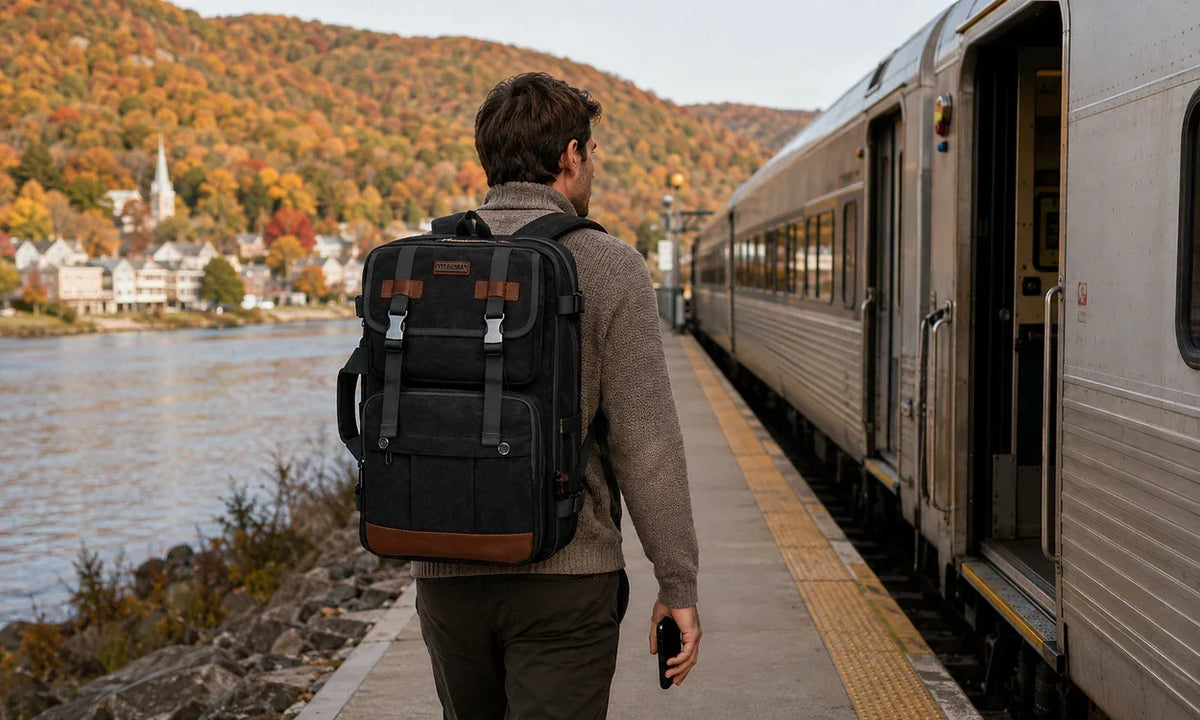
Consider two current WITZMAN travel bags in a nearby capacity class. The A8023 is a 40L zipper backpack measuring 20.5 inches high, 12.5 inches wide, and 8.5 inches deep. The A8006-3 is a 45L horizontal duffel measuring 22.5 inches long, 11 inches high, and 11 inches deep.
Five liters alone cannot predict the packing result. A wide folded shirt, laptop sleeve, or rectangular packing cube interacts differently with each opening and body shape. The A8023 stacks its capacity vertically across a structured front and main body. The A8006-3 spreads its capacity along a broad duffel opening. Neither layout is automatically more useful; each favors a different load.
| Capacity audit | A8023 backpack | A8006-3 duffel | Why it matters |
|---|---|---|---|
| Listed capacity | 40L | 45L | The modest label difference hides a major shape change. |
| Exterior dimensions | 20.5 x 12.5 x 8.5 in | 22.5 x 11 x 11 in | One builds upward; the other distributes volume horizontally. |
| Opening and structure | Structured zipper backpack with stacked front zones | Broad duffel opening with a separate shoe compartment | Access and compartment walls decide which objects use the deepest space. |
A Capacity Label Has Four Different Ledgers
When shoppers say a backpack feels smaller than advertised, they may be comparing different kinds of capacity without realizing it. Separating them prevents most confusion.
- Nominal capacity is the liter figure on the product page or label. It is useful for sorting a category, but it is not a universal packing outcome.
- Measured enclosed capacity is the volume captured by a test method. The method decides whether expansion zones and enclosed pockets count.
- Usable packing capacity is the portion your objects can occupy after curves, padding, dividers, seams, and hardware take their share.
- Mission-fit capacity is what remains useful for one particular trip. A camera cube, size-12 shoes, a laptop, and soft clothing each reward different geometry.
This is why a liter-to-days chart should be treated cautiously. Clothing compresses; shoes and electronics do not. Our earlier 30L vs 40L packing comparison helps estimate trip length, while this guide explains why two bags within the same liter class still behave differently.
How Backpack Liters Are Actually Measured
There is a formal method for comparing capacity, but not every retail specification tells you which method was used. The ASTM F2153 backpack-capacity method defines unextended and extended capacity for backpacks and related soft bags. Its scope excludes areas that are not fully enclosed by fabric, including open mesh pockets and bottle holders.
Osprey publicly describes an industry-style process in which the pack and its components are filled with 20 mm plastic balls, then the balls are transferred to a measuring cylinder. The brand explains that this is more suitable than multiplying height, width, and depth because packs have rounded corners and cylindrical forms. Its illustrated volume-measurement process is a useful picture of what a liter test is trying to capture.
The important detail is not the plastic balls themselves. It is the counting boundary. Does the figure include a fully enclosed front pocket? An expansion panel? A detachable section? Open bottle storage? Unless a brand states the method and the included zones, compare liters as approximate category markers rather than laboratory-identical values.
The Geometry Tax
Every pack loses some theoretical box volume to geometry. The amount and location of that loss matter more than the percentage.
Curved shoulders remove rectangular space
A rounded top is comfortable around the shoulders and visually compact, but the missing corners cannot accept a rigid packing cube or laptop. Socks can fill them; a toiletry case cannot. Two packs with equal liters may therefore carry the same amount of loose fabric but different numbers of rectangular organizers.
Taper changes where the depth lives
A bag can measure seven inches deep at its base and narrow toward the top. The exterior specification is still accurate at the stated point, yet the upper half will not behave like a seven-inch-deep box. Check side-view product images, not just the front.
Back panels and laptop padding occupy the flattest zone
Foam, framesheets, and suspended laptop sleeves improve protection and carry comfort. They also occupy the broad, flat area that is easiest to pack. That is not wasted design, but it belongs in the capacity budget. If a laptop is central to the trip, protected volume is useful volume; if no device is carried, it may feel like a penalty.
The opening can be smaller than the cavity
A tall top-loader may have adequate internal volume yet resist a wide packing cube at the mouth. A clamshell opening exposes more of the cavity and usually accepts rigid rectangles more easily. Access does not create liters, but it determines whether you can use them without unpacking everything.
Compartments Spend Space to Buy Control
Dividers are often described as either a benefit or wasted space. Both descriptions are incomplete. A shoe wall, padded laptop sleeve, organizer panel, and zipper seam consume material and prevent the interior from acting like one continuous sack. In exchange, they isolate dirty items, limit migration, and reduce retrieval time.

A 40L label cannot show whether a rectangular packing cube aligns with the opening, front structure, and usable depth.
The contrast between the A8023 and A8006-3 makes this trade visible. The backpack distributes material across its back panel and stacked access zones; the duffel uses part of its horizontal body for a separate shoe compartment. Loading bulky shoes can still change the shape available to the main compartment. The same principle appears in our deeper guide to whether a backpack shoe compartment is useful or wasted space.
Organization should therefore be judged by friction removed per liter spent. A divider that protects a work laptop every day is productive. Twelve tiny pockets that never match your objects are not.
Run a Same-Load Audit
Do not test bags with a random heap. Use one repeatable load that exposes shape, rigidity, and access. A practical audit for a short trip includes:
- one medium rectangular clothing cube;
- one folded overshirt or light jacket;
- one pair of casual shoes;
- one compact toiletry kit;
- one laptop or rigid document folder;
- one bottle reserved for exterior access.
Load the rigid objects first. If the cube catches at the opening, record that as an access constraint rather than forcing it. Add shoes and observe whether their compartment pushes into the clothing zone. Fill the remaining curves with the soft garment. Finally, retrieve the laptop and toiletry kit without removing the cube.
| Audit stage | What to observe | What liters cannot tell you |
|---|---|---|
| Insertion | Does the widest rigid item clear the opening? | Mouth width and zipper path |
| Settlement | Do shoes or padding raise the floor? | Shared compartment boundaries |
| Void filling | Can soft garments use curves around rigid items? | Shape compatibility |
| Retrieval | Can priority items leave without unpacking? | Operational access |
This test also prevents overpacking. If the zipper closes only after the soft walls are rounded outward, measure the loaded bag again. The same bulge that steals comfort can cause a failure during an airline baggage sizer test.
What Do 25L and 30L Look Like?
There are no single standard backpack dimensions for each liter class. As pure box math, an 18 x 12 x 7-inch rectangle is about 24.8L, while a 20 x 11 x 7-inch rectangle is about 25.2L. Both could be described as a 25 liter backpack size, yet one is wider and shorter and the other is taller and narrower. A real backpack will curve inside those boxes.
For readers asking how big is a 30 liter backpack, 30L equals roughly 1,831 cubic inches. A theoretical box around 18.5 x 13 x 7.6 inches is close to that volume, as is a taller box around 21 x 12 x 7.25 inches. These are geometry examples, not recommended product dimensions. Harness shape, pockets, padding, and measurement boundaries can move the real specification.
The practical reading order is:
- Use liters to choose the broad capacity class.
- Use height, width, and depth to understand the silhouette.
- Use side and open views to find taper, curves, and occupied zones.
- Use your widest rigid object to test the opening.
- Use the loaded dimensions for airline planning.
Two 2026 Capacity Interpretations From WITZMAN
For modern travelers, these are not ranked as a universal first and second place. They show how nearby capacity labels can produce very different usable shapes.

A8023 40L Convertible Travel Backpack
20.5 x 12.5 x 8.5 in | $115.86
A structured 40L recycled-canvas zipper backpack for travelers who want an upright carry shape and segmented access without a flap-style top. Check your widest cube against the opening and front-panel depth.

A8006-3 45L Canvas Duffel
22.5 x 11 x 11 in | $89.68
A horizontal 45L canvas duffel with a broad main compartment, independent shoe compartment, and convertible 3-in-1 carry options. It favors wide packing pieces and footwear separation over an upright backpack footprint.
Compare additional silhouettes in the WITZMAN travel backpack collection.
Key Takeaways From the Audit: Six Questions
- What is included in the stated liters? Look for expansion, detachable parts, and enclosed exterior pockets.
- Where are the maximum dimensions measured? Inspect side images for taper rather than treating one depth as uniform.
- What is the widest opening? Compare it with your laptop, packing cube, camera insert, or shoes.
- Which compartments borrow from each other? Fill the shoe zone and watch what happens to the main floor.
- Which volume is protected? Decide whether laptop padding and organization solve your trip or merely occupy space.
- What are the loaded dimensions? Soft bags change shape. Test the actual packed profile before relying on a carry-on label.
Frequently Asked Questions the Liter Label Leaves Open
Does a 30L backpack always hold more than a 25L backpack?
It should have a larger stated capacity, but it may not fit every load better. A well-matched 25L rectangle can carry a rigid cube more efficiently than a tapered 30L pack with a narrow opening. Compare the exact objects, not just total volume.
Can I calculate backpack liters from dimensions?
You can multiply height, width, and depth and convert cubic inches to liters using 0.016387. The result is only the outer bounding box. Curves, taper, padding, seams, and the fact that dimensions may be measured at maximum points make it an estimate, not the usable interior capacity.
Do exterior pockets count toward backpack capacity?
It depends on the measurement method. Fully enclosed pockets may be included; open bottle pockets may not be. ASTM F2153 specifically excludes areas that are not completely enclosed by fabric. Check the manufacturer's stated method when precise comparison matters.
Is a taller backpack better for travel?
A taller shape can stack clothing vertically and use a narrow footprint, but it may be less convenient for wide cubes and may exceed a particular airline's height limit when full. A shorter rectangular shape can be easier to organize. Neither is universally superior.
Should I choose backpack size by trip length?
Trip length is a starting point, not the final rule. Laundry plans, climate layers, shoe size, electronics, and toiletries change the load. Start with a realistic packing list, then use the approach in our guide to packing seven days without overpacking.
In Summary: Read Liters Last
Use the liter figure to enter the right aisle, then stop asking it to do every other job. Exterior dimensions reveal the silhouette. Open and side views reveal curves and taper. Compartment walls show where volume is protected or divided. A same-load audit proves whether the opening and geometry work with your belongings.
The most honest backpack-size decision is not "How many liters do I need?" It is "Which shape gives my real load the fewest unusable spaces and the least retrieval friction?" Once that answer is clear, the liter label becomes useful again.


Share:
Dopp Kit vs Toiletry Bag: Size, Layout, and Trip-Length Guide
Left- vs Right-Shoulder Sling Carry: Access, Security, and Comfort