

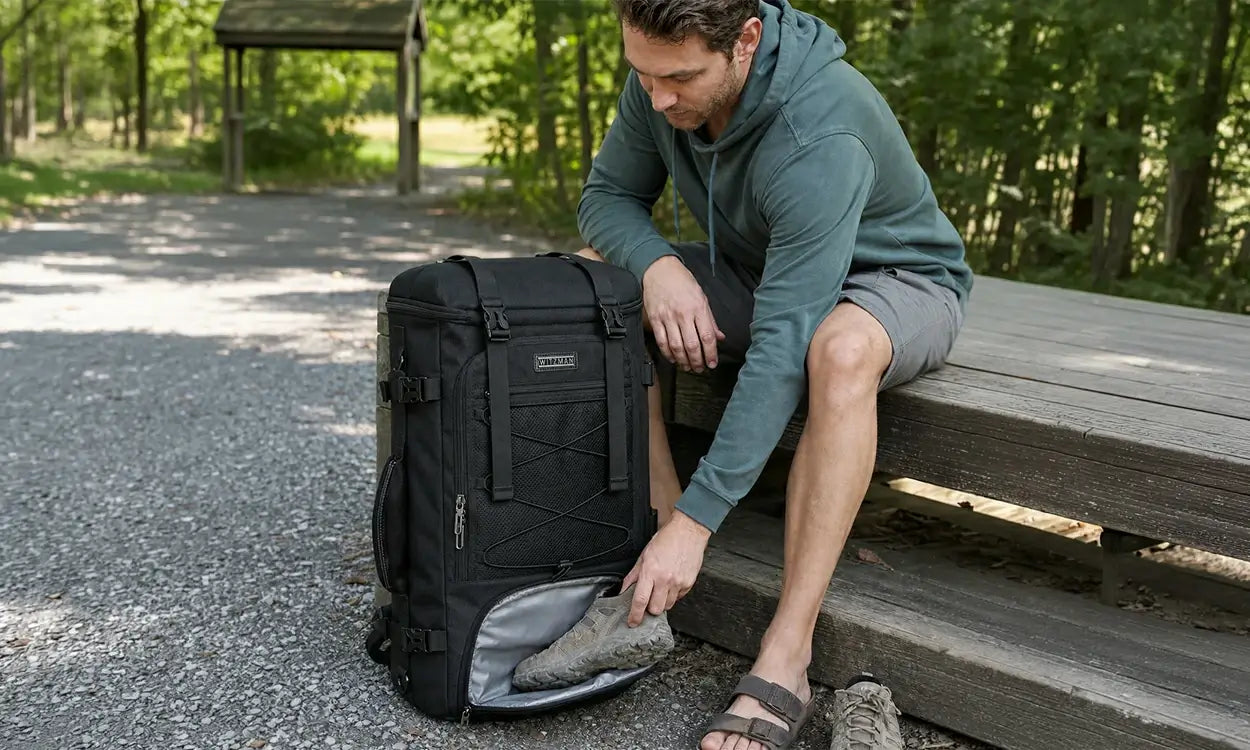
Quick Answer: The best backpack with shoe compartment is worthwhile when you regularly carry gym shoes, trail footwear, or a second pair that must stay away from clean clothing. It is wasted space when you usually wear your only shoes, pack bulky boots, or need every liter for clothing and tech. A soft, collapsible shoe liner costs little space when empty, but once filled, it expands into the same internal volume your main compartment uses.
That last point is the whole decision. A shoe compartment is not extra capacity bolted onto a backpack. In most soft-sided travel bags, it is a separate fabric sleeve with its own zipper and lining. Empty, it can fold out of the way. Filled, it pushes into the main compartment. The feature buys separation and fast access by trading away flexible packing space.
Two Travelers, Two Opposite Answers
Separation-first traveler
He leaves work for the gym, changes shoes at a trailhead, or packs trainers for nearly every weekend trip. Footwear enters and leaves the bag several times, sometimes dusty or damp.
Likely answer: useful. A dedicated lower opening prevents repeated contact with clothing and avoids rebuilding the main compartment just to retrieve shoes.
Space-first traveler
She wears one versatile pair in transit, packs minimally, and uses the same backpack for a laptop, camera, or a tightly controlled carry-on wardrobe.
Likely answer: unnecessary. A simple shoe pouch gives occasional separation without reserving the bottom of the bag around footwear.
Neither traveler is more organized. They simply repeat different tasks. The separation-first user saves time every time shoes move in or out. The space-first user benefits from an uninterrupted main compartment that can change shape around clothing, cubes, and equipment.
The Same-Load Test: What Changes When Shoes Use Their Own Compartment?
To make the comparison fair, keep the load constant: one pair of low-cut men's size 10 trainers, four T-shirts, two pairs of trousers, four sets of underwear and socks, one light overshirt, a compact toiletry pouch, chargers, and a laptop. The traveler wears another pair in transit.
This is a packing model, not a laboratory claim that every shoe or backpack consumes the same number of liters. Shoe volume changes with size, sole thickness, heel structure, and whether the uppers compress. The purpose is to compare what happens to the same items when only the storage method changes.
| Packing result | Dedicated shoe compartment | Shoes in a separate pouch |
|---|---|---|
| Main-compartment shape | The filled shoe sleeve creates a fixed bulge from the bottom or side, so clothing must stack around it. | Shoes can rotate, split heel-to-toe, or move to the top when the rest of the load changes. |
| Clean/dirty separation | Dedicated lining keeps soles from directly touching garments. | Depends on the pouch; a thin drawstring bag may transfer moisture or odor. |
| Access | Shoes leave through their own zipper without disturbing folded clothing. | Fast if the pouch is packed at the top; disruptive if it sits under a packing cube. |
| Empty-space efficiency | Good with a soft collapsible liner; lower with a rigid or heavily padded shoe box. | Maximum flexibility because no zone is permanently assigned to footwear. |
| End-of-trip cleanup | One defined lining takes most of the dirt, but it must be wiped and aired. | The removable pouch can be washed separately; the bag stays cleaner if the pouch contains everything. |

How Much Capacity Does a Shoe Compartment Cost?
The right answer is “roughly the volume of the shoes, plus any structure around them,” not a universal liter number. A soft divider itself may be nearly flat when empty. A pair of trainers is not. Once the compartment is occupied, the soles, heels, and trapped air determine how far it intrudes into the main packing area.
Low-profile knit trainers are the easiest case. Their uppers compress, and the shoes can nest heel-to-toe. Court shoes, thick running midsoles, and hiking shoes resist compression. Boots may fit poorly even when the bag is marketed with a shoe pocket, because the opening and internal length matter as much as total backpack capacity.
This is why a 33L backpack with a shoe compartment may not pack clothing like an uninterrupted 33L box. Capacity labels describe the whole bag, while padding, laptop walls, pockets, and dividers all influence usable geometry. Our 30L versus 40L backpack comparison explains why two bags with similar stated liters can behave differently.
Does a Shoe Compartment Stop Odor?
It reduces direct contact; it does not eliminate odor. A separate lining contains soil, grass, and damp soles better than placing shoes beside shirts. Ventilation openings can help moisture escape, but airflow does not clean footwear or prevent bacteria from producing odor.
The most effective routine happens before the zipper closes:
- Let shoes dry whenever the itinerary allows.
- Remove loose dirt and empty gravel before packing.
- Take out insoles when they are especially damp.
- Use a washable shoe pouch inside the compartment when cleanup will be difficult.
- Open and air the compartment after arrival instead of leaving worn shoes sealed overnight.
- Wipe the lining according to the bag's care instructions before storing the backpack.
A lined compartment is therefore a hygiene boundary, not an odor-proof chamber. That distinction matters for the best gym backpack with shoe compartment: frequent gym use rewards easy cleaning and ventilation more than a long feature list.
What Happens to the Backpack's Center of Gravity?
Shoes at the bottom can make a backpack feel stable when they sit close to the wearer's back. But “low” is not automatically “balanced.” A lower front shoe pocket can place dense rubber soles farther away from the spine. The farther weight moves outward, the more it can pull backward on the shoulder straps.
Three details decide the result:
- Shoe weight: lightweight trainers behave differently from leather boots or thick court shoes.
- Compartment position: a pocket close to the back panel carries better than a deep bulge on the outer face.
- Remaining load: a laptop placed flat against the back can help keep the load close; heavy toiletries in the front pocket can compound the backward pull.
After packing, tighten the main compression straps and walk for ten minutes. If the bag swings, pulls away from the shoulders, or requires overtightening the straps, the issue may be load position rather than total weight.
Shoe Compartment Pros and Cons
| Advantages | Tradeoffs |
|---|---|
| Keeps dirty soles from directly touching clothing. | Filled shoes consume volume inside the same overall bag. |
| Provides independent access after the main compartment is packed. | A fixed pocket shape may waste small gaps around rigid footwear. |
| Creates one easy-to-clean dirt zone. | The compartment can retain odor when closed before shoes are dry. |
| Useful for gym-to-work, trail-to-car, and mixed business/weekend trips. | Heavy shoes in a low outer pocket may pull the load away from the back. |
| Can also isolate dirty laundry when footwear is being worn. | Extra zipper, lining, and seams add some weight and cleaning work. |
Who Should Choose One?
A shoe compartment is likely worth it when at least two of these describe your normal week:
- You pack a second pair on most overnight or weekend trips.
- You move directly between work, the gym, and home.
- Your footwear is frequently dusty, wet, or unsuitable beside clean clothing.
- You need to retrieve shoes after the main clothing load is fully organized.
- You regularly separate dirty clothes on the return journey.
Skip the feature, or treat it as optional, when you wear one versatile pair, travel with an ultralight capsule, carry bulky equipment, or need the main compartment to change shape from trip to trip. Travelers who rarely pack shoes may be better served by a removable washable pouch.
Family packing creates a different calculation because snacks, diapers, and children's items compete for quick-access zones. Our weekend bag versus travel backpack guide for family trips covers that priority separately.
Backpack or Weekender Bag With Shoe Compartment?
A backpack is the better answer when walking distance, stairs, trains, or hands-free movement matter. Its taller footprint keeps the load close to the body, but a lower shoe sleeve competes directly with folded clothing above it.
A weekender or duffel gives shoes more horizontal room and makes it easier to pack a larger pair. That can suit car travel, gym use, or a hotel transfer where carrying distance is short. The tradeoff is shoulder comfort and a wider footprint. If footwear is one of several large categories, consult our duffle bag size and dimensions chart before assuming a bigger bag is automatically easier.
The best weekender bag with shoe compartment is therefore not simply the largest model. It should match the shoe size, trip length, transport method, and how far the bag will be carried.
Two WITZMAN Shoe-Separation Options
These products solve different jobs. B715 keeps a 2–3 day load on your back; B717 gives footwear and wet/dry separation more room in a large weekender format. Always compare the listed dimensions with your own transport limits.

B715 32.8L Convertible Travel Backpack
12.5 x 20 x 8 in | 3.7 lb
Recycled nylon, lined and ventilated shoe compartment, up to 16-inch laptop storage, and backpack, duffel, or shoulder carry.
USD 86.78
Best role here: gym-to-work routines and 2–3 day trips where shoes need independent access.

B717 54L Travel Weekender Duffel
25 x 11 x 12 in | 4.2 lb
Nylon construction with shoe storage, wet/dry separation, tablet compartment, and water bottle pocket.
USD 95.86
Best role here: car trips, gym weekends, or 5–7 day loads where footwear space matters more than compact backpack carry.
A Four-Step Buying Test
- Load the actual shoes. Check both the zipper opening and the internal length. Do not rely on a photograph of smaller trainers.
- Pack clothing after the shoes. Judge whether the remaining main-compartment shape still fits your ordinary trip, not an edited showroom load.
- Walk with the full bag. Notice outward pull, heel movement, shoulder pressure, and whether compression straps control the load.
- Plan the return trip. Decide how the compartment will be aired and cleaned after damp footwear or dirty laundry.
For carry-on travel, measure the backpack after the shoe pocket is filled. A soft compartment can change the bag's depth even when the published dimensions look suitable. Airline limits vary, so use our personal-item and under-seat fit guide as a measuring method, then confirm the operating carrier's current rules.
Key Takeaways
- A shoe compartment creates separation, not extra capacity.
- A soft liner costs little space when empty; filled footwear occupies the main bag's usable volume.
- Separate storage contains dirt but does not make damp shoes odor-free.
- Low shoe placement can feel stable, but a deep outer pocket may shift weight away from the spine.
- Frequent gym, trail, or two-shoe travelers benefit most; one-pair minimalists benefit least.
- Test the backpack with your largest normal shoes and complete clothing load before choosing.
Frequently Asked Questions
Do shoe compartments reduce backpack space?
Yes, when filled. Most soft shoe compartments expand into the main interior rather than adding volume outside the stated capacity. When empty, a flexible liner can fold mostly flat; rigid or padded structures consume more permanent space.
Can a shoe compartment prevent bad smells?
It can reduce direct odor transfer to clothing, but it cannot stop odor production. Dry and clean footwear before packing, use available ventilation, and air the compartment after arrival.
What makes the best gym backpack with shoe compartment?
Prioritize a washable or wipeable lining, ventilation, an opening large enough for your trainers, and comfortable carry after water, laptop, and clothing are added. Easy cleanup matters more than maximum pocket count.
Can a laptop backpack with shoe compartment carry both safely?
Yes, when the laptop has its own padded area and shoes do not push into it. Load the shoes first, then check whether the laptop compartment remains flat and the bag still closes without pressure on the device.
Will boots fit in a backpack shoe compartment?
Not always. Boots are longer, taller, and less compressible than trainers. Compare the compartment opening and internal dimensions with the actual boots; total backpack liters do not guarantee fit.
Is a backpack or weekender better for carrying shoes?
Choose a backpack for longer walking and hands-free movement. Choose a weekender when shoes are bulky, carrying distance is short, or the trip includes a larger clothing load. The best choice depends on transport and shoe geometry, not only capacity.
In Summary: Buy the Separation Only When You Will Use It
A backpack with a shoe compartment is a smart modern travel tool for recurring gym sessions, active weekends, and trips where footwear must remain accessible and separated. It is an inefficient default for travelers who wear one pair, pack bulky gear, or need a completely flexible main compartment.
The decision becomes simple once you stop judging the feature while it is empty. Put in your real shoes, add your normal clothing and tech, then carry the full load. If separation still improves the trip after the space and balance costs appear, the compartment has earned its place.

Share:
One Bag vs 1.5 Bag Travel: Backpack, Daypack, or Sling?
How to Test a Carry-On Backpack in an Airline Sizer Before You Fly