

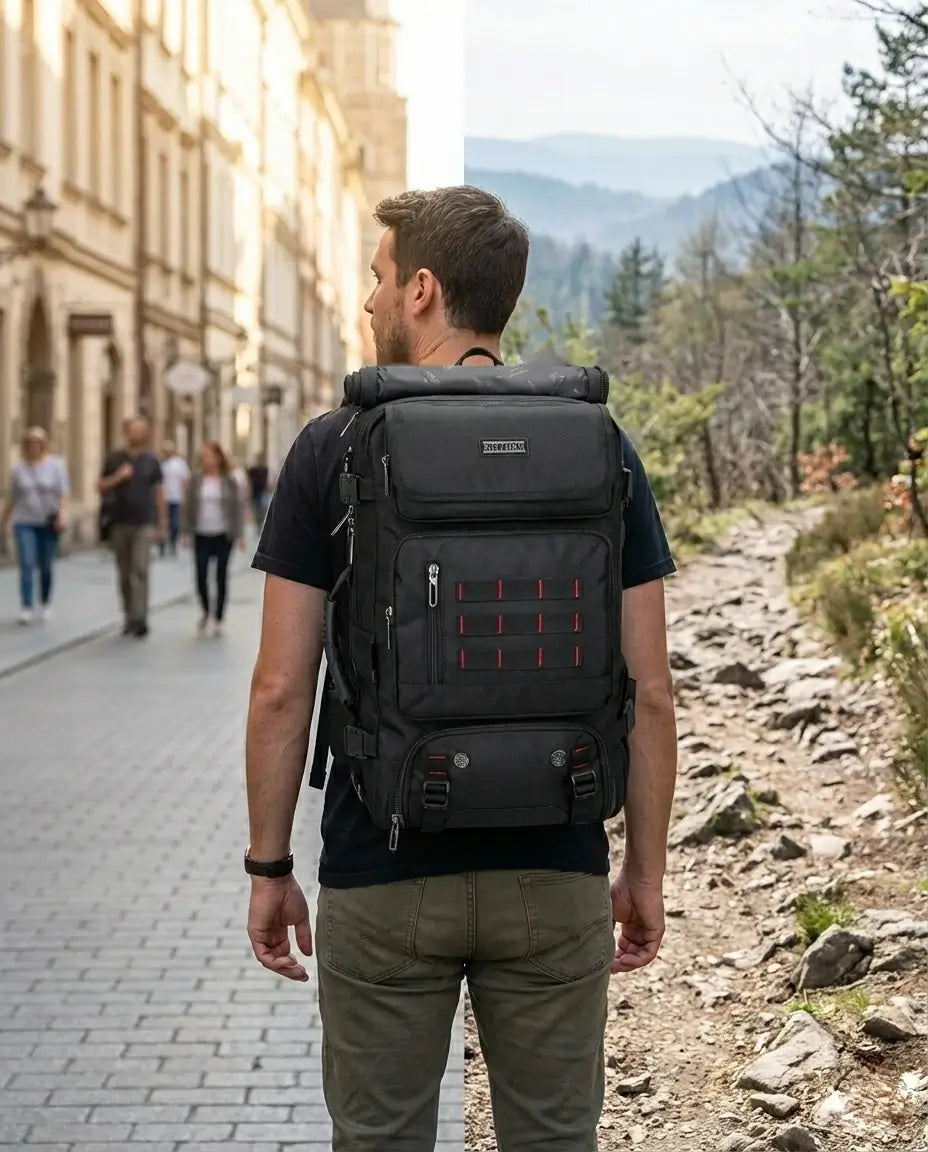
A backpack can fit everything on your packing list and still be the wrong bag. It may exceed the allowance on your flight, pull away from your shoulders during a station transfer, or make you unpack your clothes whenever you need a charger.
Learning how to choose a backpack means checking three things together: the outside dimensions when packed, the fit with your normal load, and access to the belongings you use repeatedly. Your destination tells you which of those deserves the most attention. This guide focuses on travel, with clear boundaries between city trips, easy outdoor outings and mountain journeys carrying overnight equipment.
What will you carry, and for how long?
Before comparing bags, write down the longest stretch you expect to carry everything. A taxi-to-hotel journey and a day of transfers followed by a long walk can involve the same destination and completely different demands. Add the largest rigid objects: a laptop in its case, camera insert, shoes or medical equipment. These can determine the required opening and shape before clothing enters the decision.
Separate the load into three groups: items you must bring, items you will wear, and items you can obtain or wash at the destination. A second pair of shoes and a laptop may change your bag choice more than two extra days away. Leave room for a layer removed during the day; a bag that closes only while you are wearing your jacket has no practical margin.
| Planning starting point | Load to check | What can change the choice |
|---|---|---|
| Day outing: roughly 15-25L | Water, weather layer, food and daily essentials | A large camera kit or bulky winter layer |
| Compact overnight trip: roughly 25-30L | One clothing change, toiletries and daily essentials | Extra shoes, large laptop or formal clothing |
| Travel with several outfit changes: roughly 30-40L | Clothing cube, toiletries, electronics and a spare layer | Laundry frequency and rigid equipment |
| More than 40L | A load that genuinely needs extra space | Airline restrictions and the burden of carrying it |
These are editorial starting ranges, not measured packing results or guaranteed trip lengths. Use the 30L versus 40L packing comparison to explore the effects of shoes, laundry and electronics before deciding that a longer trip automatically needs a larger bag.
Which backpack dimensions will your journey accept?
Record the height, width and depth allowed by the most restrictive transport segment. Keep the personal-item allowance separate from any overhead carry-on allowance you have purchased. A backpack label cannot tell you which category your ticket includes.
The FAA advises checking your airline's permitted bag count and dimensions and preparing for the possibility of a gate check. That is why a general “carry-on” label is insufficient: the relevant comparison is your packed bag against your operating airline and fare.
Measure after loading. Include filled front pockets, protruding handles and anything that makes the bag deeper. Check expansion in the configuration you will actually use. Compressing soft clothing may help; a laptop, shoe or hard toiletry case cannot be assumed to compress with it.
Liters describe capacity, not an airline envelope. Two similarly rated backpacks can have different heights, openings and usable interior shapes. Our guide to backpack liters and usable space explains the geometry; the packed backpack sizer check turns that comparison into a practical home exercise.

Buying checklist illustration. Passing one check does not establish the other two; the dimension sketch is not to scale.
How should a backpack fit when it is loaded?
An empty try-on tells you little about a loaded journey. Use your expected contents, wear the clothing you normally travel in, and adjust the straps before judging comfort. Walk, turn, sit down, and lift the bag as you would during a transfer. An initial ten-minute check is a useful screening step, not evidence that the bag will remain comfortable all day.
For an adjustable trekking pack, compare your torso measurement with the manufacturer's harness range and fitting instructions. For any travel backpack, use a loaded try-on to check how the straps sit and whether the bag stays close as you move. Do not assume that a larger capacity or thicker padding will provide a better fit.
Many travel backpacks use fixed harnesses and have different support systems. A chest strap helps position the shoulder straps; it should not be treated as equivalent to a load-bearing hipbelt. Check the specific construction instead of assuming every bag with padded straps distributes weight the same way.
- Shoulders: straps should settle comfortably without digging into the neck or rubbing the underarms.
- Back: look for uncomfortable hard objects, persistent pressure points or a bag that keeps pulling away as you move.
- Stride: the lower bag should not repeatedly bump your legs or interfere with walking.
- Adjustments: you should be able to achieve a comfortable position without pulling every strap to its limit.
If the fit feels wrong, rearrange the load once and reassess. Persistent discomfort is a reason to change the model or reduce the load. Product labels such as men's or women's can help narrow a search, but strap shape, torso fit and a loaded try-on are more useful than the label alone.
Choose for the destination's hardest part
City travel: repeated access and confined spaces
Airports, trains, cafes and hotel rooms reward a controlled profile and useful openings. Check whether you can remove the laptop while the clothing compartment stays closed, reach the ticket while wearing the bag, and turn through a train aisle without swinging loose straps into someone else.
Organization has a cost. Padded sleeves and dividers protect and separate belongings, but they also add weight and occupy space. If you travel without a computer, do not choose a heavy tech-focused layout solely because it has more pockets. An understated exterior may suit several settings; it does not make a bag theft-proof.
Mountain travel: distinguish a day walk from an overnight trek
A town-based holiday with an easy trail walk does not require the same system as carrying a tent, food and sleeping equipment between camps. For the latter, investigate a purpose-built trekking pack with an appropriate harness, load support and space for the actual outdoor equipment. Convertible carrying modes alone do not establish that capability.
A shoe compartment can contain dirt, but it takes space from the overall load and does not prove odor control or waterproof separation. Wet shoes may still need a separate protective bag, and damp clothing should be aired when conditions permit. Use the shoe-compartment decision guide to decide whether that feature solves your problem.
Mixed trips: decide what leaves the hotel
When the main backpack stays at your accommodation during outings, prioritize the travel load and use a smaller day bag for water and a layer. If you carry everything through towns and onto trails, loaded comfort becomes much more important. A second bag helps only when the roles are clear; our one-bag and 1.5-bag comparison explores that choice.
| Trip pattern | Check first | Feature worth considering | Watch for |
|---|---|---|---|
| City breaks and work travel | Device access and packed dimensions | Separate laptop opening | Extra padding you do not need |
| Frequent rail transfers | Lifting and turning with the full load | Useful handles and controlled straps | Expanded depth in narrow aisles |
| Hotel stay with easy day walks | What must leave the hotel | Small separate day bag | Carrying the entire travel load unnecessarily |
| Overnight mountain route | Harness fit and equipment load | Purpose-built trekking support | Assuming travel conversion features equal trail support |
Which opening and compartments will you actually use?
A full panel or clamshell opening exposes more of the clothing compartment, which can help when moving between accommodations. It also needs space to open. A top opening can be convenient for a vertically packed load, but a low item may require moving what is above it. A U-shaped opening can provide broad access without necessarily opening the bag into two equal halves. Judge the actual zipper path in the product images.
Try a retrieval exercise with the bag filled: remove your charger, put it back, retrieve the laptop, then find the rain layer. If the clothing cube has to leave every time, either the layout or your packing method needs work. More pockets will not help if none fits the things you use.
Check a laptop compartment against the device's physical dimensions and protective case. A quoted screen size is a starting point, not a promise that every computer of that diagonal fits. For wet items, a removable pouch offers flexibility, but it should not become long-term storage for damp fabric.
What do fabric, stitching and zippers tell you?
Read the material specification, then inspect construction. Canvas and nylon describe broad material families; neither word alone proves how a finished backpack handles rain, abrasion or years of use. A water-resistant surface is not proof of waterproof seams, zippers or device protection. Use separate protection for electronics when exposure matters.
In close-up photographs, look at how shoulder straps and handles attach, whether zipper ends are finished cleanly, and whether stitching around high-load connections appears consistent. Those observations help you ask better questions. Photographs cannot establish tear strength or laboratory durability.
During a physical inspection, open the bag with a realistic load. The zipper should close without forcing the fabric into a tight bulge. Check pull accessibility, buckle adjustment and whether loose straps can be controlled. Consider care instructions, repair support and return conditions alongside price; a material upgrade is worth less if the bag never fits your journey.
Two WITZMAN examples: fixed 34L or expandable canvas?
The following comparison uses official specifications, with prices checked on September 10, 2026. These two models illustrate different choices within travel backpacks; they are not a hands-on ranking or recommendations for technical mountain trekking. Product prices and availability can change.
| Same comparison criteria | B744 | A6617-3 |
|---|---|---|
| Listed capacity | 34L | Approx. 32-42L |
| Listed H x W x D | 49.5 x 31.8 x 21.6 cm | 50 x 32 x 20 cm closed; depth 26 cm expanded |
| Empty weight | 1.54 kg | 1.85 kg |
| Materials | Recycled nylon exterior; polyester lining | Canvas; PU accents; polyester lining |
| Useful design distinction | U-shaped opening; independent device compartment | Expandable depth; convertible carrying modes |
| Weight remaining in a hypothetical 7 kg single-bag budget | 5.46 kg | 5.15 kg |
The weight example subtracts the listed empty bag from 7 kg; it is not an airline allowance or a measured packing result. The B744 leaves 310 g more for contents. The A6617-3 adds 6 cm of listed depth when expanded. Neither difference automatically decides the purchase, but both are more informative than calling either bag universally carry-on approved. The 7 kg packing budget guide shows how shoes and electronics compete for the remaining allowance.
B744: for a consistent travel load with a laptop

The 34L layout, wide U-shaped opening and separate device compartment make it worth considering for work trips and frequent hotel changes. The listed sleeve supports up to a 16-inch laptop and an 11-inch tablet; compare your actual devices and cases before buying.
Tradeoff: at 1.54 kg, it is not an ultralight empty shell. Its listed 21.6 cm depth also needs checking against the exact allowance on your ticket.
View B744 specifications and current price · Checked price: $85.78.
A6617-3: for travelers who will use expansion deliberately

Choose the canvas model when its texture, convertible carry options and adjustable capacity suit your itinerary. Keep the expansion closed when the booked transport allowance requires the narrower profile, then open it only where the extra depth is acceptable.
Tradeoff: its 1.85 kg empty weight consumes more of the load budget. Expansion does not create additional airline allowance, and a full travel backpack may be excessive for the day walks after arrival.
View A6617-3 specifications and current price · Checked price: $89.86.
Before you commit, run the same load through both options
- Pack: use the same clothes, device, shoes and toiletry kit. Close the zippers without forcing them.
- Measure: record the full exterior and the expansion state. Compare with every restrictive booking.
- Weigh: include bottles, removable straps and accessories as they will travel.
- Wear: walk and sit with that load. Reject persistent rubbing, pressure or interference with your stride.
- Retrieve: reach the three items you use most without spreading the rest across the floor.
This is a proposed home comparison, not a test performed for this article. Check the seller's return conditions before loading or using a new purchase outside. Record what failed: a bag that misses a required dimension or remains uncomfortable should not win because it has an extra pocket.
Questions that remain after the comparison
Is a 40L backpack too big for a weekend?
It can be if the load is only a change of clothes and toiletries. Bulky layers, shoes or equipment may justify the space. Compare the packed profile and weight rather than filling a 40L bag because the space is available.
Can I use a hiking backpack as a carry-on?
Possibly, if its actual loaded dimensions and weight fit the allowance you purchased. A tall frame, lid or attached equipment can be the limiting part. A hiking designation neither establishes nor rules out compliance.
Should I choose the lightest backpack?
Choose the lightest option that still fits your load, body and access needs. A lower empty weight leaves more room in a weight budget, but unsuitable straps or an opening that obstructs your equipment can outweigh that advantage.
Is a convertible backpack better for city and mountain trips?
Conversion can help with carrying through stations or handling luggage. It does not establish trekking support. For mixed trips, decide whether the main bag stays at the hotel or carries the full load along the trail.
Your final shortlist should contain bags that pass the packed-size, loaded-fit and access checks. From there, choose the features that solve your hardest travel day. For another comparison step, explore WITZMAN travel backpacks or the guide to choosing one backpack for trains and budget airlines.


Share:
Instagram vs Reality: Travel Bags That Actually Work Beyond the Perfect Shot
TSA-Friendly Backpacks: Features Every Traveler Should Know