

Picture this: You're racing through Charles de Gaulle Airport, your connecting flight boards in 20 minutes, and you're lugging around three separate bags—a bulky backpack, a laptop bag, and that weekend duffel you grabbed at the last minute. Sound familiar? If you've ever found yourself playing luggage Tetris or paying absurd overweight fees, you're about to discover why the travel backpack for men landscape has been revolutionized by one simple concept: convertible functionality.
The Modern Man's Travel Dilemma
We live in an era where business trips blend seamlessly with weekend getaways, where remote work means your office might be a café in Prague one day and a co-working space in Austin the next. Traditional luggage simply can't keep up with this fluid lifestyle. The average business traveler now takes 6.8 trips per year, according to 2025 industry data, and 73% report struggling with carrying multiple bags during transit.
Enter the 3-in-1 convertible backpack—a game-changing solution that transforms from backpack to duffel to tote bag faster than you can say "boarding group A." But this isn't just about convenience; it's about fundamentally reimagining how we approach travel in the modern world.
Why Three Forms Matter More Than You Think
The Psychology of Versatile Gear
Think about your smartphone. Twenty years ago, you'd carry a phone, camera, GPS, music player, and flashlight separately. Now, one device handles it all seamlessly. The men carry on backpack market is experiencing the same transformation. Convertible functionality is about having a bag that can serve more than one purpose while sticking to the lightweight rule when on the go.
When you invest in a high-quality weekend duffel backpack with convertible capabilities, you're not just buying luggage—you're buying adaptability. Airport security lines? Backpack mode for hands-free movement. Cramped taxi? Duffel mode fits better in tight spaces. Client meeting? Tote mode looks professional and refined.
Real-World Scenarios Where Conversion Saves the Day
The Business Commuter: Jake, a sales director from Chicago, discovered the power of conversion during a particularly hellish week. Monday through Wednesday, his travel backpack for men served backpack duty during his daily train commute. Thursday, he flew to Denver—same bag, now in duffel mode, slid perfectly into the overhead bin. Friday's client presentation required the sophisticated tote configuration. One bag, one week, three completely different contexts.
The Digital Nomad: Sarah and her boyfriend Mark spent six months island-hopping through Southeast Asia. Their convertible backpacks pulled double duty as day packs for temple visits (backpack mode) and beach gear carriers (duffel mode). When they needed to look presentable for visa appointments, tote mode provided that professional appearance immigration officers appreciate.
The Weekend Warrior: For guys who transition from Monday meetings to Saturday mountain trails, a men carry on backpack with conversion capabilities means never choosing between professional appearance and outdoor functionality. The same bag that carries your laptop Tuesday morning can haul camping gear Friday evening.
The Engineering Behind the Magic
Stowable Strap Systems: More Complex Than You'd Think
The hallmark of any quality 3-in-1 convertible backpack lies in its strap management system. Cheap knockoffs simply stuff straps into pockets, creating bulky, awkward shapes. Premium designs use engineered solutions: magnetic closure panels, compression zip systems, and strategically placed hideaway compartments.
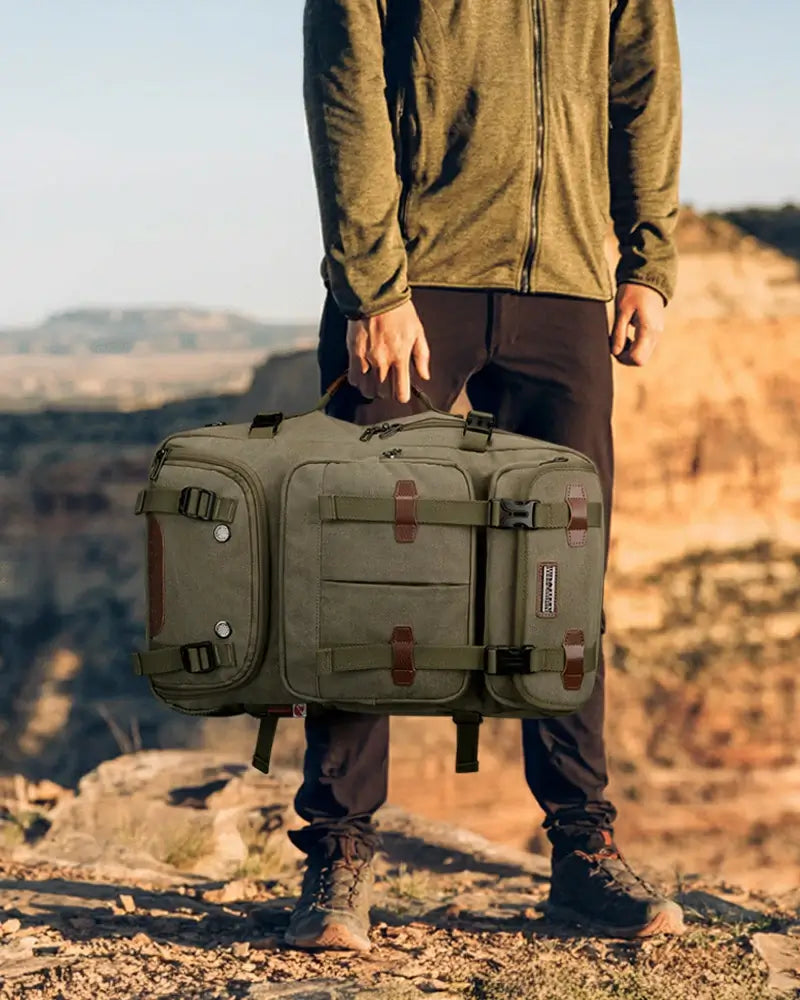
WITZMAN's approach exemplifies this thoughtful engineering. This travel backpack's versatility is unmatched. Easily convert it into a duffel, shoulder bag, or tote by adjusting or hiding the shoulder straps. The key word here is "easily"—if conversion takes more than 30 seconds, you're dealing with inferior design.
Material Science Meets Travel Demands
Modern travel backpack for men designs leverage advanced materials that were unavailable just five years ago. High-denier nylon blends offer laptop-protecting structure in backpack mode while maintaining the flexibility needed for duffel conversion. Water-resistant coatings protect against unexpected downpours in any configuration.
The fabric choice impacts more than just durability. Weight distribution changes dramatically as you convert between modes. A weekend duffel backpack that feels balanced as a backpack but creates shoulder strain as a duffel indicates poor material selection and design integration.
Compartment Architecture: The Hidden Complexity
Creating a bag that functions effectively in three distinct modes requires compartment architecture that borders on the genius level. Consider the laptop sleeve: positioned correctly for backpack access, but not interfering with duffel packing efficiency or tote elegance. Many are designed to be airline carry-on compliant, making air travel seamless, but achieving this across three configurations demands serious engineering chops.
Premium designs incorporate what industry insiders call "modal optimization"—each compartment serves specific functions in each mode while never compromising the others. Your charging cables don't become inaccessible when you switch from backpack to duffel. Your shoes compartment doesn't interfere with laptop access in tote mode.
Current Market Trends and Consumer Behavior
The Rise of Hybrid Work Travel
Demand for multi-functional bags (e.g., foldable, convertible designs) will grow, driven largely by changing work patterns. The traditional business trip—fly somewhere, attend meetings, return home—has evolved into "workations," extended stays, and multi-purpose travel combining business and leisure.
This trend particularly impacts men carry on backpack purchases. Buyers now prioritize versatility over specialization. They want one premium bag that handles boardroom presentations and weekend hiking trails with equal aplomb. The market has responded with increasingly sophisticated convertible designs.
Sustainability Consciousness
Environmental awareness significantly influences modern travel gear purchases. Buying one 3-in-1 convertible backpack instead of three separate bags reduces manufacturing impact, shipping footprints, and storage requirements. Quality convertible bags often last longer than traditional designs because they're built to withstand multiple conversion cycles and varied use patterns.
Millennial and Gen Z travelers particularly value this sustainability angle. They view their travel backpack for men purchase as a long-term investment in reducing their environmental footprint while enhancing travel flexibility.
Technology Integration Demands
Modern travelers expect their weekend duffel backpack to accommodate not just clothing and toiletries, but an entire mobile office setup. Laptops, tablets, power banks, charging cables, wireless headphones, portable speakers—the list continues growing.
Convertible designs excel here because they can optimize for different tech-carrying scenarios. Backpack mode prioritizes laptop protection and cable management. Duffel mode allows tech gear to integrate with clothing without creating wrinkles. Tote mode enables quick access to devices during meetings or presentations.
Practical Benefits That Actually Matter
Airport Navigation Mastery
Anyone who travels regularly knows that airports present unique challenges that change throughout your journey. Checking in? Tote mode keeps documents easily accessible. Security line? Backpack mode keeps hands free for ID and boarding passes. Long terminal walks? Backpack mode distributes weight properly. Cramped aircraft overhead bins? Duffel mode maximizes space utilization.
The men carry on backpack configuration proves particularly valuable during extended layovers. Convert to backpack mode for comfortable terminal exploration, switch to tote mode for business lounge work sessions, then back to duffel mode for easy overhead storage.
Urban Transportation Adaptability
City travel presents constantly changing scenarios where conversion capability provides genuine advantages. Navigating subway turnstiles requires different bag configurations than boarding crowded buses or climbing apartment stairs. A quality travel backpack for men adapts to these varied urban challenges.
Uber rides favor duffel mode—easier to slide into back seats and doesn't tower above seat backs. Walking meetings benefit from tote mode's professional appearance. Rush-hour commuting demands backpack mode for crowd navigation and stability.
Weather Response Flexibility
Weather changes can dramatically impact travel comfort, but convertible bags offer adaptive solutions. Heavy rain makes backpack mode preferable—better weight distribution and hands-free umbrella usage. Sunny weather might favor tote mode for easy access to sunglasses and sunscreen. Windy conditions benefit from backpack mode's stability and security.
Choosing Quality: What Separates Premium from Pretenders
Conversion Mechanism Durability
The most critical factor in 3-in-1 convertible backpack longevity involves the conversion mechanisms. Cheap bags use basic zippers and thin straps that fail within months. Premium designs incorporate reinforced stress points, high-grade hardware, and redundant closure systems.
Look for bags using YKK zippers, particularly at conversion points. Check strap attachment points for reinforced stitching and metal hardware rather than plastic clips. Quality conversion systems should operate smoothly after hundreds of cycles.
Load-Bearing Performance Across Modes
A travel backpack for men might carry 15 pounds comfortably in backpack mode, but how does it perform with the same weight as a duffel? Premium designs maintain comfort and stability across all configurations. Interior frame systems, strategic padding placement, and handle positioning all contribute to this performance.
Test different configurations with realistic loads before purchasing. A bag that develops hot spots or creates pressure points in duffel mode will become unwearable during extended use.

Professional Appearance Standards
The tote configuration often determines whether a weekend duffel backpack works for business travel. Cheap convertible bags look obviously like disguised backpacks when converted to tote mode. Premium designs achieve visual coherence across all configurations—each mode appears purposefully designed rather than compromised.
Consider the environments where you'll use tote mode. Client meetings, business dinners, and professional conferences all demand bags that enhance rather than detract from your professional image.
Cost Analysis: Investment vs. Expense
True Cost of Traditional Multi-Bag Systems
Most travelers own separate bags for different scenarios: a laptop bag for commuting, a gym bag for weekend activities, a travel duffel for longer trips, and perhaps a day pack for urban exploration. Quality versions of each run $100-200, creating a $400-800 investment in multiple specialized bags.
A premium men carry on backpack with genuine convertible functionality costs $200-400 but replaces multiple specialized bags while offering superior versatility. The cost-per-use calculation strongly favors the convertible approach for frequent travelers.
Durability Economics
Convertible bags face more diverse stresses than single-purpose designs, so build quality becomes crucial. However, premium convertible bags often outlast traditional luggage because manufacturers design them for varied use patterns and mechanical stress.
WITZMAN's engineering approach exemplifies this philosophy. Many Witzman travel backpacks feature a 3-in-1 convertible design, allowing them to be used as a backpack, duffel bag, and tote bag, but the focus remains on long-term durability across all modes.
Hidden Cost Savings
Beyond replacement costs, convertible bags generate savings in areas travelers rarely calculate. Reduced packing time, eliminated bag-checking fees, decreased storage requirements, and simplified organization all provide financial benefits that accumulate over time.
Business travelers particularly benefit from these hidden savings. Faster airport transit, reduced chance of lost luggage, and improved travel comfort can impact productivity and stress levels in ways that justify premium pricing.
Future-Proofing Your Travel Setup
Emerging Travel Patterns
The best travel backpack is unique for each person, but certain trends affect everyone. Bleisure travel (business + leisure) continues growing, remote work enables location independence, and sustainability consciousness influences purchasing decisions.
Convertible travel backpack for men designs align perfectly with these trends. They accommodate the varied requirements of combined business-leisure trips, support the mobility needs of location-independent workers, and satisfy environmental concerns through reduced consumption.
Technology Evolution Accommodation
Travel technology continues evolving rapidly. Five years ago, most travelers carried simple laptops and smartphones. Today's mobile office includes tablets, wireless chargers, portable monitors, noise-canceling headphones, and various adapters and cables.
Quality 3-in-1 convertible backpack designs anticipate this evolution through modular internal organization systems. Configurable dividers, expandable pockets, and adaptable cable management accommodate changing technology requirements without requiring new luggage purchases.

Global Travel Infrastructure Changes
Airport designs, airline policies, and urban transportation systems continue evolving, often in ways that favor versatile luggage over specialized designs. Smaller aircraft overhead bins, stricter carry-on enforcement, and increased security screening all favor travelers with adaptable gear.
Convertible designs provide insurance against these changing requirements. When airline policies change, travelers can adjust their carrying mode rather than purchasing new compliant luggage.
Making the Conversion Decision
Lifestyle Compatibility Assessment
The weekend duffel backpack convertible approach isn't optimal for everyone. Specialized travelers—those who focus exclusively on one activity type—might benefit more from purpose-built gear. However, the modern professional lifestyle increasingly demands versatility.
Consider your last six months of travel. If you've carried multiple bags for different trip types, converted from business to leisure activities during single trips, or struggled with luggage compatibility across transportation modes, convertible designs likely align with your needs.
Quality Investment Justification
Premium men carry on backpack convertible designs require significant upfront investment, but the cost-per-use calculation favors quality. Cheap convertible bags often fail at stress points, provide poor comfort across modes, and require replacement within 1-2 years.
Calculate your annual travel frequency, multiply by expected bag lifespan, and compare against the cost of multiple traditional bags plus replacement cycles. For most frequent travelers, the numbers strongly favor premium convertible investment.
The travel landscape continues evolving rapidly, driven by changing work patterns, environmental consciousness, and technological advancement. The 3-in-1 convertible backpack represents more than mere convenience—it's a fundamental rethinking of how travel gear should adapt to modern mobility requirements.
Whether you're navigating international business travel, exploring new cities on weekend adventures, or transitioning between professional and personal activities, the right convertible bag eliminates the compromise between specialization and versatility. It's not just about carrying your belongings; it's about adapting seamlessly to whatever your journey demands.
The question isn't whether you need multiple bags for different scenarios—you do. The question is whether you want to carry them separately or have them intelligently integrated into one supremely adaptable system. For the modern traveler, the choice seems increasingly clear: one bag, three ways, infinite possibilities.


Share:
From City Streets to Mountain Peaks: Multi-Purpose Bags for All Terrains
Digital Nomad Essentials: The Only Travel Bag Guide You'll Ever Need in 2025