

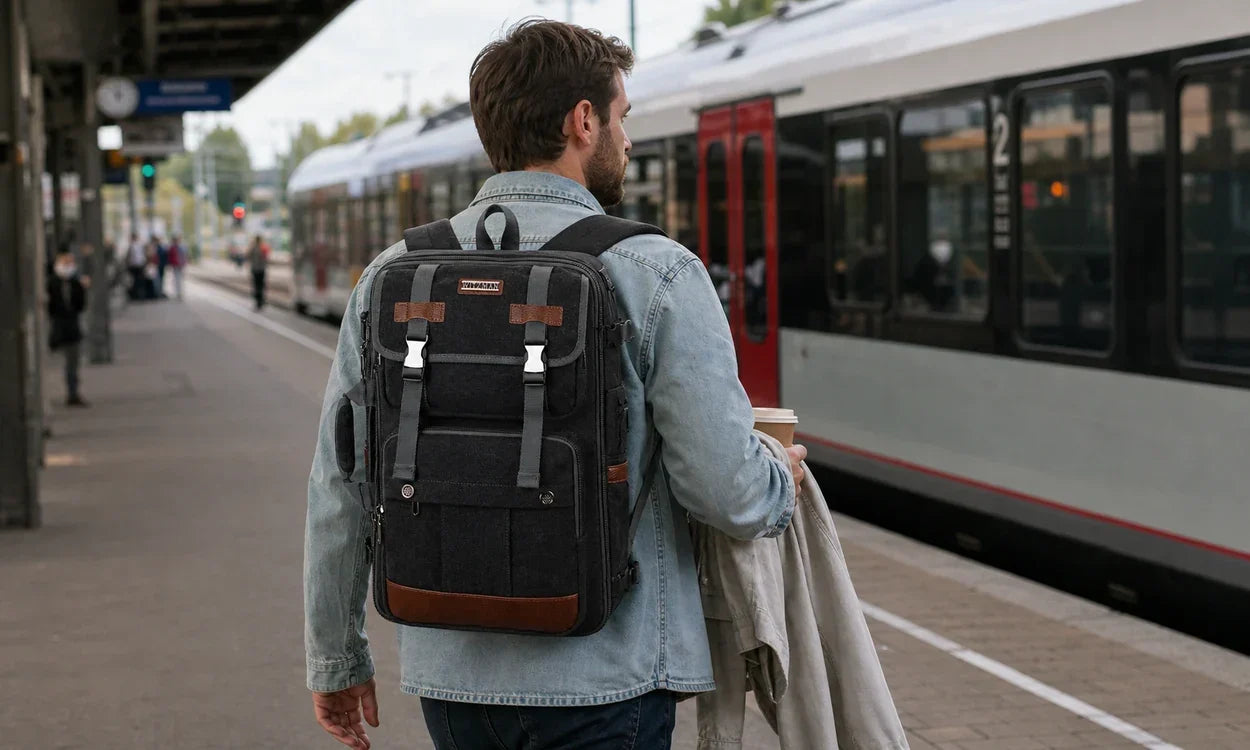
The best backpack for train travel is not automatically the best backpack for a budget flight later the same day. A railway station rewards hands-free movement, quick access and a bag you can lift without help. A low-cost airline may ignore all of that and judge three packed dimensions, a fare-specific weight allowance and whether the bag enters a sizer.
For a mixed Europe itinerary, design the bag around the stricter booked flight, then organize it for the faster railway transfer. That reverses the usual shopping logic. Capacity is not the first decision; the smallest permitted envelope on the itinerary is.
The governing rule
Pack to the flight. Arrange for the train. Expand only after the final gate check is behind you.
The Journey Changes the Backpack's Job Five Times
Imagine a rail-to-air travel day. The times below are a planning sequence, not a report from a test trip. Each stage imposes a different physical demand on the same bag.
This is why a useful Europe train travel luggage plan is a sequence rather than a packing list. If the bag has to be rebuilt at every transition, the organization is wrong even when every item technically fits.
Where Train Logic and Airline Logic Collide
Rail operators and airlines do not share one European baggage standard. As a current railway example, Eurostar says travelers must be able to carry and store their own luggage safely. Its page lists no general weight limit and gives route-specific length allowances: up to 85 cm on routes to and from London and 75 cm on its other listed routes. Those numbers are generous beside a cabin-bag sizer, but they do not make a heavy bag easier to lift.
For a current budget-airline example, Ryanair lists a 40 x 30 x 20 cm under-seat bag with all fares. Its Priority & 2 Cabin Bags option adds a 10 kg overhead bag measuring 55 x 40 x 20 cm. These are carrier- and fare-specific examples, not a Europe-wide promise. Check the operating airline and purchased fare again before packing.
| Constraint | Railway consequence | Budget-airline consequence | Design response |
|---|---|---|---|
| Weight | Often a self-carry problem before it is an allowance problem. | May be a hard fare limit. | Subtract empty-bag weight before choosing contents. |
| Depth | Affects aisle turns, rack placement and body clearance. | Can decide whether the bag fits a sizer. | Keep soft items away from the deepest outer pocket. |
| Access | Tickets, water and electronics may be needed repeatedly. | Liquids and electronics may need removal at security. | Create one transit layer that can be emptied quickly. |
| Expansion | Useful after arrival or during a rail-only segment. | Can push a soft bag beyond permitted depth. | Treat expansion as a post-flight mode, not free capacity. |
Build to the Smaller Envelope, Organize for the Faster Transfer
A multi-modal route creates two layers of compliance. The first is the booking layer: identify the smallest bag allowance across every flight segment, including the operating carrier rather than only the company that sold the ticket. The second is the packed layer: measure the deepest point after shoes, cables and toiletries are loaded.
Do not average the rules. If one flight allows 25 cm of depth and another allows 20 cm, the trip is a 20 cm trip unless you buy a different allowance or check the bag. Our airline sizer test guide explains why listed dimensions and a fully packed soft backpack can diverge.
The railway setup then operates inside that smaller envelope. Place the items used between stations and seats in a thin access layer. Keep the dense load close to the back. Reserve expansion space for the rail-only portion after the last flight, or leave it closed for the entire route. Travelers debating overall volume should compare the consequences in our 30L vs 40L travel backpack guide; liters alone do not protect the 20 cm dimension.

A6617-3 vs A8013: Same Route, Different Risk
The comparison below uses official WITZMAN specifications and the cited Ryanair overhead allowance only as a worked example. It is a specification analysis, not a guarantee or a hands-on fit test.
| Specification | A6617-3, black | A8013, brown | Multi-modal implication |
|---|---|---|---|
| Listed capacity | Approx. 32-42L, expandable | 40L | Expansion is useful on rail, but capacity must not override the flight envelope. |
| Listed dimensions | 50 x 32 x 20 cm collapsed; 50 x 32 x 26 cm expanded | 50.8 x 33 x 22.86 cm | Against a 55 x 40 x 20 cm example, only the collapsed A6617-3 aligns on paper, with no depth margin. |
| Empty weight | 1.85 kg | 2.015 kg | Under a 10 kg example, contents receive 8.15 kg or 7.985 kg before accessories are added. |
| Organization | 16 listed pockets and compartments; up to 17-inch laptop compartment; convertible carry | Laptop and tablet storage, shoe compartment, water-bottle pocket; convertible carry | More pockets improve access only when they do not create an uncontrolled outer bulge. |
| Primary tradeoff | The expandable mode adds 6 cm of listed depth. | The fixed listed depth already exceeds the 20 cm example. | Neither should be described as universally compliant or as the cited free personal item. |
The A6617-3 is the more airline-aware choice for this specific worked example, but only in its collapsed configuration and only if the packed bag still measures within the limit. Since its listed depth equals 20 cm, a filled outer pocket can remove the theoretical fit. Its expandable 42L mode is better treated as a rail-only or destination mode.
The A8013 is the more train-first arrangement when a traveler values a fixed 40L layout, separated shoes and repeat access across several transfers. It is not the stronger choice for a strict 20 cm depth allowance: the listed bag is 22.86 cm deep before any packed bulge. Choose it when the actual flight allowance is more generous, when a cabin upgrade fits the packed bag, or when checking is acceptable.
Two WITZMAN Options, With Their Boundaries


The Final Load: Three Depth Zones and One Conversion Move
A final load plan should control depth as deliberately as weight. Think from the back panel outward.
Zone 1: The Contact Plane
Place the laptop and the flattest dense items nearest the back, using the product's documented device compartment. This stabilizes the load during platform stairs and prevents a charger brick or toiletry bottle from creating a hard projection on the front face. A large laptop can also dominate the weight budget; the subtraction method in our 7 kg carry-on load plan works for any airline limit.
Zone 2: The Compressible Core
Build one compact clothing block sized to the flight, not to the expanded bag. Wear the bulkiest layer and primary shoes during the air segment. If the A8013 shoe compartment is used, measure the bag after the shoes are inside; a compartment can organize the load without making its volume disappear. For a clearer explanation of that geometry, see why backpack liters do not equal usable shape.
Zone 3: The Transit Skin
Keep the rail ticket, passport, phone, cable pouch, headphones and one light layer in a shallow access path. The goal is not to fill every pocket. It is to avoid opening the clothing core in a station while keeping the front profile controlled. Water can stay accessible on the train, but a full bottle belongs in the final airport weight check and may need to be emptied before security.
The Airport Conversion Move
- Move rail-only quick-access items back into their assigned interior spaces.
- Close the A6617-3 expansion fully, if that model is used.
- Empty or flatten protruding outer pockets and secure loose straps.
- Measure height, width and deepest point while packed.
- Weigh the entire bag with removable straps, tech and anything bought during the rail leg.
- Run the real sizer sequence before leaving home, then repeat after the final packing change.
This conversion should take minutes, not require a floor-wide repack. If it does, the access layer is too deep or the main compartment has been filled to the zipper line.
What Leaves the Bag First When the Two Rules Do Not Fit
When the packed bag misses either weight or depth, remove items in an order that protects the travel system.
- Rail-only consumables: water and food bought for the train should not quietly become airline payload.
- Duplicate convenience items: a second cable, backup pouch or extra book is easier to remove than the layer required at arrival.
- Second footwear: shoes consume both mass and rigid depth. They are often the first structural cut, especially in a shoe compartment.
- Just-in-case clothing: preserve the planned repeat-and-laundry system; remove duplicates before removing weather protection.
- The bag choice itself: if a recurring 20 cm limit conflicts with a 22.86 cm product, no folding method changes the listed geometry. Choose a different allowance or a different bag.
That last step is the honest boundary. A good budget airline backpack is not a capacity claim. It is a packed object that fits the fare you actually bought. If the trip continues with a smaller destination carry, the one-bag versus 1.5-bag framework can help decide whether a compact secondary bag earns its space.
Choose the Itinerary, Not the Category Label
Choose the black A6617-3 when the strictest booked flight is close to the cited 55 x 40 x 20 cm overhead example, you can keep the bag collapsed, and you are willing to verify the packed depth with no margin assumed. Its strongest feature for a mixed route is controlled mode change: compact for the flight, expandable only when the itinerary permits.
Choose the brown A8013 when the route is predominantly rail, the flight allowance accepts its actual packed depth, and the shoe compartment and fixed 40L organization solve a real access problem. Do not choose it by assuming canvas will compress from 22.86 cm to 20 cm at the gate.
Neither model is a light empty shell, and neither matches the cited 40 x 30 x 20 cm free under-seat allowance on listed dimensions. If the fare includes only a personal item, start with our under-seat backpack guide instead of trying to force a 40L-class travel bag into the wrong category.
Four Questions to Answer on the Booking Screen
- What is the smallest cabin-bag envelope across every operating carrier?
- Is that allowance included, purchased, or still only assumed?
- How much payload remains after subtracting the verified empty-bag weight?
- Can the packed bag be lifted, accessed and converted without unpacking on a station floor?
The final rule is simple: the flight sets the outside of the bag; the train sets the inside. Once both are designed together, one backpack can move through both systems without pretending their constraints are the same.
Compare broader train-travel bag formats or browse the WITZMAN travel backpack collection.

Condividi:
Shoulder-Season Packing for Europe: A Rain-to-Sun Layer System
Holiday Travel Carry-On: A Full-Flight Overhead Bin Contingency Plan