

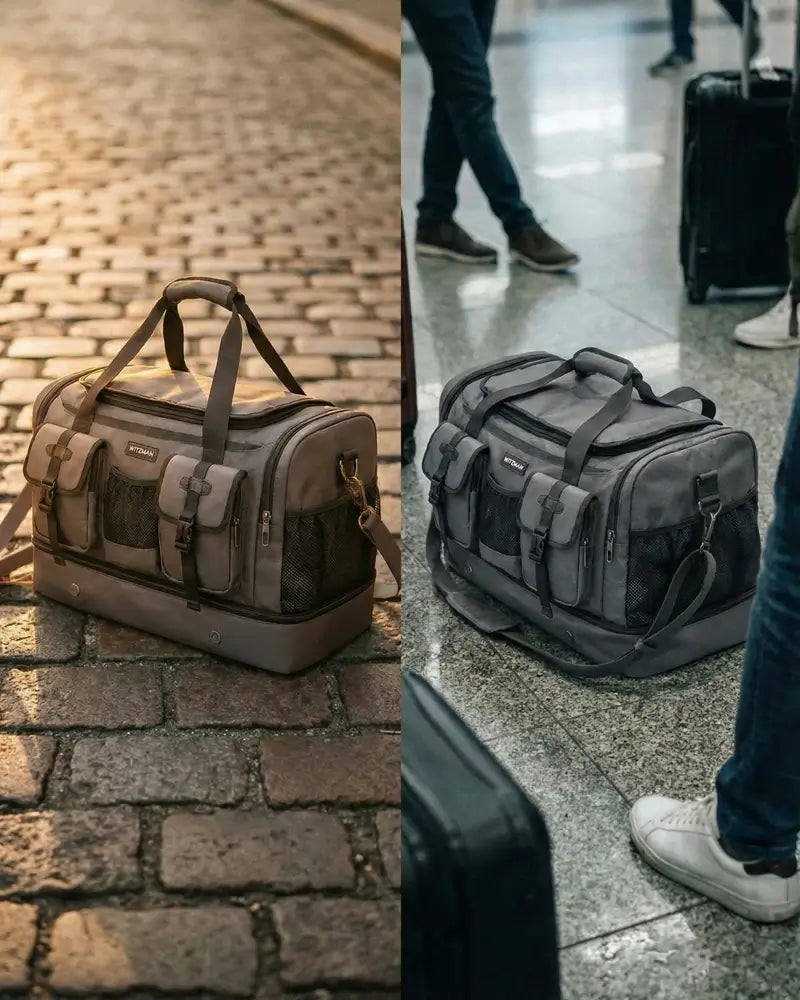
I've been in the travel gear business long enough to watch the same cycle play out hundreds of times. Someone sees a gorgeous leather weekender in a perfectly lit photo—positioned just so on cobblestones in front of a Parisian café—and decides that's the bag they need. Three months later, that same bag is shoved in the back of their closet, replaced by something far less photogenic but infinitely more practical.
The disconnect between what looks good on Instagram and what actually works when you're hauling it through an airport at 6 AM is something I deal with almost daily. People come into our shop with screenshots of bags they've seen online, and part of my job has become gently steering them toward what they'll actually use rather than what will gather likes.
The Aesthetic Trap
Let's start with the obvious: beautiful bags exist, and there's nothing wrong with wanting something that looks good. I own a gorgeous canvas and leather duffel that photographs beautifully. I also barely use it anymore because it weighs close to four pounds empty, has exactly one interior pocket, and the leather handles dig into my shoulder after about fifteen minutes.

The bags that dominate travel Instagram tend to share certain characteristics. They're often made from premium leather or waxed canvas. They have minimal branding, clean lines, and a vintage or artisanal aesthetic. They look absolutely perfect sitting on a hotel bed next to a carefully arranged flat lay of travel essentials.
What these photos don't show is how that gorgeous leather patinas (which is Instagram-speak for "gets dirty and scratched"). They don't show you trying to find your passport in a bag with no organization system while a line of irritated people builds up behind you at security. They definitely don't show what happens when you set your beautiful canvas bag down in a puddle at a train station.
What Actually Matters When You're Moving
I've traveled enough to know that the reality of moving through airports, train stations, and cities looks nothing like the static perfection of travel content. Your priorities shift dramatically when you're dealing with actual travel conditions.
Weight becomes crucial. I cannot overstate this enough. A bag that weighs five pounds empty means you're starting your weight budget already in the hole. When you're trying to stay under airline weight limits or just trying to make it up four flights of stairs to your Airbnb, every pound matters. Some of the most Instagram-famous bags are built like tanks, which is great for durability but terrible for your back.
Organization matters more than you think it will. When I was younger, I subscribed to the "just throw everything in" school of packing. Then I missed a flight because I couldn't find my boarding pass quickly enough. Now I'm a zealot about compartments. The bags that photograph best often have beautifully simple interiors—one big open space that looks clean and minimalist. In practice, this means everything you own becomes a jumbled mess the moment you zip it up.

Weather resistance isn't sexy, but it's essential. Water-resistant coatings, sealed zippers, protected seams—none of these things look particularly impressive in photos. But the first time you're caught in a downpour with your laptop in your bag, you'll understand why they matter. I've seen people baby their leather bags with waterproofing sprays and rain covers, which technically works but also defeats the purpose of having a convenient travel bag.
The Durability Question
Here's where Instagram really misleads people: those beautiful wear patterns on vintage-style bags? That's not always "character." Sometimes it's just damage.
The leather industry has gotten good at marketing patina—the way leather changes color and texture with use. And genuine patina can be beautiful. But there's a difference between a well-made bag that ages gracefully and a bag that simply falls apart over time while brands convince you the deterioration is intentional.
I've handled thousands of bags over the years, and I can usually tell within a few seconds whether something is built to last or just built to look good initially. The hardware is a big tell. Those elegant brass rivets might oxidize into a greenish mess. Thin leather straps will stretch and tear. Decorative stitching that looks intricate often creates weak points.
The bags that actually hold up tend to be less photogenic. They use ballistic nylon instead of leather. They have chunky, industrial-looking zippers that will survive being opened and closed a thousand times. The stitching is functional rather than decorative. They look like they mean business, which doesn't always translate well to the carefully curated aesthetic of travel content.
The Carry-On Conundrum
Carry-on bags might be where the Instagram-reality gap is widest. The algorithmic feed loves a hard-shell spinner suitcase in millennial pink or a vintage-looking trunk with leather straps. Both of these look fantastic in photos. Both of them have significant practical problems.

large nylon travel duffel bag for men
Hard-shell spinners have become ubiquitous, and I understand why—they protect contents well and look sleek. But they don't compress, which means you're stuck with their full dimensions even when half-empty. They're also surprisingly easy to crack if you check them (despite being designed to protect contents). And those four spinner wheels? Great on smooth airport floors, less great on cobblestones or when you're trying to keep your bag stable on a moving train.
The vintage trunk aesthetic is even more problematic. Real vintage trunks weren't designed for modern travel—they're heavy, awkwardly shaped, and lack modern features like wheels or padded laptop compartments. Modern bags that mimic this aesthetic often inherit the worst features while trying to add contemporary functionality, resulting in something that's neither authentically vintage nor practically modern.
What actually works tends to be boring: soft-sided bags with compression straps, multiple carrying options, and enough structure to maintain their shape without being rigid. These bags don't photograph as well, but they adapt to different situations better than their more photogenic cousins.
The Personal Item Problem
The "personal item" category—your daypack or under-seat bag—is where I see the most misguided purchases. People want something that looks good in daily life but can also function for travel. This usually means they end up with something that's mediocre at both.
Fashion backpacks have exploded in popularity, partly driven by Instagram's influence on everyday style. These bags often have laptop compartments and enough space for travel essentials, so people assume they'll work for trips. But they're usually missing critical features like water bottle pockets on the outside, compression straps, or sternum straps for stability. The materials tend to be chosen for aesthetics rather than durability.
I've watched people struggle through airports with beautiful leather backpacks that have exactly one shoulder strap adjustment and no organizational system. Meanwhile, the person next to them with a technical daypack is gliding through with everything accessible and comfortable.
When Aesthetic and Function Align
This isn't to say you have to choose between looking good and being practical. Some bags manage both, though they're rarer than you'd think.
The sweet spot tends to be bags from companies that came from outdoor or technical backgrounds but have refined their aesthetics over time. They understand load distribution, weather resistance, and durability because that's their foundation, but they've learned to make products that don't look like you're summiting Everest when you're just going to a work conference.
Materials matter here. Modern technical fabrics can look surprisingly good while offering practical benefits. Waxed canvas can work if it's backed with something more substantial. Leather accents can add visual interest without compromising the overall functionality of a nylon bag.
The key is that the practical features come first, with aesthetic considerations layered on top, rather than the reverse.
What I Actually Recommend
After years in this business, here's what I tell people who ask for honest advice: start with your actual use case, not aspirational lifestyle content.
Think about your real travel patterns. If you're doing quick business trips, you need different features than if you're backpacking Southeast Asia. If you primarily travel domestically, airline size restrictions matter less than if you're constantly navigating European budget carriers with strict limits.
Consider maintenance realistically. That leather bag requires conditioning. That white fabric will show every stain. Can you actually keep up with the care, or will it become a source of stress?
Test weight and carrying comfort in person if possible. What feels fine for five minutes in a store can become unbearable after an hour in an airport. This is especially true for backpacks—the difference between properly adjusted straps and poorly adjusted ones is enormous.
Look for versatility in carrying options. The best travel bags let you carry them multiple ways—hand carry, shoulder strap, backpack straps, or attached to rolling luggage. This adaptability matters more than you think.
The Real Takeaway
Instagram isn't reality, and that's fine. Social media is aspirational by nature, designed to show idealized versions of life. The problem comes when we make purchasing decisions based on that aspirational content without considering practical needs.
The best travel bag isn't the one that will get the most likes. It's the one you'll reach for trip after trip because it makes travel easier rather than harder. It's the one that disappears into the background, doing its job without demanding attention or special care.
I still appreciate beautiful bags. I still own a few that are more about aesthetics than pure function. But I'm clear-eyed about when I'll use them—for short trips where I can accommodate their limitations, not for real travel where I need gear to perform.
The travel bag that works beyond the perfect shot is usually the one you see less often in those perfect shots. It's the bag that's actually been to those places, that shows honest wear from real use, that's been refined through countless trips rather than designed for a single perfect photo. That's worth more than any amount of Instagram validation.

Share:
The Digital Nomad's Paradox: Balancing Tech Protection with Spontaneous Adventure