

A useful travel backpack review after a trip begins when the last receipt, damp shirt and forgotten charging cable come out of the bag. Ten days are long enough to expose access mistakes and early wear signals, but not long enough to prove lifetime durability.
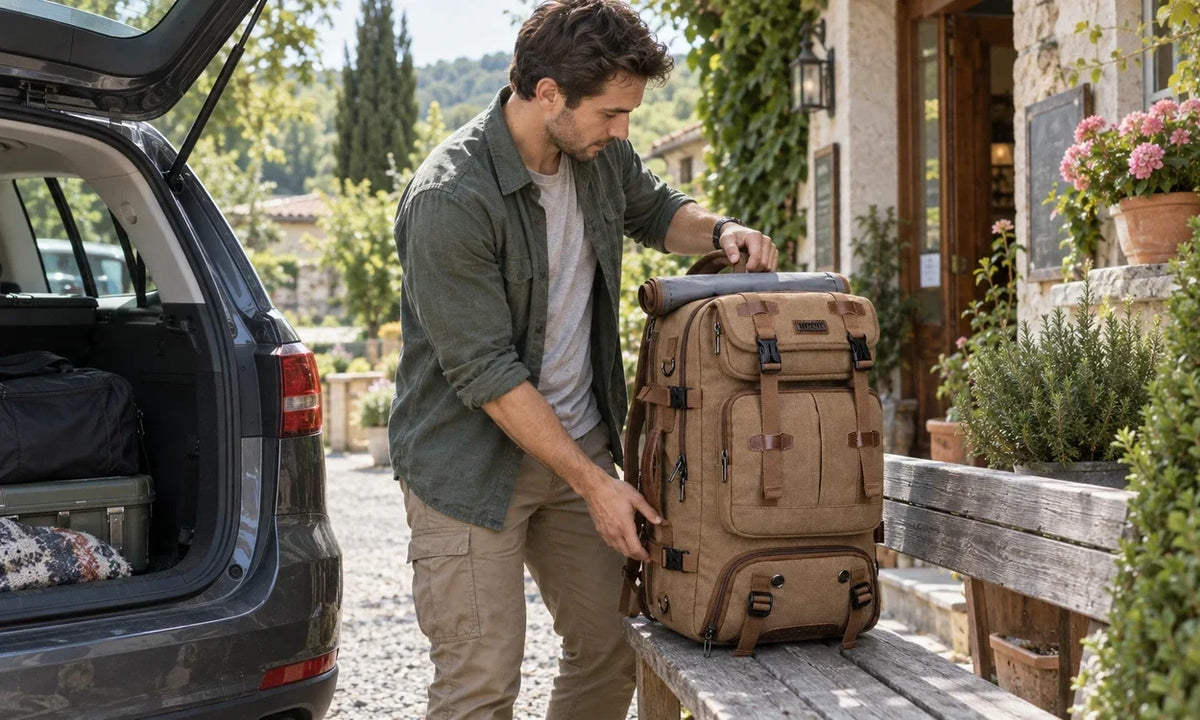
This article uses the current WITZMAN A8013 as a worked example because its structured 45L canvas body, front organizer, shoe compartment and convertible carry system make the tradeoffs easy to see. It is not presented as a completed WITZMAN ten-day field test, and the clean official photographs are not mislabeled as post-trip wear. Product facts come from the current A8013 page; the inspection method below is designed for readers to apply to their own bag after real travel.
Day zero is part of the review
A scratch only means something when you know what occupied that surface before departure. Make four plain daylight photographs: the lower front corners, the base, the carry-handle anchors and the zipper curves. Record the packed depth at the widest point, too. Soft bags change shape under load, and overpacking can create friction or zipper pressure that the empty product never shows.
The A8013 gives this baseline a useful scale. WITZMAN currently lists it at 45L, 13.5 × 9.5 × 20.5 inches and 4.43 lb, with more than 18 pockets, a 17-inch laptop sleeve, a ventilated shoe compartment and backpack, shoulder-bag and duffel carry modes. Those features create many possible homes for an item. They also create more places to forget one. If liters are your starting point, read why backpack liters do not tell the whole story before treating 45L as usable open volume.
Empty the bag backward, not all at once
Dumping everything on the bed destroys the most valuable evidence: where the load actually ended up. Instead, remove items in reverse reach order. Start with what was still near the top, then what settled into corners, then what remained inside zipped sub-compartments. Place each item into one of three groups.
Used often, found without looking and returned to the same location. This position survives the next trip.
The item mattered, but reaching it interrupted movement or required opening the main compartment.
The item needs a specific itinerary reason before it receives space again. “Just in case” is not a location.
On a tall multi-pocket bag such as the A8013, the most common failure is not too little organization. It is assigning small items to spaces that are deeper than the items are tall. A loose adapter or key pouch can disappear below flat documents. One compact cable pouch is easier to retrieve than six objects distributed across six pockets.

The A8013 has distinct clothing, small-item and footwear zones. The photograph shows the current product layout; it does not claim to document a completed trip.
The first thing to review is reach order
Travel makes access sequential. At a checkpoint, identification and phone matter. At the seat, earbuds, medication, a cable and one warm layer matter. After arrival, transit directions, sunglasses and a room address matter. A bag can hold all of them and still perform badly if those sequences share one deep pocket.
| Travel moment | What should be reachable | What the ten-day audit asks |
|---|---|---|
| Check-in and security | ID, phone, documents, liquids pouch | Did any item require opening the clothing compartment or setting the bag on the floor? |
| At the seat | Earbuds, cable, medication, eye mask | Could one removable pouch leave the bag before it went overhead? |
| Street arrival | Transit card, map, sunglasses, room address | Were these mixed with documents that should have been secured after the checkpoint? |
| Hotel reset | Laundry, shoes, toiletries | Did dirty or damp items cross into clean clothing space? |
| Return journey | Receipts, souvenirs, wet layer | Did miscellaneous objects spread into every free pocket? |
If you use a smaller destination bag after arrival, decide that split before departure. Our one-bag versus 1.5-bag guide explains when a sling or packable daypack earns its place. The purpose is not to add another bag automatically; it is to keep the large travel backpack closed during ordinary walking.
Read scratches by location and function
A mark near the base tells a different story from a widening stitch hole at a handle anchor. Begin with location, then identify whether the change is cosmetic, structural or functional. Canvas will crease and polish where it repeatedly bends. That visible change is not equivalent to torn fibers, loose webbing or a zipper that binds under a normal load.

Use these clean A8013 reference surfaces as a baseline: lower front corners, shoulder-strap anchors, handle roots and the shoe-compartment seam.
Do not scrub before documenting the change. Cleaning can remove useful evidence and aggressive treatment can create a second problem. The material checklist in our canvas backpack quality guide helps identify reinforcement and hardware points, while the backpack care guide covers routine cleaning and drying.
Rain marks need a three-photo test
Canvas can darken while wet, so the first photograph should be taken before wiping. Blot loose water, empty the nearest compartment and make a second image. Let the bag dry naturally with pockets open, away from direct heat, then photograph the same area again. Only the third image can show whether the apparent mark was temporary wetting, residue or a persistent outline.
Our rainy-season packing guide explains how to separate wet layers from dry clothing. WITZMAN describes the A8013 fabric as water-resistant, not a reason to leave electronics unprotected in prolonged rain.
What the A8013 tradeoffs look like after a trip
A credible backpack real world review must include the cost of the features, not only their names. At 4.43 lb empty, the A8013 uses a meaningful part of a strict cabin weight allowance before packing begins. The structured canvas body and layered organization suit travelers who value defined compartments, visual character and three carry modes. They are a weaker match for someone whose first priority is the lowest possible empty weight.
The shoe compartment is useful only when it replaces another footwear bag or keeps a genuinely dirty pair away from clothing. When occupied, it also intrudes into usable interior volume. The laptop sleeve earns space for a traveler carrying a large computer; without one, that padded zone is not automatically free-form capacity. More pockets improve recall only when every pocket has a stable role.

WITZMAN A8013 Canvas Travel Backpack
45L · 13.5 × 9.5 × 20.5 in · 4.43 lb. Best suited to travelers who want a substantial canvas bag, a defined shoe zone, large-laptop storage and convertible backpack, shoulder and duffel carry. Less suitable for strict 7 kg itineraries or travelers who prefer an ultralight, single-cavity pack. Airline rules vary, so compare the fully packed dimensions and total weight with the carrier.
View A8013For a broader material and shape comparison, browse the canvas travel backpack collection. If your route combines stations and low-cost flights, the train and budget-airline guide shows why access and weight must be solved together.
Build the second-trip map from what actually happened
The end product of a travel backpack experience is not a star rating. It is a shorter decision list for the next departure. Keep the pocket locations that became automatic. Consolidate the items that repeatedly sank. Remove objects that lacked an itinerary reason. Repair structural changes before they become failures.
Ten days can reveal access friction, poor load habits, moisture procedure and the first high-contact changes. It cannot establish multi-year seam life, universal comfort, waterproofness or acceptance by every airline. To choose the next bag around route and body fit, use How to Choose a Travel Backpack Based on Destination.
The bag that comes home should not be compared only with a spotless catalog image. Compare it with the trip: what stayed easy, what became annoying, what mark dried away, what changed function and which item you never want to dig for again.
Source note: A8013 dimensions, weight, capacity, materials and listed features were checked against the current WITZMAN product page on September 23, 2026. Official product photographs are used as accurate model references, not as documentary evidence of wear. No laboratory test, customer trip or first-person use has been invented for this article.


Share:
Sleepy Hollow Instead of Salem: A Less Crowded Halloween Weekend