

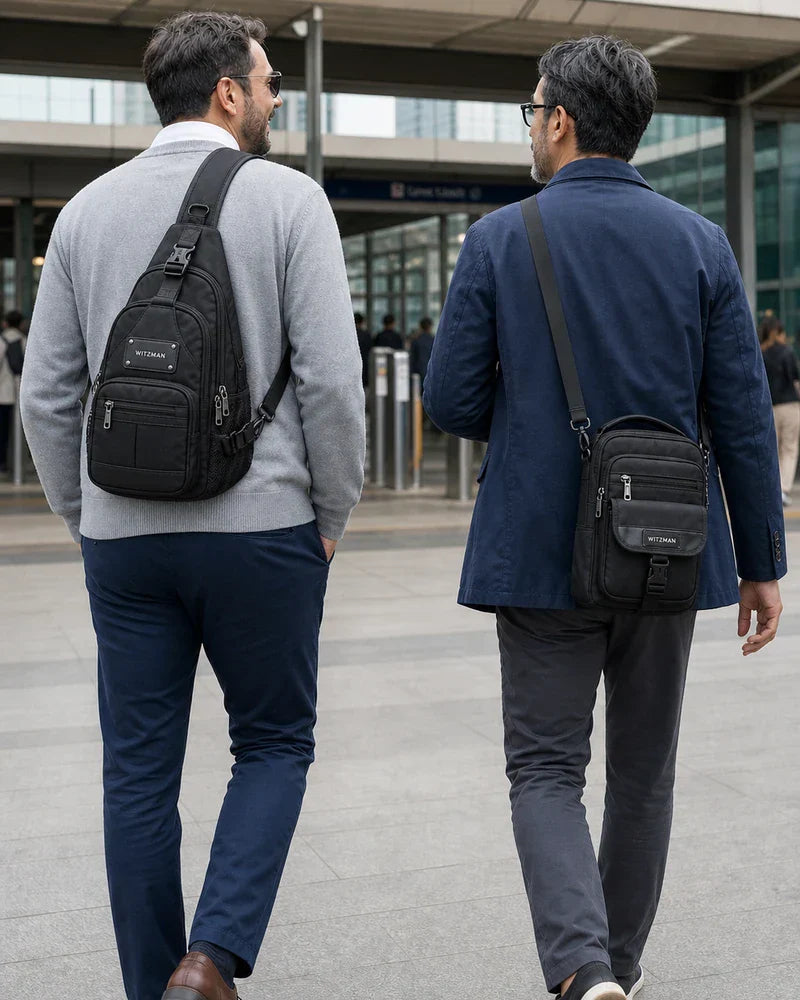
A sling bag is usually the better commuter choice when you walk, cycle, change trains, or want your essentials held close to the body. A crossbody bag is often better when you carry a tablet, notebook, charger, and other work items that benefit from a more structured vertical layout. The right answer depends less on the category name than on where the bag sits, how much you load, and how often you need to reach inside it.
Quick Answer
Choose a sling bag for active, lightweight commuting and a crossbody bag for organized daily carry with more rectangular storage. The Witzman B735 Sling Bag suits commuters who want a close, stable back carry, while the Witzman B699 Crossbody Bag suits people who prefer an upright organizer carried at the rear hip. Neither is automatically more comfortable: load weight, strap adjustment, commute length, and body position matter more than the label.
Key Takeaways
- A sling bag sits closer to the upper back and moves less during fast walking or cycling.
- A crossbody bag provides a more familiar rectangular layout for tablets, notebooks, chargers, and small work items.
- For crowded transit, keep either style behind your arm or rotate it forward only when you need access.
- Do not overload a one-strap bag; reducing weight usually improves comfort more than adding padding.
- Test the bag with your real commute load before deciding which shape works better.
Sling Bag vs. Crossbody Bag at a Glance
| Commute factor | Sling bag | Crossbody bag |
|---|---|---|
| Typical position | High and close across the back | Vertical at the rear or side hip |
| Best load | Phone, wallet, bottle, compact layer, small tablet | Tablet, notebook, charger, accessories, daily essentials |
| Movement | Stable for walking, cycling, and transfers | Comfortable for steady walking and office arrival |
| Access | Rotates quickly from back to front | Wide, familiar compartment access at the side |
| Organization | Vertical zones and quick-access pockets | Structured rectangular compartments |
| Professional use | Casual and active | More traditional work-bag profile |
The distinction becomes clearer when both bags are worn correctly. A sling bag uses an asymmetrical body and a single strap to hold the load diagonally across the upper back. A crossbody bag uses a longer strap attached to both sides of the bag, allowing a vertical body to rest around the rear hip or side of the torso. A crossbody bag is not meant to be flattened against the center of the back like a sling, and a sling should not hang loosely at the hip like a small briefcase.

Start With Your Real Daily Load
Before comparing straps or pockets, place everything you normally carry on a table. A minimalist commute may include a phone, wallet, keys, earbuds, transit card, sunglasses, a small bottle, and a compact umbrella. A work-focused commute may add a tablet, notebook, power bank, charging cable, medication, lunch, or a light jacket.
A sling works best when the load remains compact. Its narrow shape can distribute small items vertically without creating a wide profile in a train aisle. The shape becomes less effective when bulky objects are stacked far away from the body. That extra depth pulls backward on the shoulder and makes the bag shift during movement.
A crossbody bag can make better use of flat rectangular objects. Its compartments are easier to scan when you carry a tablet, notebook, documents, and several small accessories. However, the extra organization can encourage overpacking. A bag that feels manageable at home may become uncomfortable after twenty minutes of walking, especially when all the weight hangs from one shoulder.
Comfort Is About Position, Not Just Padding
A properly adjusted sling should sit close to the upper or middle back. The strap should follow the torso without pressing against the neck, and the bag should not bounce when you take a fast step. Keeping the load close reduces leverage on the shoulder, which is useful for commuters who cycle, climb stairs, or frequently move between platforms.
A crossbody bag should hang vertically at the side or rear hip with the strap crossing the opposite shoulder. For rear carry, the front pockets face outward and the top handle remains upright. The bag should not sit so low that it strikes the thigh, and it should not be tightened so high that its lower corners press into the ribs. A rear-hip position keeps the front of the body clear while preserving the option to slide the bag forward for access.
With either style, alternate shoulders when practical and keep the heaviest items closest to the body. If you regularly carry a laptop, a large water bottle, or several pounds of equipment, a two-strap backpack may be the more responsible choice. One-strap bags are excellent daily tools, but they should not be treated as small backpacks with unlimited capacity.
Access During a Train or Bus Commute
Sling bags are known for quick rotation. You can bring the bag from the back to the chest without removing the strap, retrieve a transit card or phone, and return it to the back. This is useful during transfers, but it only works well when frequently used items have consistent pocket locations.
A crossbody bag offers a different type of access. When positioned at the rear hip, it can slide to the side while remaining upright. The rectangular opening makes notebooks, a tablet, or a charger easier to identify. The tradeoff is width: a full crossbody bag can occupy more space beside the body than a narrow sling.
In crowded vehicles, move either bag in front of you before entering the densest area. This protects the contents, prevents the bag from contacting other passengers, and makes it easier to sit without removing the strap. Once you leave the crowd, return it to the back so your hands and walking path remain clear.
Mobility for Walking and Cycling
For a commute that includes a bicycle or a long walk, the sling bag usually has the advantage. A close-body upper-back position keeps the load from swinging near the hip. The difference is especially noticeable when stepping off a curb, climbing stairs, or looking over a shoulder in traffic.
A crossbody bag can still work for walking, particularly when the strap is shortened enough to keep the bag against the rear hip. It is less suited to vigorous cycling if the bag is heavily loaded or allowed to swing. Commuters who use a crossbody bag on a bicycle should test whether it remains clear of the saddle, arm movement, and jacket pockets.
Organization for Work Essentials
A good commute bag should give every repeated item a predictable home. Keep the transit card and keys in one quick-access pocket, electronics in a padded or protected zone, and anything that could leak in a separate pouch. The goal is not to maximize the number of pockets; it is to reduce the number of decisions required during the trip.
The B735 uses a tall sling layout with multiple front zones. This favors commuters who organize smaller essentials vertically and want the bag close to the back. The B699 uses a deeper rectangular layout with several zippered sections, a front organizer, a rear tablet compartment, and a top handle. That arrangement is more natural for a notebook-and-tablet routine.
Two Witzman Options for Daily Commuting
These models serve different carrying habits rather than competing only on capacity.


Which One Fits Your Commute?
Choose a sling bag when:
- You walk or cycle for a meaningful part of the commute.
- You carry a compact set of essentials rather than flat work documents.
- You frequently move through stairs, gates, and crowded connections.
- You prefer the load high and close to your back.
Choose a crossbody bag when:
- You carry a tablet, notebook, charger, and several organized accessories.
- You want a vertical bag that can rest at the rear hip and slide to the side.
- Your commute is mainly walking, rail, bus, or office-to-office travel.
- You value a top handle and traditional rectangular compartment access.
A Five-Minute Commute Test
- Pack the exact items you carry on a normal workday.
- Adjust the strap while wearing your usual coat or jacket.
- Walk quickly, climb stairs, sit down, and stand up without holding the bag.
- Retrieve your transit card, phone, and earbuds with one hand.
- Check for neck pressure, shoulder pulling, bouncing, and interference at the hip.
If the bag shifts, first shorten the strap and move dense items closer to the body. If discomfort remains, reduce the load. A different bag shape cannot fully compensate for carrying too much weight on one shoulder.
Frequently Asked Questions
Is a sling bag safer than a crossbody bag on public transit?
Neither style is automatically safer. Keep zippers closed, use internal pockets for valuables, and move the bag to the front in dense crowds. A close fit and consistent awareness matter more than the category.
Can a crossbody bag be worn on the back?
Yes. A vertical crossbody bag can rest at the rear hip with the strap crossing from the opposite shoulder. The bag should remain upright, with its front facing outward, rather than being flattened across the center of the back.
Which style is better for cycling?
A compact sling generally moves less during cycling because it sits higher and closer to the body. Test the strap and load before riding, and avoid carrying heavy or rigid items that affect balance.
Which bag is better for carrying a tablet?
A structured crossbody bag with a dedicated padded compartment is usually easier to organize around a tablet. Always confirm the actual device and compartment dimensions before purchase.
How heavy should a one-strap commute bag be?
There is no universal number because comfort depends on body size, walking distance, and strap design. Keep the load as light as practical and treat persistent shoulder or neck pressure as a sign to reduce weight or use a two-strap backpack.
In Summary
A sling bag is the stronger choice for mobility, compact loads, and an active commute. A crossbody bag is the stronger choice for upright organization, tablets, notebooks, and a more traditional work routine. Choose based on how the bag sits during movement, then verify the decision with your real daily load.
Conclusion
For a light, movement-heavy commute, choose the close fit of a sling. For a tablet-and-notebook routine, choose the structured access of a crossbody bag. Keep either one light, adjust it for your outerwear, and use the position that gives you control without restricting movement.



Share:
Large Duffel Bags for Men: Features to Consider for Extended Trips
Business Travel Gift Guide: Bags and Gear for the Traveling Professional