

Quick answer: An airline baggage sizer test is only useful when the backpack is packed exactly as it will be on travel day. Measure the tallest, widest, and deepest points, including filled pockets, straps, buckles, and handles. Then place the bag into a box or frame built to your airline's current internal size limit. A soft backpack passes only when it fits without force and stays within the frame after you release it.
An empty backpack can look comfortably compliant and still fail at the gate. The usual reason is not the height printed on the product page. It is a rounded front pocket, a packed shoe compartment, or a sweatshirt pushed into the last available space. Soft luggage changes shape around its contents, so the test has to follow the load, not the label.
The Test Card: What Counts as a Pass?
Before touching a tape measure, write down the allowance for the airline actually operating each flight segment. Codeshare partners, regional aircraft, route, cabin, and fare may change what is accepted. This article explains how to test; our separate guide to airline guidelines for backpacks explains the difference between a carry-on and a personal item.
Airline language makes the physical standard clearer. American Airlines says a carry-on must fit its airport sizer and measures the total bag, including handles and wheels. Delta also directs travelers to size-check displays at counters and gates and includes handles or wheels in its published measurement. Those are examples, not a worldwide standard, so check the current rule on the operating carrier's website before every trip. See the official American Airlines carry-on page and Delta carry-on guidance.
For this field test, use three outcomes:
| Result | What happens | What to do next |
|---|---|---|
| Clean pass | The loaded bag drops inside, remains within the top edge, and lifts out normally. | Keep the packing list and strap settings unchanged. |
| Compression pass | A soft bulge needs light hand guidance, but the bag fits after the external straps are tightened. | Remove one low-priority item for a margin of error. |
| Fail | A rigid edge is too long, the bag springs above the frame, or fitting requires sustained force. | Repack, reduce the load, or choose another bag or checked-bag plan. |
Test 1: Pack the Backpack as if Departure Is Tomorrow
The first mistake in a soft backpack carry on test is measuring an empty shell. Pack the exact shoes, toiletry pouch, laptop, chargers, clothing cubes, and outer layer planned for the flight. Fill quick-access pockets too. If a water bottle will be empty through security but carried later, decide whether it sits inside or outside during boarding and test that configuration.
Close every zipper without leaning on the bag. Secure loose shoulder straps and remove temporary accessories that will not be attached at boarding. If the zipper track is under visible tension, the bag is already telling you that the listed dimensions may no longer describe its packed shape.
A useful discipline is to photograph the packed layout before closing it. If the bag passes, you have a repeatable loading map. If it fails, you can see which cube or pocket created the problem rather than starting over blindly. Travelers still deciding between capacities can use our 30L vs 40L travel backpack comparison before committing to a packing list.
Test 2: Measure the Bag's Real Envelope
If you are searching how to measure backpack for carry on, think in terms of an invisible rectangular box around the loaded bag. Do not follow the curve of the fabric. Measure straight across the greatest height, width, and depth.
- Height: Stand the bag naturally. Measure from the lowest base point to the highest fixed point, including a handle or rolled top that cannot be tucked down.
- Width: Measure the widest point, including packed bottle pockets, buckles, and side compression hardware.
- Depth: Place the bag against a wall and measure perpendicularly from the wall to the furthest front bulge. Do not press the bulge flat while reading the tape.
- Repeat: Measure twice, then record the larger result. Soft fabric shifts when the bag is moved.
A rigid ruler or carpenter's square is more reliable than wrapping a cloth tape around a curved pocket. Two flat books also work: hold one against each side of the bag, measure the distance between them, and keep the books parallel.

Test 3: Build a Cardboard Sizer at Home
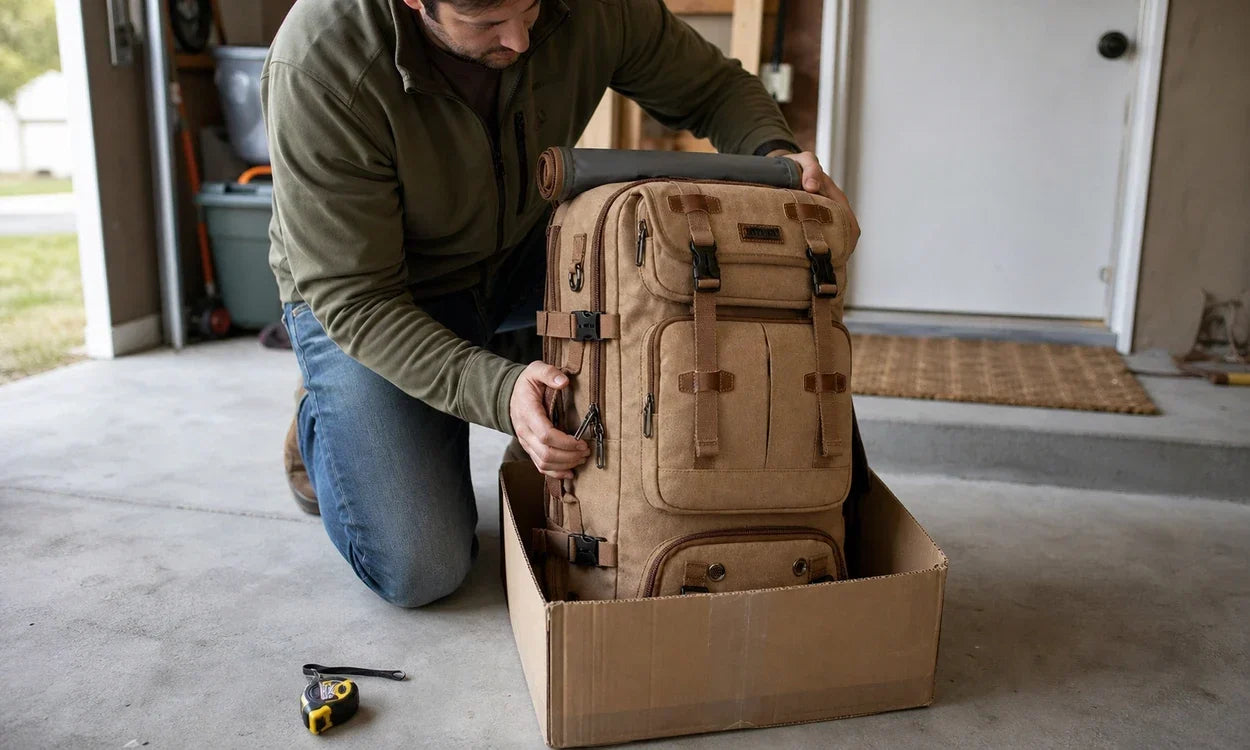
You do not need airport equipment to reproduce the important part of an airline sizer. Use a sturdy shipping carton or make an open-top frame from corrugated cardboard. The inside dimensions must match the airline's published maximum; using the outside dimensions accidentally gives the bag extra room.
The simplest method is to mark the required internal height, width, and depth on a large box, cut it down, and reinforce the corners with tape. Keep the top fully open. If no suitable box is available, tape three cardboard panels into a U-shaped channel for width and depth, then add a removable strip at the maximum height.
Lower the backpack in using its normal handle. Do not rotate it into a diagonal position unless the airport sizer and airline permit that orientation. Release both hands for three seconds. A springy pocket that rises above the edge is still outside the measured envelope. Then lift the bag out; a design that wedges tightly going in may be worse when a boarding line is waiting behind you.
Expert insight: Leave a small practical margin rather than packing to a perfect laboratory fit. The same soft contents can settle differently after a taxi ride, security inspection, or several hours on your back. A margin also helps when the airport frame has rounded corners or protective rails that your cardboard box does not reproduce.
Test 4: Tighten Compression Straps, Then Test Again
Compression straps are useful when they cross the area that is actually bulging. Loosen them before packing, close the bag, then tighten left and right in small alternating pulls. This keeps the load centered instead of dragging everything toward one side.
Run the measurement and box test again. Record the before-and-after depth. If the bag only passes while you hold pressure on it, that is not a stable compression pass. The straps should maintain the smaller shape on their own.
Compression has limits. It can flatten a sweater or pull a soft front panel closer to the load. It cannot reduce a rigid laptop compartment, shorten a back panel, or safely crush toiletries and electronics. It also cannot compensate for an overstuffed zipper. If the strap attachment points distort or the zipper teeth separate under tension, remove contents.
The Three Failure Zones on a Soft Backpack
1. The zipper-face bulge
This is the most common hidden dimension. A tightly packed cube pushes outward, then the front organizer adds another layer. Move dense, flat items toward the back panel and replace one thick cube with two thinner layers. Do not solve the problem by crushing a laptop compartment.
2. The top edge and handle
A soft collar may fold, but a padded handle, rolled construction, or internal stay may not. Measure the bag in its natural closed configuration. If the top only fits when held at an unnatural angle, treat it as a failure.
3. The side pockets and loose straps
A bottle pocket can make an otherwise compliant bag too wide. Long shoulder straps may also snag on a metal sizer. Empty or flatten exterior pockets, secure strap tails, and keep boarding documents somewhere accessible without reopening the packed main compartment.
If the same packing list repeatedly creates a deep front bulge, the answer may be a different packing system rather than a larger bag. Our seven-day one-backpack method shows how to reduce duplicates before adding capacity.

One useful test case
WITZMAN A8013 40L Canvas Travel Backpack
The A8013 is listed at 20 × 13 × 9 inches and uses a soft canvas body with external side buckles. That makes it a useful example for this article: a listed 9-inch depth has little room for an outward pocket bulge under an airline rule that also uses a 9-inch depth. The correct decision still depends on the packed measurement and the operating airline's current limit.
Current price: $95.78 USD. Product dimensions and capacity come from the WITZMAN catalog; airline acceptance is never assured.
View the A8013 detailsMake the Airport Test Boring
The goal of practicing at home is not to win an argument at the gate. It is to make the airport check uneventful. Arrive with the compression straps already set, exterior pockets flat, and a plan for anything that may need to come out if the bag is gate-checked. Keep medication, travel documents, batteries, valuables, and one essential layer in a removable pouch.
Also decide whether your second bag is a personal item. A backpack that fits the overhead carry-on limit does not automatically fit under the seat, and the allowance may depend on fare class. Read our practical under-seat fit guide before trying to use the same bag in both roles. Travelers who want a small destination bag can compare the tradeoffs in one-bag vs 1.5-bag travel.
Frequently Asked Questions
Can I squeeze a soft backpack into an airline sizer?
Light guidance is reasonable because soft fabric naturally shifts, but the backpack should fit without kicking, sitting on it, removing contents in line, or holding continuous pressure. The safest home standard is a stable fit after you release both hands.
Should I measure a carry-on backpack empty or full?
Measure both. The empty measurement confirms the underlying bag structure; the fully packed measurement is the one that predicts sizer fit. Use the exact travel load, including filled exterior pockets.
Do backpack straps count in the carry-on size limit?
Airlines typically evaluate the complete item that enters the sizer. Secure shoulder straps and loose webbing against the bag, but do not remove permanent hardware simply to obtain a smaller measurement. Always follow the operating airline's wording.
Can compression straps make an oversized backpack compliant?
They can control compressible fabric and clothing bulges. They cannot shorten rigid components, repair an overfilled zipper, or guarantee acceptance. Retest the bag after tightening and make sure it holds the smaller shape without your hands.
What if my backpack matches the carry on backpack size limit exactly?
Reduce the load enough to create a small margin. Soft contents settle, measuring methods differ, and physical sizers may have rails or rounded corners. An exact fit at home leaves no tolerance for those differences.
In Summary
For a modern traveler, a reliable airline baggage sizer test has five parts: verify the operating carrier's current rule, pack the real load, measure the bag's full rectangular envelope, reproduce the internal dimensions with cardboard, and retest after compression. The result should be repeatable and require no force. That process tells you more than a capacity label or an empty-bag measurement ever can.


Share:
Backpack With a Shoe Compartment: Useful Feature or Wasted Space?
Dopp Kit vs Toiletry Bag: Size, Layout, and Trip-Length Guide